
170+ Families have converted their Physical shares with us
Dematerialization Of Physical Shares
Convert Physical Shares to Your Demat Account.
Nataraj Krishnamurthy
Client - Physical to Demat
Get Expert Assistance
End the Risks of
Paper Shares
Physical certificates can be damaged, lost, or forged. Dematerialization converts them into secure digital holdings, eliminating ownership risks.
Trade Instantly,
Borrow Easily
Demat shares allow immediate selling or pledging for loans—no delays, no paperwork, just faster financial flexibility.
Avoid SEBI
Penalties
With physical shares now banned, demat is the only way to receive dividends, bonuses, and other shareholder benefits.
Here’s How It Works
Here’s How We Guide Your Digital Journey
Easily convert your paper share certificates into digital form with our expert, step-by-step process.
01
Open A Demat Account
Get started quickly, no lengthy forms or paperwork.
Create a secure foundation for effortless investing.

02
Submit Your Share Certificates
Submit certificates easily, no complex steps involved.
Begin your journey with simple, secure submission.
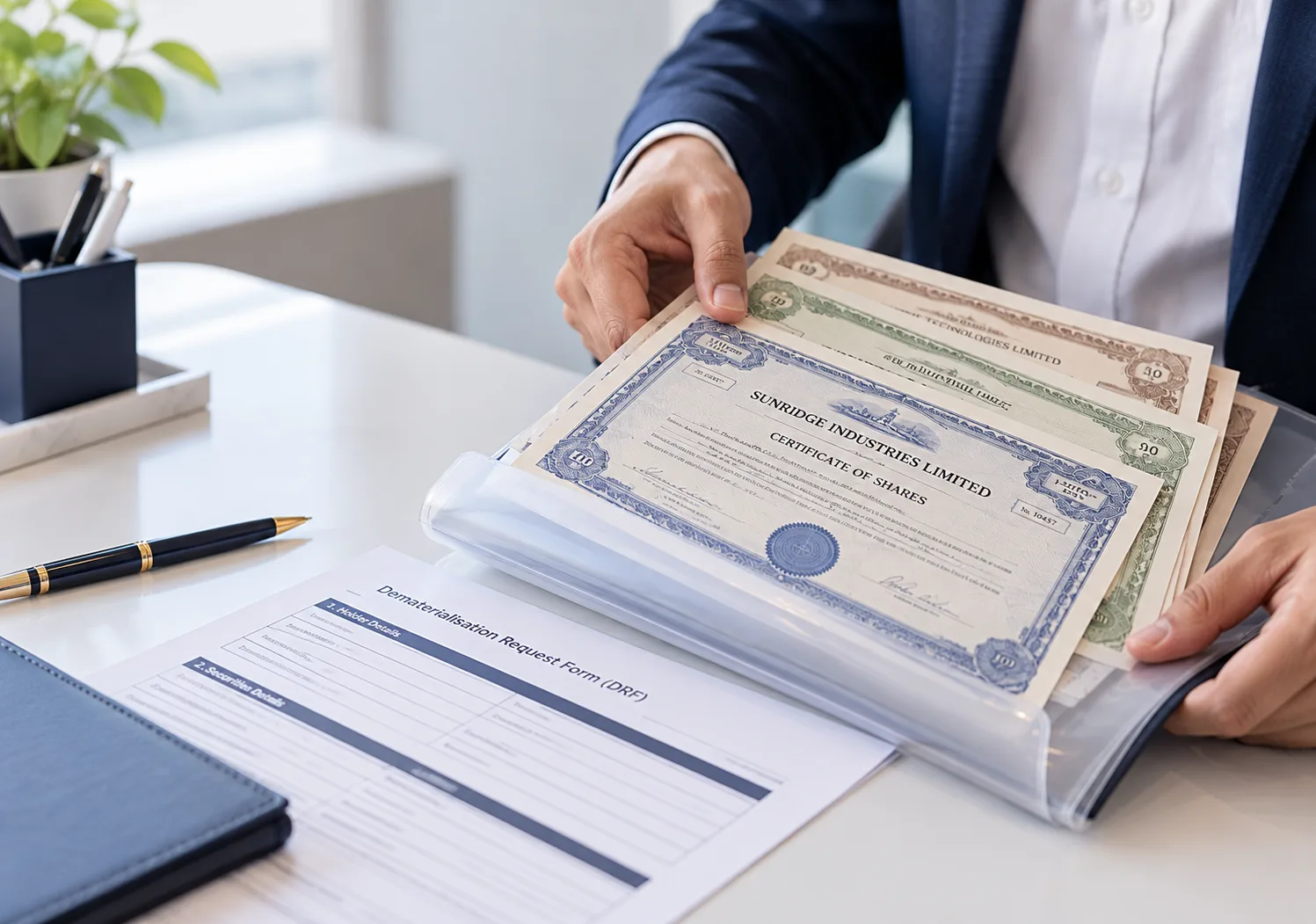
03
Verification And Processing
Verification is seamless, handled by trusted professionals.
Documents reviewed carefully, ensuring a smooth transition.

04
Electronic Transfer
Shares transferred safely and instantly.
Manage everything easily in one place.

Client Story
From Lost Papers to Lasting Clarity
"I had some shares left by my grandparents that I struggled to digitize. Banks gave me the runaround with endless paperwork, but nothing worked until I found Crystal Peak Wealth."
The Challenge
The client struggled for months with delays and confusion in dematerializing inherited shares, facing minimal support and excessive bureaucracy from traditional institutions.
Our Solution
The client struggled for months with delays and confusion in dematerializing inherited shares, facing minimal support and excessive bureaucracy from traditional institutions.
Impact Delivered
- 100% shares digitized
- Zero paperwork stress for the client
- Personalized, end-to-end support
- Restored confidence and peace of mind
"I have struggled through the whole process of Demat stocks and shares over several years. I highly recommend now the use of professional services like Crystal Peak Wealth to provide excellent Demat-related services.”
The Challenge
Our Solution
Impact Delivered
- Shares successfully dematerialized
- Eliminated years of paperwork hassle
- End-to-end expert support provided
Testimonials
What Our Clients Say

Ronak Chandaliya
I had an excellent experience working with Pavanji along with Ayusha for retrieving my father lost share certificates and completing the dematerialisation process. The entire procedure was handled with great professionalism, clarity, and efficiency.

Viraj Mahadevia
Pavan and his team at Crystal Wealth are extremely professional and able to deliver!

Mohammad Asif Ghadiyali
Teams knowledge and capability is great which helps in execution properly. For demat of physical shares, very few individuals can handle the task so clearly. The result speaks about them itself. Keep up the good work.

Avinash Kalia
Crystal Peak team (Pavan+team) were very helpful in sorting out some of the issues with paper stock inherited from my parents. Made a very difficult process easier to navigate.

Nataraj Krishnamurthy
Had great experience with Crystal Peak Wealth… I had a wonderful experience for getting my physical shares demated, they offer good service, I would definitely recommend their services to others. They also gave a lot of guidance and trustworthy advice. Thank you to the team at Crystal Peak Wealth.
FAQ’s
Happy to Answer All Your Questions
and experiences drive our mission. Together, we strive to make a positive impact.
Dematerialization is converting physical share certificates into electronic format, enhancing the security and ease of transactions.
Crystal Peak Wealth guides clients through opening a Demat account and submitting their physical shares for dematerialization, ensuring a seamless transition to digital shareholding.
By dematerializing shares through Crystal Peak Wealth, clients benefit from enhanced security against theft, loss, or damage of physical certificates.
Read More
How to Convert Physical Shares to Demat
Still holding paper share certificates? You’re not alone; lakhs of Indian investors and families still have physical shares tucked away in files and lockers. But paper certificates can’t be sold on the exchanges anymore; they’re easy to lose or damage, and transferring them is far harder than most people expect. Converting them to demat (electronic) form solves all of this.
This guide walks you through exactly how to convert physical shares to demat in 2026, what the process involves, the documents you’ll need, how long it takes, what it costs, and the situations (lost certificates, joint holders, inherited shares) that trip people up.
What “dematerialisation of shares” means
Dematerialisation is the process of converting your physical share certificates into electronic form. Once dematerialised, the shares sit in a demat account held with a Depository Participant (DP), usually a bank or broker, which is linked to one of India’s two central depositories, NSDL or CDSL.
In simple terms: your paper certificate is surrendered and cancelled, and an equal number of shares are credited to your demat account, where they can be held, tracked and sold electronically.
Why convert your physical shares now
Converting isn’t just tidier for most investors; it’s now necessary:
-
You can’t sell physical shares directly. Since SEBI’s rule change, shares can only be transferred in demat form. Paper certificates cannot be sold on the stock exchange as they are.
-
Paper is risky. Certificates get lost, torn, eaten by damp, or stuck with mismatched signatures and old addresses, each of which can turn into a long recovery process.
-
Faster, cleaner transactions. Selling, gifting, pledging or transmitting shares is quick once they’re in demat form.
-
Everything in one place. Dividends, bonus shares and your full holding are visible and manageable online.
If your shares are in an unlisted or private company, the rules are slightly different; see our guide on dematerialisation of shares for private companies.
Documents required to convert physical shares to demat
Keep these ready before you start. Missing or mismatched paperwork is the single biggest cause of delays.
-
Original physical share certificate(s)
-
A completed Dematerialisation Request Form (DRF) (your DP provides this)
-
PAN card of all holders
-
Proof of identity and proof of address (Aadhaar, passport, etc.)
-
A cancelled cheque or bank proof for the linked account
-
Recent passport-size photograph
-
If details don’t match: supporting documents (e.g. name-change, address-update, or signature-update proof)
Tip: The name and signature on the certificate must match the records held by the company’s Registrar & Transfer Agent (RTA). If they don’t, sort that out first it’s the most common reason a request is rejected.
Step-by-step: how to convert physical shares to demat
Step 1 — Open a demat account
Open a demat account with a registered DP (a bank, broker or financial institution) if you don’t already have one. Submit your PAN, identity and address proof and a photograph. Once verified, you’ll receive a unique Client ID. Choose a DP with responsive support and clear charges.
Step 2 — Check your certificates carefully
Confirm each certificate is registered in your name (or joint names) and that the folio number, share quantity and holder details are consistent. If a certificate is lost, damaged or has errors, request a duplicate from the company’s RTA before proceeding. Our guide on recovering and replacing share certificates explains how.
Step 3 — Fill in the Dematerialisation Request Form (DRF)
Your DP gives you a DRF. Fill in the company name, the ISIN (a unique code for the security your DP can look it up), the folio number, and the number of shares. Make sure every holder’s signature matches the specimen registered with the company.
Step 4 — Submit the DRF and certificates
Write “Surrendered for Dematerialisation” across the face of each certificate, then submit them with the DRF to your DP. You’ll get an acknowledgement receipt; keep it safe; it’s your tracking reference.
Step 5 — Verification by the DP and RTA
Your DP forwards everything to the company’s RTA through NSDL/CDSL. The RTA checks the details against its records to confirm ownership and authenticity. If anything doesn’t match, the request may be returned at this stage (see what to do if your DRF is rejected).
Step 6 — Shares credited to your demat account
Once approved, the physical certificates are cancelled, and an equal number of shares are credited electronically to your demat account. Your DP notifies you when it’s done.
How long does it take?
Typically 15 to 30 days from submission, assuming the paperwork is clean. It can take longer if signatures or details don’t match, if certificates need duplicates first, or if the RTA has a backlog. Getting the documents right up front is the best way to keep it to the shorter end.
What does it cost?
Charges vary by DP, but as a rough guide you can expect:
-
A dematerialisation fee per certificate (commonly in the region of ₹150 + GST per certificate), and
-
Postage/handling charged by the DP, plus
-
Ongoing annual maintenance charges (AMC) on the demat account itself.
These are typical ranges; confirm the exact charges with your chosen DP before you begin, as they differ from one provider to another.
Special situations to watch for
-
Joint holdings: every co-holder must be on the demat account and must sign the DRF, in the same order as on the certificate.
-
Inherited or deceased-holder shares: these need a transmission process first (using a death certificate and legal proof), not a normal conversion; see transmission of shares procedure in India.
-
Lost or damaged certificates: get duplicates issued by the RTA before you apply.
-
Signature or address mismatch: update the records with the RTA first to avoid rejection.
Common mistakes that cause delays
-
Signatures that don’t match the company’s records
-
Old address or name not updated with the RTA
-
Submitting for the wrong holder order on joint certificates
-
Not keeping the acknowledgement receipt for tracking
-
Assuming inherited shares can be demated directly (they need transmission first)
How Crystal Peak Wealth helps
Most delays come from small paperwork issues a mismatched signature, an old address, a missing duplicate that are easy to miss but slow everything down. With 20+ years of experience helping investors and families convert paper shares, Crystal Peak Wealth handles the entire process end to end: verifying your certificates, coordinating with the DP and RTA, fixing mismatches, and following the request through to credit.
If you’re holding physical shares and want it done the first time correctly, see how our physical-to-demat service works or message us on WhatsApp for a quick, no-obligation assessment of your holding.
Not sure whether to convert at all? Our comparison of physical vs demat shares lays out the trade-offs.
Frequently asked questions
Can I still convert physical shares to demat in 2026? Yes. There is no deadline that stops you from dematerialising your holdings. Bear in mind, though, that physical shares can’t be sold on the exchange until they’re converted.
How long does dematerialisation take? Usually 15–30 days from submission if the documents are in order. Mismatches or missing certificates extend it.
What documents do I need to convert physical shares to demat? The original certificates, a completed DRF, PAN, identity and address proof, a bank proof, and a photograph, plus supporting documents if any details need correcting.
What if I’ve lost my share certificate? You’ll need to get a duplicate issued by the company’s Registrar & Transfer Agent before converting. Our duplicate share certificate guide explains the steps.
How much does it cost to dematerialise shares? Typically, a per-certificate fee (around ₹150 + GST is common) plus postage and the account’s annual maintenance charge. Confirm exact figures with your DP.
Can shares of a deceased family member be dematerialised? Not directly; they must go through the transmission process first. See our transmission of shares guide.
Can shares in a private limited company be dematerialised? Yes, and it’s increasingly required. The process differs slightly; see dematerialisation of shares for private companies.