
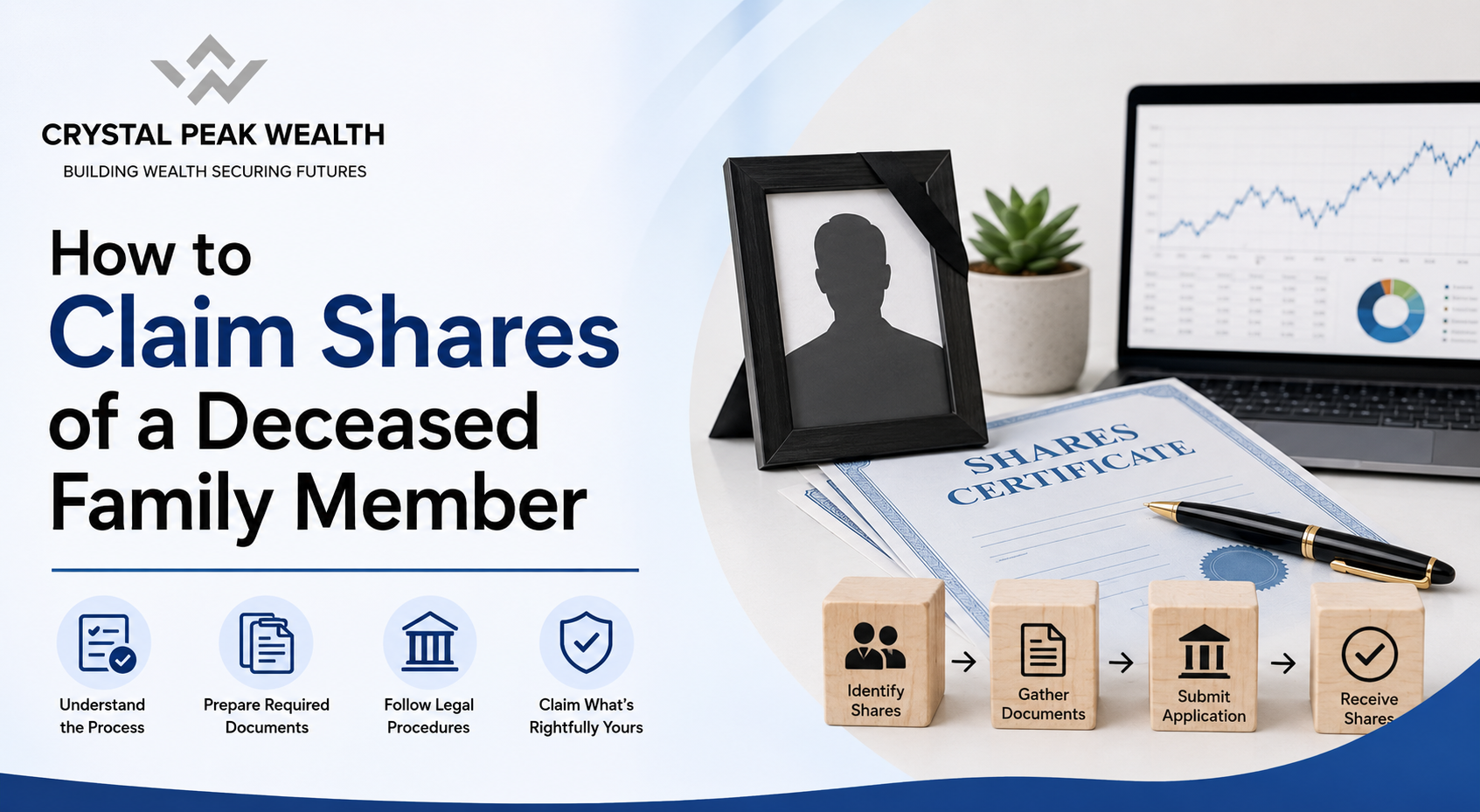
Losing a loved one is one of life’s most difficult experiences. During this emotional time, families often discover that the deceased owned investments such as shares, mutual funds, or securities. While these assets are meant to provide financial security for the family, many people have no idea how to claim shares of deceased family member without making costly mistakes.
Unfortunately, thousands of crores worth of shares remain unclaimed every year simply because legal heirs are unaware of the correct procedure. Whether the shares are held in physical certificates, a Demat account, or have already been transferred to the Investor Education and Protection Fund (IEPF), every situation follows a specific legal process.
If you’re wondering how to claim shares of deceased family member, this guide explains everything in simple language. We’ll cover the documents you’ll need, the deceased shareholder claim process, the role of a legal heir certificate for shares, common challenges, and practical tips to help you complete the process smoothly.
Why It’s Important to Claim a Deceased Family Member’s Shares
Many families delay claiming investments because they assume the process is too complicated. Others simply don’t know the deceased even owned shares until years later.
Understanding how to claim shares of deceased family member ensures that valuable investments are not forgotten or left idle. Shares can continue to earn dividends, appreciate in value, or even become eligible for bonuses and stock splits. Ignoring them may eventually lead to the shares being transferred to the IEPF after prolonged inactivity.
Claiming these investments not only protects your family’s financial interests but also ensures that the rightful legal heirs receive the wealth that was intended for them.
What Happens to Shares After the Shareholder Passes Away?
The ownership of shares doesn’t automatically transfer after the shareholder’s death. Instead, the shares remain in the deceased person’s name until the legal transmission process is completed.
The exact deceased shareholder claim process depends on several factors, including:
- Whether a nominee has been registered
- Whether the shares are held in physical or Demat form
- Whether a valid Will exists
- The total value of the holdings
- Whether the shares have been transferred to IEPF
Knowing these factors is the first step in understanding how to claim shares of deceased family member correctly.
Step 1: Identify All Shareholdings
Before beginning the legal process, identify every investment owned by the deceased.
Look for:
- Physical share certificates
- Demat account statements
- Dividend warrants
- Emails from stockbrokers
- Bank statements showing dividend credits
- Income tax records
- Portfolio statements
Many families begin learning how to claim shares of deceased family member only after discovering forgotten investments years later.
Preparing a complete inventory helps avoid missing valuable assets.
Step 2: Check Whether a Nominee Exists
A nominee simplifies the transmission process significantly.
If the deceased appointed a nominee, the company or Depository Participant (DP) usually transfers the shares after verifying the required documents.
However, being a nominee doesn’t necessarily make someone the final legal owner under inheritance laws. The nominee generally receives the shares as a trustee until legal ownership is determined according to the applicable succession laws or the deceased’s Will.
Understanding this distinction is an important part of how to claim shares of deceased family member.
Step 3: Determine Whether Shares Are Physical or Demat
The procedure varies depending on how the shares are held.
Physical Shares
Physical shares require transmission through the company’s Registrar and Transfer Agent (RTA). Since physical share certificates are no longer freely transferable, legal heirs often need to complete transmission before dematerialization.
Demat Shares
Demat shares are generally transferred through the Depository Participant where the deceased maintained the Demat account.
This distinction is one of the first things professionals evaluate while determining how to claim shares of deceased family member.
Documents Required for the Claim Process
Documentation plays the biggest role in the success of any transmission request.
Although requirements may vary depending on the circumstances, families are commonly asked to provide:
- Death Certificate
- PAN card of claimant
- Aadhaar Card
- Client Master Report (for Demat transfer)
- Cancelled cheque
- Passport-sized photographs
- Nomination documents (if applicable)
- Succession Certificate (when required)
- Probate of Will (if applicable)
- Indemnity Bond
- Affidavit
- No Objection Certificate (NOC) from other legal heirs
- Legal heir certificate for shares (where applicable)
Many applications are delayed simply because a single document is missing.
One of the biggest lessons while learning how to claim shares of deceased family member is ensuring that all paperwork is complete before submission.
When Is a Legal Heir Certificate Required?
One of the most common questions families ask concerns the legal heir certificate for shares.
This document helps establish the rightful legal heirs of the deceased when there is no registered nominee or when additional verification is required.
Depending on the company’s policies, shareholding value, and state-specific regulations, authorities may ask for:
- Legal Heir Certificate
- Succession Certificate
- Probate of Will
- Letter of Administration
Understanding which document applies to your situation can save months of unnecessary delays during the deceased shareholder claim process.
Step 4: Submit the Transmission Request
Once all documents are ready, the claimant submits the transmission request.
The application generally includes:
- Transmission Request Form
- Supporting identity documents
- Death Certificate
- Required affidavits
- Indemnity Bond
- KYC documents
- Banking details
Companies or RTAs verify every document before approving transmission.
Learning how to claim shares of deceased family member means understanding that even minor documentation errors can delay approval.
What If There Is No Nominee?
Many investors never register nominees.
Fortunately, legal heirs can still complete the deceased shareholder claim process, although the documentation becomes more extensive.
The company may request:
- Legal heir documents
- Family settlement documents
- Succession Certificate
- Probate
- Indemnity Bond
- NOC from all surviving legal heirs
The absence of a nominee often increases the processing time, making expert guidance especially valuable.
If you’re researching how to claim shares of deceased family member, don’t assume the process ends simply because no nominee exists.
Shares Held Jointly
Joint shareholding often simplifies transmission.
If one holder passes away, the surviving holder generally becomes entitled to the shares after submitting:
- Death Certificate
- Transmission Request
- Identity proof
- Updated KYC documents
After transmission, the surviving holder may add a new nominee to avoid future complications.
This is another important aspect of understanding how to claim shares of deceased family member.
Special Case: Shares Already Transferred to IEPF
Sometimes families discover investments after several years.
If dividends remain unclaimed for seven consecutive years, the corresponding shares are generally transferred to the Investor Education and Protection Fund (IEPF).
In such cases, the normal transmission process changes.
Legal heirs must first establish their entitlement before filing an IEPF claim, which involves additional documentation, verification, and coordination with the company and the IEPF Authority.
Because of these extra steps, families searching for how to claim shares of deceased family member often seek professional assistance to avoid repeated objections and delays.
Common Challenges Families Face
While the procedure may seem straightforward on paper, the reality is often more complicated. During the deceased shareholder claim process, families frequently encounter obstacles such as:
- Missing or damaged physical share certificates
- Outdated KYC records of the deceased
- Name mismatches across PAN, Aadhaar, and share records
- No nominee registered
- Multiple legal heirs with differing claims
- Lack of awareness about the correct authority to approach
- Shares spread across several companies and Registrars
- Investments transferred to the IEPF due to prolonged inactivity
These challenges become even more overwhelming when the family is already coping with the emotional loss of a loved one. Understanding how to claim shares of deceased family member is not just about filling out forms—it also requires careful document verification, coordination with RTAs, depositories, and, in some cases, legal authorities.
Step 5: Complete the Shares of Deceased Parent Transfer
One of the most common situations families face is the shares of deceased parent transfer. Whether you’re transferring your mother’s or father’s investments, the process generally follows the same legal framework but may require different supporting documents depending on whether a nominee exists.
For the shares of deceased parent transfer, you should:
- Verify all investments held by the deceased.
- Collect the required identity and legal documents.
- Submit the transmission request to the Registrar and Transfer Agent (RTA) or Depository Participant (DP).
- Respond promptly if additional documents are requested.
- Ensure the transferred shares are credited to your Demat account.
Many families postpone the shares of deceased parent transfer because they believe the paperwork is too complicated. In reality, starting the process early can prevent unnecessary delays and reduce the chances of the investments becoming dormant or moving to the Investor Education and Protection Fund (IEPF).
Understanding how to claim shares of deceased family member becomes much easier when you approach the process step by step instead of trying to complete everything at once.
Claiming Father’s Unclaimed Shares: What You Should Know
Another frequently searched topic is claiming father’s unclaimed shares. This situation often arises when children discover old share certificates, dividend warrants, or forgotten investments years after their father’s passing.
If you’re claiming father’s unclaimed shares, begin by identifying:
- The companies in which the investments were made.
- Whether the shares are physical or held in Demat form.
- Whether dividends have remained unclaimed.
- If the shares have already been transferred to the IEPF.
If the shares are still with the company, the transmission process is relatively straightforward. However, if they have been moved to the IEPF, additional verification and documentation will be required.
Families researching how to claim shares of deceased family member are often surprised to learn that even decades-old investments can still be recovered with the correct documentation.
How Long Does the Process Take?
One of the biggest concerns people have while learning how to claim shares of deceased family member is the timeline.
The duration depends on several factors:
Situation | Estimated Timeline |
Nominee registered | 2–6 weeks |
No nominee | 1–4 months |
Succession Certificate required | 3–8 months |
Probate required | 4–12 months |
IEPF claim | 6–12 months or longer |
Incomplete documents, legal disputes, or discrepancies in records can further extend the timeline.
Starting the process with complete and accurate documentation is the best way to avoid unnecessary delays.
Common Mistakes to Avoid
Many applications are rejected or delayed because of avoidable mistakes. If you’re trying to understand how to claim shares of deceased family member, make sure you avoid these common errors:
1. Waiting Too Long
Families often delay the process for years due to emotional reasons. Unfortunately, prolonged inactivity may result in the shares being transferred to the IEPF.
2. Submitting Incomplete Documents
Missing affidavits, unsigned forms, or incorrect identity proofs can delay processing.
3. Ignoring Name Mismatches
Even minor spelling differences between PAN, Aadhaar, bank records, and share certificates can create complications.
4. Assuming a Nominee Is the Legal Owner
A nominee facilitates the transfer process but does not always become the legal owner under succession laws.
5. Forgetting Old Investments
Many investors owned shares in multiple companies. Failing to identify all investments may leave valuable assets unclaimed.
Understanding these pitfalls is an essential part of learning how to claim shares of deceased family member successfully.
Tips to Make the Process Easier
The transmission process becomes significantly smoother when families take a systematic approach.
Here are a few practical tips:
- Create a checklist of all required documents before applying.
- Keep multiple self-attested copies ready.
- Verify KYC details carefully.
- Maintain copies of every application submitted.
- Track communication from the RTA or DP.
- Respond to document requests promptly.
- Seek professional assistance if the case involves multiple legal heirs, missing certificates, or IEPF claims.
Following these practices will make how to claim shares of deceased family member much less stressful.
Why Professional Assistance Can Save Time
Although it’s possible to complete the process independently, many families find the legal and procedural requirements overwhelming.
Professional experts can assist with:
- Identifying all investments
- Preparing documentation
- Coordinating with RTAs
- Handling Demat-related formalities
- Rectifying documentation discrepancies
- Filing IEPF claims
- Managing communication with authorities
Instead of navigating multiple departments on your own, experienced professionals help ensure the deceased shareholder claim process is completed correctly the first time.
If your case involves old physical share certificates, missing documents, or complex inheritance issues, professional guidance can significantly reduce delays.
This is especially true for those learning how to claim shares of deceased family member while also managing the emotional challenges of losing a loved one.
Frequently Asked Questions
Can I claim shares if there is no nominee?
Yes. Legal heirs can still claim the shares by submitting the required legal documents, which may include a legal heir certificate for shares, Succession Certificate, Probate, or other supporting records depending on the circumstances.
Can multiple legal heirs jointly claim the shares?
Yes. All legal heirs may jointly apply or authorize one representative through appropriate declarations and No Objection Certificates (NOCs), if required.
What happens if the original share certificates are lost?
Lost physical certificates do not necessarily prevent recovery. The company or Registrar and Transfer Agent may require additional documentation, including indemnity bonds and affidavits, before processing the transmission.
Is there a deadline to start the claim process?
There is no fixed deadline for claiming inherited shares. However, prolonged inactivity can result in dividends remaining unpaid and shares eventually being transferred to the IEPF, making the process more time-consuming.
Can I recover shares that have already been transferred to the IEPF?
Yes. Legal heirs can recover shares transferred to the IEPF by following the prescribed claim procedure and submitting all required supporting documents.
Final Thoughts
Losing a family member is emotionally challenging, and dealing with financial paperwork can make the situation even more stressful. Fortunately, understanding how to claim shares of deceased family member doesn’t have to be complicated when you know the correct process.
Whether you’re completing a shares of deceased parent transfer, obtaining a legal heir certificate for shares, managing the deceased shareholder claim process, or claiming father’s unclaimed shares, timely action and accurate documentation are the keys to success.
By identifying all investments, gathering the required documents, and following the prescribed transmission procedure, you can ensure that your loved one’s hard-earned investments are transferred to their rightful beneficiaries without unnecessary delays.
Remember, every family’s situation is unique. If the case involves multiple heirs, missing documents, physical share certificates, or IEPF recovery, seeking expert assistance can save considerable time and effort.
Need Expert Help Claiming Shares of a Deceased Family Member?
Navigating inheritance paperwork while grieving can be overwhelming—but you don’t have to do it alone.
Crystal Peak Wealth specializes in helping families recover and transfer investments through end-to-end assistance, including:
- Transmission of shares
- IEPF claim assistance
- Recovery of unclaimed dividends
- Physical share transmission
- Dematerialisation support
- Documentation review and preparation
- Liaising with RTAs, companies, and regulatory authorities
With a knowledgeable team and a streamlined process, Crystal Peak Wealth helps simplify even the most complex share transmission cases, giving families peace of mind during a difficult time.
Take the First Step Today
If you’re looking for trusted guidance on how to claim shares of deceased family member, let Crystal Peak Wealth handle the paperwork while you focus on what matters most.
Visit: https://crystalpeakwealth.com/
Book a consultation today and let experienced professionals help you recover your family’s rightful investments.