
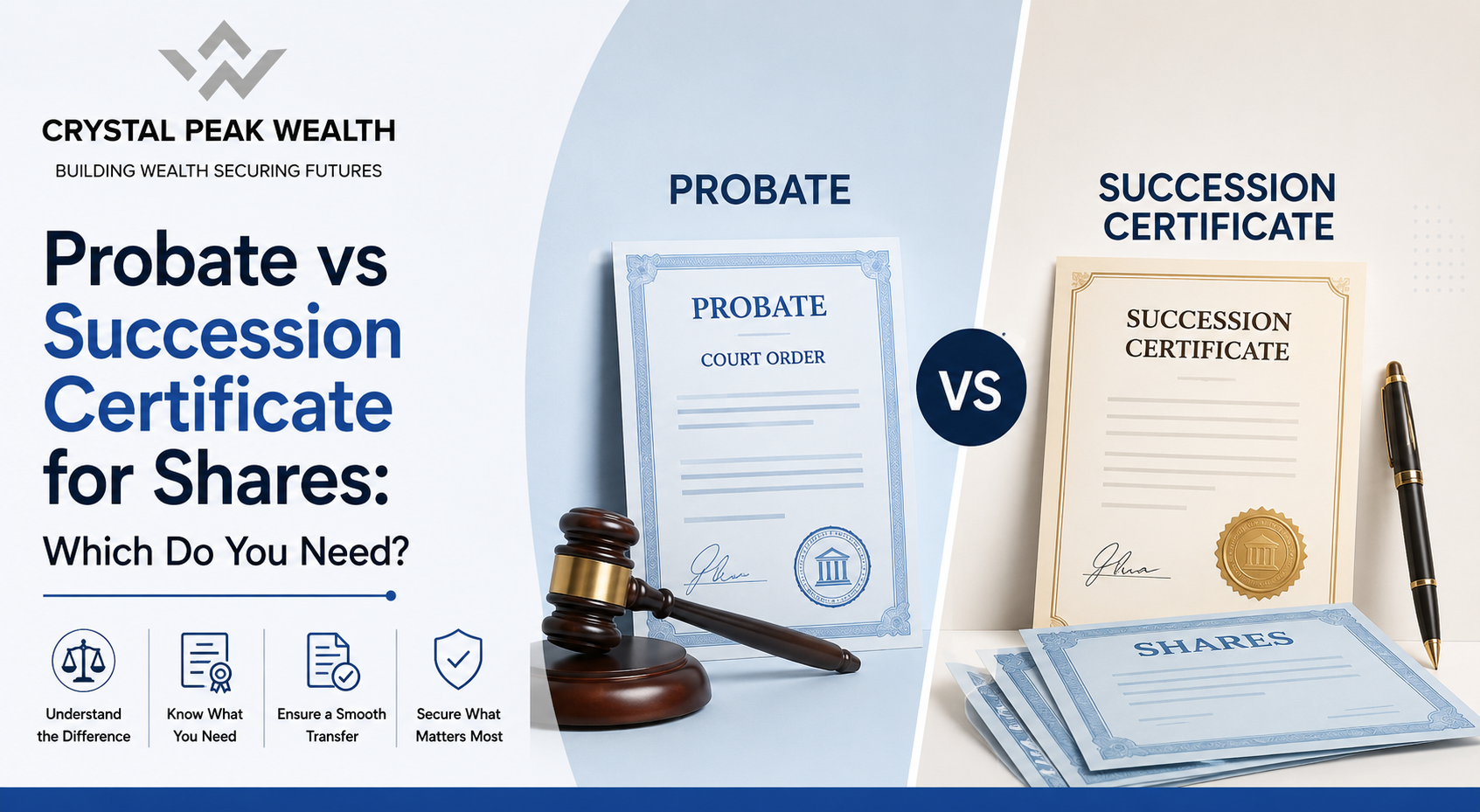
When a loved one passes away, dealing with their financial assets is often one of the most challenging tasks for the family. Among these assets, shares and securities require specific legal procedures before ownership can be transferred to the rightful heirs. Unfortunately, many people confuse probate vs succession certificate for shares, assuming both documents serve the same purpose. This misunderstanding often leads to filing the wrong application, resulting in unnecessary delays, additional court fees, and avoidable legal complications.
As awareness about estate planning and inheritance laws grows in India, more families are searching for reliable guidance on probate vs succession certificate for shares. Understanding the difference between these legal documents can save both time and money while ensuring that the transmission of shares happens smoothly.
In this guide, we’ll explain probate vs succession certificate for shares in simple language, discuss when each document is required, explore the probate process for shares India, explain succession certificate court fees, and discuss the role of a letter of administration for shares. By the end of this article, you’ll know exactly which legal document applies to your situation.
Why Understanding Probate vs Succession Certificate for Shares Matters
Many legal heirs assume that one certificate works for every inheritance case involving shares. However, Indian succession laws distinguish between different situations based on whether the deceased left a valid Will.
This is why understanding probate vs succession certificate for shares is essential before approaching a court or a company registrar.
Choosing the wrong legal document may result in:
- Rejection of your application
- Additional legal expenses
- Delays in transferring shares
- Repeated court appearances
- Difficulty accessing dividends or other shareholder benefits
Instead of spending months correcting mistakes, knowing the difference between probate vs succession certificate for shares helps families complete the process correctly the first time.
What Is Probate?
Probate is a legal certification issued by a competent court confirming that a deceased person’s Will is genuine and legally valid. Once probate is granted, the executor named in the Will receives legal authority to administer the estate according to the deceased’s wishes.
In cases involving listed or unlisted shares, probate serves as legal proof that the executor has the authority to transfer ownership.
Understanding probate vs succession certificate for shares starts with knowing that probate applies primarily when there is a valid Will.
The court examines:
- The authenticity of the Will
- Identity of beneficiaries
- Identity of the executor
- Whether the Will was executed legally
Once approved, companies, registrars, depositories, and financial institutions generally accept probate for transferring securities.
What Is a Succession Certificate?
A succession certificate is entirely different.
It is issued by a civil court when someone dies without leaving a valid Will (intestate). Instead of validating a Will, it establishes who has the legal authority to collect debts and securities belonging to the deceased.
These may include:
- Equity shares
- Mutual fund investments
- Bonds
- Debentures
- Fixed deposits
- Bank balances
This distinction is one of the biggest reasons why people search for probate vs succession certificate for shares.
A succession certificate does not determine ownership of all inherited property. Instead, it authorizes the certificate holder to receive specified debts and securities on behalf of the legal heirs.
Probate vs Succession Certificate for Shares: The Basic Difference
The easiest way to understand probate vs succession certificate for shares is by asking one simple question:
Did the deceased leave a valid Will?
If the answer is Yes, probate may be required.
If the answer is No, a succession certificate may become necessary.
Here’s a simple comparison:
|
Probate |
Succession Certificate |
|
Used when there is a valid Will |
Used when there is no Will |
|
Validates the Will |
Identifies legal heir(s) |
|
Executor applies |
Legal heir applies |
|
Covers the estate mentioned in the Will |
Covers debts and securities |
|
Court verifies authenticity of the Will |
Court determines rightful claimant |
Understanding this distinction eliminates much of the confusion surrounding probate vs succession certificate for shares.
When Is Probate Required for Shares?
One of the most common questions families ask is when is probate required for shares.
Probate is generally required when:
- The deceased left a registered or unregistered Will.
- The company or Registrar and Transfer Agent (RTA) specifically requests probate.
- Financial institutions require legal confirmation before transferring high-value securities.
- There is a dispute regarding the Will.
- Local succession laws mandate probate in certain jurisdictions.
Although probate is not mandatory in every case across India, many institutions insist upon it before processing transmission requests involving substantial shareholdings.
Therefore, understanding when is probate required for shares becomes an important part of planning the transmission process.
Probate Process for Shares India
The probate process for shares India involves several legal steps that must be completed before ownership can be transferred.
Step 1: Filing the Probate Petition
The executor files a probate petition before the competent District Court or High Court having jurisdiction.
Required documents generally include:
- Original Will
- Death certificate
- Identity proof
- Details of legal heirs
- Details of shareholdings
Step 2: Court Examination
The court reviews:
- Validity of the Will
- Signature of the testator
- Witnesses
- Supporting documents
If objections arise, hearings may be scheduled.
Step 3: Public Notice
In many cases, the court issues a public notice inviting objections from interested parties.
If nobody contests the Will, the matter usually proceeds more smoothly.
Step 4: Grant of Probate
Once satisfied, the court grants probate.
The executor now has legal authority to approach:
- Companies
- Registrars
- Depositories
- Banks
- Mutual fund houses
for transferring the shares.
This is the standard probate process for shares India, although timelines differ depending on the court and whether any disputes arise.
What Happens If There Is No Will?
If someone dies intestate (without a valid Will), probate cannot be obtained because there is no Will to validate.
Instead, legal heirs generally apply for a succession certificate.
This is where understanding probate vs succession certificate for shares becomes extremely important.
The court verifies:
- Family relationships
- Legal heirs
- Asset details
- Claims made by applicants
After verification, the succession certificate authorizes the legal heir to collect the specified securities.
Succession Certificate Court Fees
Many applicants underestimate the cost involved in obtaining a succession certificate.
The succession certificate court fees depend on:
- State laws
- Value of securities
- Applicable court fee schedules
Most states calculate succession certificate court fees as a percentage of the estate value, subject to prescribed limits under local legislation.
Apart from statutory court fees, applicants should also consider:
- Advocate fees
- Documentation expenses
- Affidavit charges
- Notary expenses
- Miscellaneous filing costs
Understanding succession certificate court fees beforehand helps families avoid unexpected financial burdens.
Can Both Probate and Succession Certificate Be Required?
Surprisingly, yes.
Certain complex estates contain multiple asset classes, disputed ownership, or separate legal proceedings involving different jurisdictions.
In such situations, legal advisors may recommend both procedures for different categories of assets.
This is another reason why understanding probate vs succession certificate for shares is essential before beginning the legal process.
Professional advice can prevent unnecessary applications and ensure that the correct legal route is followed from the outset.
Common Mistakes People Make
Many families unintentionally complicate the inheritance process by making avoidable mistakes.
Some of the most common include:
- Assuming probate and succession certificates are identical.
- Applying for probate when no Will exists.
- Applying for a succession certificate despite having a valid Will.
- Ignoring nominee details.
- Failing to gather complete shareholding records.
- Delaying legal proceedings for several years.
- Not understanding when is probate required for shares before filing.
These errors can significantly increase costs, delay share transmission, and create additional legal hurdles.
Does a Nominee Eliminate the Need for Probate or a Succession Certificate?
Another common misconception surrounding probate vs succession certificate for shares is that appointing a nominee automatically transfers ownership.
In reality, a nominee acts as a trustee or custodian of the shares until the rightful legal heirs are determined under the applicable succession laws or the valid Will of the deceased. Depending on the facts of the case, companies, depositories, or courts may still require probate, a succession certificate, or other legal documents before the final transfer of ownership.
Therefore, simply having a nominee does not always remove the need for legal succession procedures.
Letter of Administration for Shares
While discussing probate vs succession certificate for shares, there is another important legal document that families often overlook—the letter of administration for shares.
A letter of administration for shares is issued by a competent court when:
- The deceased left a Will but did not appoint an executor.
- The appointed executor has passed away or is unwilling to act.
- The executor cannot be located.
- The Will exists, but no one has legal authority to administer the estate.
In such situations, the court appoints an administrator who is responsible for managing and distributing the deceased’s estate according to the law or the Will.
A letter of administration for shares grants powers similar to those of an executor under probate. It allows the administrator to approach companies, Registrars and Transfer Agents (RTAs), depositories, and financial institutions to complete the transmission of shares.
Understanding the role of a letter of administration for shares is essential because many people mistakenly apply for a succession certificate even when a valid Will exists but lacks an executor. In such cases, a letter of administration—not a succession certificate—is generally the appropriate legal remedy.
Probate vs Succession Certificate for Shares: A Detailed Comparison
To simplify the decision-making process, here’s a detailed comparison of probate vs succession certificate for shares.
|
Basis |
Probate |
Succession Certificate |
|
Applicable when |
Valid Will exists |
No Will exists |
|
Purpose |
Validates the Will |
Establishes authority over debts and securities |
|
Applicant |
Executor named in the Will |
Legal heir(s) |
|
Court verifies |
Authenticity of the Will |
Legal heirship |
|
Covers |
Entire estate under the Will |
Debts and securities such as shares |
|
Applicable to |
Testate succession |
Intestate succession |
|
Time Required |
Depends on court proceedings |
Depends on court proceedings |
|
Required for share transmission |
In many cases where a Will exists |
In many intestate cases |
Knowing these differences helps avoid confusion regarding probate vs succession certificate for shares and ensures the correct legal process is followed.
Documents Required
Whether you’re applying for probate or a succession certificate, preparing complete documentation is crucial.
Typical documents include:
For Probate
- Original Will
- Death Certificate
- Identity and Address Proof of Executor
- Shareholding Statements
- PAN Card
- Court Petition
- Affidavits
- Witness Details (if required)
For Succession Certificate
- Death Certificate
- Identity Proof of Applicant
- Legal Heir Certificate (where applicable)
- Family Tree or Genealogical Details
- Shareholding Documents
- PAN and Aadhaar
- Court Petition
- Affidavit
Having complete documentation reduces delays during court proceedings.
How Long Does the Process Take?
One of the biggest concerns among families is the timeline involved.
The duration depends on factors such as:
- Court workload
- Whether objections are raised
- Completeness of documents
- Number of legal heirs
- Value of securities
- Jurisdiction
If there are no disputes, the process may conclude relatively quickly. However, contested matters can take significantly longer. This is another reason why understanding probate vs succession certificate for shares early can help families avoid unnecessary procedural delays.
Real-Life Example 1: When Probate Is Required
Mr. Sharma owned listed shares worth ₹1.2 crore and had prepared a legally valid Will naming his daughter as the executor.
After his demise, the company requested legal proof before transferring the shares.
Since a valid Will existed, the family followed the probate process for shares India by approaching the competent court. Once probate was granted, the shares were successfully transmitted to the beneficiaries according to the Will.
This is a classic example of when is probate required for shares.
Real-Life Example 2: When a Succession Certificate Is Required
Mrs. Verma passed away without leaving a Will.
She held shares in multiple listed companies.
Her husband and two children approached the court for a succession certificate.
After verifying the legal heirs, the court issued the certificate, enabling them to complete the transmission of the shares.
This example clearly highlights the practical difference in probate vs succession certificate for shares.
Why Families Often File the Wrong Application
Legal terminology can be confusing, especially during an emotionally difficult time.
Some common reasons include:
- Assuming every inheritance case requires probate.
- Believing every share transfer requires a succession certificate.
- Lack of awareness about Indian succession laws.
- Incorrect advice from unofficial sources.
- Confusion regarding nominees and legal heirs.
As legal awareness increases in urban India, more people are actively researching probate vs succession certificate for shares before approaching the court. This trend is helping families avoid unnecessary expenses and procedural mistakes.
Tips to Make the Process Smoother
If you’re dealing with inherited shares, consider the following best practices:
- Verify whether a valid Will exists.
- Identify the executor, if any.
- Collect all shareholding records before initiating the legal process.
- Confirm the requirements of the concerned company, RTA, or depository.
- Keep identity and relationship documents ready.
- Seek professional guidance if multiple heirs or disputed assets are involved.
- Understand the applicable succession certificate court fees before filing your application.
Proper preparation can significantly reduce delays and improve the chances of a smooth transmission process.
Frequently Asked Questions (FAQs)
1. What is the main difference between probate and a succession certificate?
The primary difference in probate vs succession certificate for shares is that probate validates a Will, while a succession certificate is issued when there is no Will and authorizes legal heirs to collect debts and securities.
2. Is probate mandatory for all shares in India?
No. Whether probate is required depends on the existence of a Will, the applicable law, the jurisdiction, and the requirements of the company or Registrar and Transfer Agent (RTA). This is why understanding when is probate required for shares is important.
3. Can a nominee transfer shares without probate?
Not always. A nominee may be able to facilitate the transmission process, but they do not automatically become the legal owner. Depending on the circumstances, probate, a succession certificate, or other legal documents may still be required.
4. What are succession certificate court fees?
Succession certificate court fees vary by state and are generally based on the value of the debts and securities covered by the certificate. Additional legal and documentation expenses may also apply.
5. What is a letter of administration?
A letter of administration for shares is issued when there is no executor available to administer the estate, even if a valid Will exists. It authorizes an administrator to manage and transfer the deceased’s assets.
6. Can legal heirs apply directly for share transmission?
Yes, in many cases they can. However, the required legal documentation depends on whether the deceased left a Will and on the policies of the company, depository participant, or RTA.
Conclusion
Understanding probate vs succession certificate for shares is essential for anyone dealing with inherited securities in India. Although both documents are related to inheritance, they serve entirely different legal purposes.
Probate confirms the validity of a Will and empowers the executor to administer the estate. A succession certificate, on the other hand, authorizes legal heirs to collect debts and securities when no Will exists. In situations where a Will exists but there is no executor, a letter of administration for shares may be the appropriate legal solution.
Taking the time to determine the correct legal document before approaching the court can save months of delay, prevent unnecessary succession certificate court fees, and ensure that the transfer of shares is completed efficiently. If you are unsure about when is probate required for shares or need guidance through the probate process for shares India, seeking professional assistance can make the entire process far less stressful.
Need Expert Help with Share Transmission or Inherited Shares?
Navigating probate, succession certificates, and inherited share transfers can be legally complex and time-consuming. A small mistake in documentation or choosing the wrong legal procedure can lead to delays, repeated court visits, and additional expenses.
Crystal Peak Wealth specializes in assisting individuals and families with a wide range of share-related services, including:
- Probate and succession guidance
- Transmission of physical and demat shares
- IEPF claim assistance
- Recovery of unclaimed dividends and shares
- Dematerialization of physical share certificates
- Duplicate share certificate support
- End-to-end documentation assistance
Whether you’re uncertain about probate vs succession certificate for shares or need professional support with inherited investments, the experienced team at Crystal Peak Wealth can help simplify the process and ensure your claim is handled efficiently.
Get in touch with Crystal Peak Wealth today and let experienced professionals guide you through every step of your share recovery and transmission journey.