
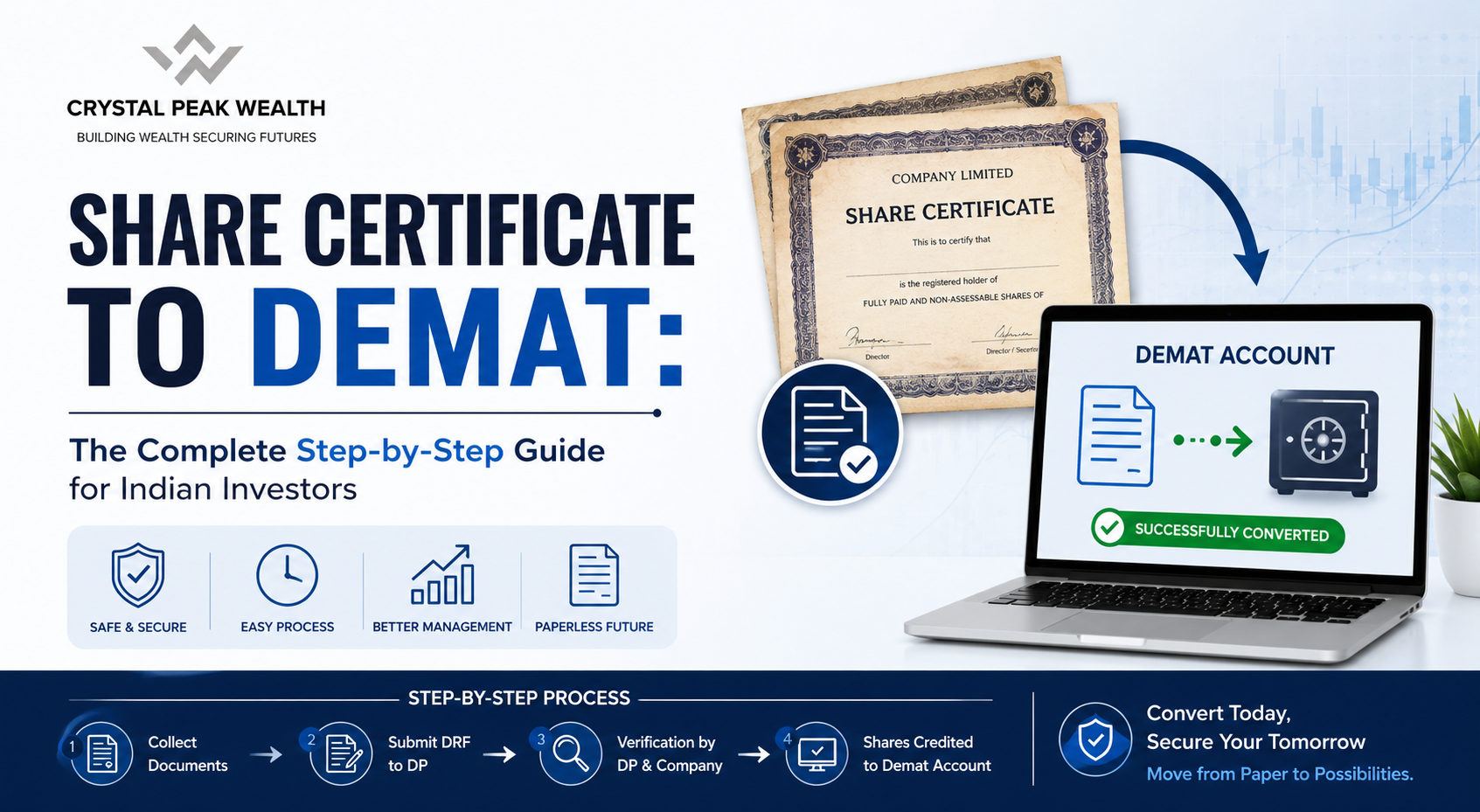
Why Your Physical Share Certificates Are a Hidden Liability
Tucked away in an old drawer or buried inside a locker, millions of Indian families hold physical share certificates that have quietly grown in value over decades. These paper documents represent real wealth — yet they sit dormant, unprotected from fire, theft, and loss, and completely inaccessible for trading.
If you’ve ever tried to sell, transfer, or even just verify physical shares, you already know the frustration. The answer to every one of these problems is the conversion of your share certificate to demat — transforming a fragile paper asset into a secure, fully tradeable digital holding.
In 2025, the Securities and Exchange Board of India (SEBI) has made the process of converting a share certificate to demat cleaner and faster than at any point in the past. Yet first-time applicants still find the end-to-end journey confusing, especially when original documents are missing or share records contain name mismatches.
This guide breaks down everything you need to know — from opening a demat account to submitting the dematerialisation request form — so you can confidently convert every physical share certificate you hold into electronic securities that work for you.
What Does “Share Certificate to Demat” Actually Mean?
When we talk about converting a share certificate to demat, we are describing the process of dematerialisation. Dematerialisation (or “demat”) is the legal conversion of physical original share certificates into an electronic format held in a digital depository account.
In India, two registered depositories manage all electronic securities:
- NSDL (National Securities Depository Limited)
- CDSL (Central Depository Services Limited)
When you convert a share certificate to demat, your physical certificates are surrendered, verified by the Registrar and Transfer Agent (RTA), and equivalent electronic units are credited to your demat account held with either NSDL and CDSL through a Depository Participant (DP) — typically a bank or stockbroker.
The result? You no longer carry paper risk. Your holdings are digitally insured, tradeable on stock exchanges within seconds, and safe from physical damage forever.
Why the Share Certificate to Demat Process Matters More Than Ever
SEBI’s 2024–25 Mandate on Physical Securities
SEBI has progressively tightened rules around physical shares. As of recent circulars:
- Listed companies are not permitted to process requests for transfer of physical shares (transfers must happen only in demat form).
- Shareholders holding physical certificates can still claim dividends and rights, but the ability to sell or transfer is severely restricted unless they complete the share certificate to demat conversion.
This makes the conversion of your share certificate to demat not just convenient — it is practically essential for anyone who wants to exercise full ownership rights.
Direct Credit of Securities: SEBI’s Biggest Simplification
One of SEBI’s most impactful recent reforms directly reduces the paperwork burden for investors converting a share certificate to demat. Previously, the process involved multiple courier steps and a longer waiting period. SEBI has now enabled direct credit of securities to your demat account upon verification, meaning the RTA can credit your electronic holdings directly — cutting out redundant steps and reducing total processing time significantly.
This reform is particularly beneficial for investors who hold inherited shares or shares bought decades ago, since their original share certificates often show outdated address or name details that previously caused delays.
Who Should Read This Guide?
The share certificate to demat process is relevant to:
- Investors who inherited physical shares from parents or grandparents
- Retirees who bought shares during the pre-demat era (pre-1996) and never converted them
- NRIs who have discovered family-held physical certificates
- First-time applicants confused about the exact documents and steps
- Anyone whose physical certificate was lost, stolen, or damaged (a different but related process)
Whether you hold one certificate or a hundred, the path to converting your share certificate to demat follows the same fundamental framework — and this guide covers all of it.
Step-by-Step: How to Convert Your Share Certificate to Demat
Step 1: Open a Demat Account with a Registered Depository Participant
Before you can begin the share certificate to demat process, you need an active demat account. A Depository Participant (DP) is an intermediary registered with either NSDL and CDSL that holds your demat account on your behalf.
You can open a demat account with:
- A bank (SBI, HDFC, ICICI, Axis, Kotak)
- A stockbroker (Zerodha, Groww, Angel One, Motilal Oswal)
- Other SEBI-registered entities
Documents required to open a demat account:
- PAN Card (mandatory)
- Aadhaar Card (for KYC)
- Cancelled cheque or bank statement
- Passport-size photographs
- Signature verification
Note: The name on your demat account must exactly match the name on your original share certificates. Even minor mismatches (e.g., “Ramesh Kumar” vs “R. Kumar”) can cause rejection of the share certificate to demat request.
Step 2: Gather Your Original Share Certificates
The share certificate to demat process requires you to physically submit your original share certificates. Collect every certificate for the specific company/companies whose shares you want to dematerialise.
Check each certificate for:
- Full name of the shareholder(s)
- Folio number
- Number of shares and their distinctive numbers
- Certificate number
- Company name and stamp
If any of these details are missing, smudged, or incorrect, flag them before proceeding — discrepancies will cause the share certificate to demat request to be rejected.
Lost your certificates? This requires a separate “duplicate share certificate” process before you can proceed with the share certificate to demat conversion. Crystal Peak Wealth specialises in this recovery — more on that below.
Step 3: Fill the Dematerialisation Request Form (DRF)
The dematerialisation request form is the official document that initiates the conversion of your share certificate to demat. You obtain this form from your Depository Participant.
Key fields in the dematerialisation request form:
- DP ID and client (demat account) ID
- ISIN number of the company (International Securities Identification Number)
- Number of certificates and total number of shares
- Certificate numbers and distinctive numbers
- Shareholder signature(s) — must match the signature on the original certificate
Important: The dematerialisation request form must be filled separately for each company whose shares you are converting. You cannot club shares of different companies in a single form.
Defacing the certificates: Before submitting, you must write “Surrendered for Dematerialisation” across the face of each original share certificate. This is a mandatory step — an undefaced certificate will be rejected.
Step 4: Submit the DRF and Certificates to Your DP
Once your dematerialisation request form is complete and certificates are defaced, submit them together to your Depository Participant. Your DP will:
- Verify the DRF for completeness
- Generate a Dematerialisation Request Number (DRN)
- Forward the physical original share certificates along with the DRF to the company’s Registrar and Transfer Agent (RTA)
Keep the DRN safe — it is your tracking number for the entire share certificate to demat conversion.
Step 5: RTA Verification and Credit to Your Demat Account
The RTA is the backend agency that maintains the company’s share registry. Once they receive your original share certificates and the dematerialisation request form, they:
- Verify the physical certificates against their records
- Confirm the number of shares and shareholder details
- Cancel the physical certificates
- Intimate the depository (NSDL and CDSL) to credit electronic securities to your demat account
Under SEBI’s streamlined process, this direct credit of electronic securities typically takes 15 to 30 days from the date the RTA receives the documents.
Once credited, your share certificate to demat conversion is complete. You will receive a confirmation from your DP, and the holdings will reflect in your demat statement.
Documents Checklist for Share Certificate to Demat Conversion
Here is a complete list of what you need:
Document | Details |
Original Share Certificates | Defaced with “Surrendered for Dematerialisation” |
Dematerialisation Request Form (DRF) | One per company, obtained from DP |
PAN Card | Self-attested copy |
Aadhaar Card | Self-attested copy |
Client Master Report | Issued by DP confirming demat account details |
Power of Attorney (if applicable) | Only if someone else is submitting on your behalf |
For joint holdings, all joint holders must sign the dematerialisation request form exactly as per the original share certificates.
Common Errors That Delay the Share Certificate to Demat Process
Despite being a well-defined process, the share certificate to demat conversion frequently gets delayed or rejected for preventable reasons:
1. Name Mismatch
If the name on your original share certificates differs from the name on your demat account (even in abbreviation), the RTA will reject the request. Always match names exactly before submitting.
2. Signature Mismatch
Your signature on the dematerialisation request form must match what the company has on record (the signature used when you originally purchased the shares). Old records often have signatures from decades ago.
3. Incomplete or Incorrect DRF
Missing the ISIN, wrong certificate number entries, or unchecked mandatory fields in the dematerialisation request form are common rejection triggers.
4. Undefaced Certificates
Forgetting to write “Surrendered for Dematerialisation” on each physical certificate is a basic but common error.
5. Multiple Companies in One DRF
Submitting shares of two different companies in a single dematerialisation request form will cause rejection. Each company requires its own form.
Special Scenarios in the Share Certificate to Demat Process
Converting Inherited Shares
If you received physical shares through inheritance (after the death of a parent or spouse), you cannot directly proceed with the standard share certificate to demat route. You must first complete the Transmission of Shares process — transferring the legal ownership to your name — before initiating dematerialisation.
Documents typically required for transmission before share certificate to demat conversion:
- Death certificate of the deceased holder
- Legal heirship certificate or probated will
- Affidavit and indemnity bond
- Original share certificates
Crystal Peak Wealth handles end-to-end transmission + share certificate to demat conversion as a combined service, which significantly reduces the total time and coordination burden.
IEPF Shares and Dematerialisation
If your shares or dividends have been transferred to the Investor Education and Protection Fund (IEPF) due to non-claim for 7+ consecutive years, the share certificate to demat process requires an additional IEPF claim step before conversion.
This is one of the most complex cases in the entire share certificate to demat landscape. Crystal Peak Wealth is among the very few firms in India with deep expertise in IEPF recovery combined with dematerialisation.
Lost or Damaged Certificates
Lost original share certificates cannot be directly submitted for the share certificate to demat process. You must first apply for a duplicate share certificate from the company, which involves:
- Filing an FIR (if applicable)
- Publishing a newspaper notice
- Submitting an indemnity bond
- Paying the company’s prescribed fee
Once duplicate certificates are issued, you can then proceed with the standard share certificate to demat conversion.
NSDL and CDSL: What’s the Difference and Does It Matter?
Both NSDL and CDSL are SEBI-registered depositories that hold electronic securities in India. The difference between them is operational — not functional — from an investor’s standpoint.
Feature | NSDL | CDSL |
Full name | National Securities Depository Limited | Central Depository Services Limited |
Established | 1996 | 1999 |
Backed by | NSE (National Stock Exchange) | BSE (Bombay Stock Exchange) |
Market share | ~55% | ~45% |
DP ID format | IN + 14 digits | 8 digits |
When you convert a share certificate to demat, the electronic securities are credited to your account in whichever depository your DP is registered with. Most large DPs are registered with both NSDL and CDSL.
The choice of NSDL and CDSL does not affect the safety, speed, or legality of your share certificate to demat conversion.
How Long Does the Share Certificate to Demat Process Take?
Stage | Typical Timeline |
Demat account opening | 1–3 business days |
DRF submission to DP | Same day |
DP forwards to RTA | 3–7 business days |
RTA verification | 7–15 business days |
Credit of electronic securities | 2–5 business days after RTA approval |
Total end-to-end | 15–30 business days |
Complex cases — name mismatches, inherited shares, IEPF involvement, or lost certificates — can extend the share certificate to demat timeline to 60–90 days or more.
Benefits of Completing Your Share Certificate to Demat Conversion
Once you complete the share certificate to demat process, you unlock:
Full Trading Rights — Your electronic securities can be bought and sold on NSE or BSE within seconds, just like any other demat-held stock.
Dividend Auto-Credit — All future dividends are directly credited to your linked bank account. No more undelivered dividend warrants.
Corporate Actions — Bonuses, rights issues, splits, and mergers are automatically reflected in your demat account once the share certificate to demat conversion is done.
Loan Against Securities — Banks readily accept electronic securities as collateral. Physical certificates are rarely accepted.
Nomination Facility — With a demat account, you can nominate a beneficiary directly, ensuring seamless transmission to heirs without the complications you’re currently navigating with physical certificates.
Zero Risk of Physical Loss — Fire, flood, theft, or simple misplacement — none of these can touch your electronic securities after the share certificate to demat conversion.
Frequently Asked Questions About Share Certificate to Demat
Q: Can I convert a share certificate to demat without a demat account?
No. A demat account is mandatory. You need to open one with a DP registered with NSDL and CDSL before you can initiate the share certificate to demat process.
Q: Is there a fee for the share certificate to demat conversion?
Most DPs charge a nominal fee per certificate or per request. Some banks offer free dematerialisation as part of their account benefits. The RTA typically does not charge separately.
Q: What happens to my original share certificates after submission?
The RTA physically cancels and destroys the original share certificates after verification and crediting of electronic securities to your demat account.
Q: Can I convert shares of a delisted company to demat?
For actively delisted companies, the share certificate to demat process may still be possible depending on whether the company has a live ISIN and registered RTA. Specialist advice is recommended in such cases.
Q: What if my dematerialisation request form is rejected?
Your DP will notify you of the reason. Common rejection reasons include name mismatch, signature mismatch, incorrect certificate details, or incomplete DRF. You must rectify the issue and resubmit.
Q: How many shares can I convert at once?
There is no legal upper limit. You can convert all your physical holdings across any number of certificates in one or multiple share certificate to demat requests.
Why Most Investors Get Stuck — and How Crystal Peak Wealth Solves It
The share certificate to demat process is straightforward on paper. In practice, first-time applicants consistently hit the same walls:
- They can’t find their original share certificates
- The name on the certificate doesn’t match the demat account
- They inherited shares without clear legal title
- The company’s shares moved to IEPF
- The dematerialisation request form was rejected with no clear explanation
Each of these roadblocks requires a different solution — and most DPs simply redirect you without resolving anything.
Crystal Peak Wealth exists precisely to bridge this gap. As Mumbai’s specialist in physical share conversion and unclaimed investment recovery, the Crystal Peak team handles the entire share certificate to demat journey on your behalf:
✅ Document collection and verification
✅ Name correction and signature mismatch resolution
✅ Transmission of inherited shares
✅ IEPF claims and recovery
✅ Duplicate certificate procurement for lost original share certificates
✅ End-to-end coordination with RTAs, DPs, NSDL and CDSL
With 170+ families served, crores worth of physical equity already converted into electronic securities, and a team averaging 20+ years of professional experience, Crystal Peak Wealth is the most trusted name in the share certificate to demat space.
Ready to Convert Your Share Certificate to Demat? Here’s How to Start.
Don’t let your physical share certificates continue to sit idle — losing value to inflation, risk, and regulatory restrictions while your wealth stays locked in paper form.
Crystal Peak Wealth offers a free expert consultation to assess your physical shareholdings, identify any complications, and create a clear roadmap for your complete share certificate to demat conversion.
📞 Call Us: +91 98200 06665
📧 Email: info@crystalpeakwealth.com
🌐 Visit: crystalpeakwealth.com
📍 Office: 3rd Floor, Oberoi Commerz 2, Goregaon East, Mumbai – 400063
→ Schedule My Free Expert Call Now
Your physical certificates represent real wealth. The share certificate to demat process is your path to fully unlocking it. Let Crystal Peak Wealth make that journey simple, secure, and stress-free.
Conclusion: The Share Certificate to Demat Conversion Is Simpler Than You Think
Converting a share certificate to demat is one of the most impactful financial steps an investor can take. It transforms a passive, at-risk paper asset into an active, protected digital holding — giving you the power to trade, pledge, and transfer your investments with the same ease as any modern shareholder.
The process involves five clear stages: opening a demat account, gathering original share certificates, filling the dematerialisation request form, submitting to your DP, and waiting for the RTA to credit electronic securities via NSDL and CDSL.
SEBI’s reforms have made the share certificate to demat process faster and more investor-friendly than ever before. And for cases involving lost certificates, inherited shares, or IEPF-transferred holdings, experienced specialists like Crystal Peak Wealth can navigate every complication on your behalf.
Start your share certificate to demat journey today — your wealth has waited long enough.
Disclaimer: This article is for informational purposes only and does not constitute financial or legal advice. Please consult a SEBI-registered professional for guidance specific to your situation.