
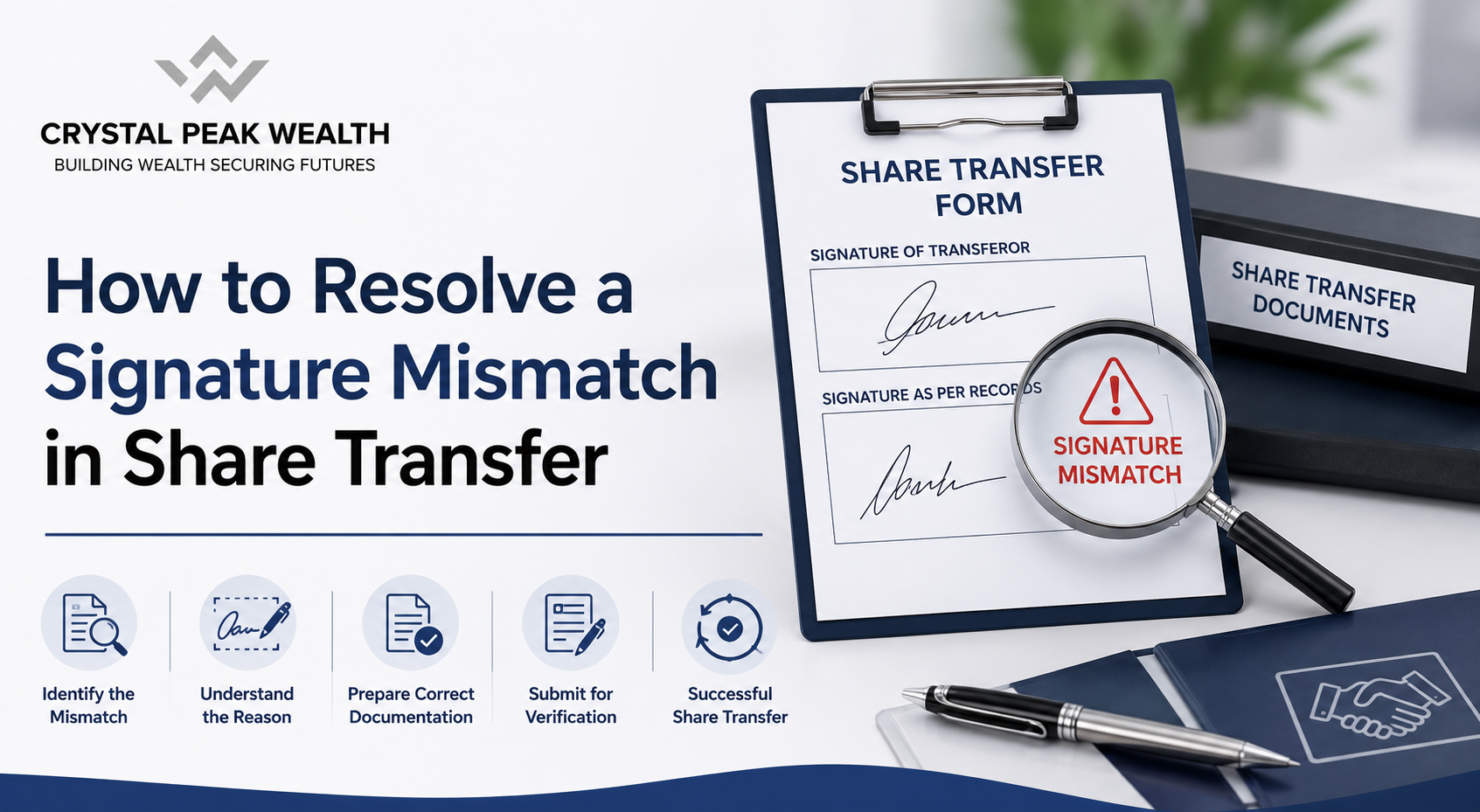
Imagine finally discovering old share certificates that could be worth lakhs of rupees, only to find out that your request has been put on hold because of one small issue—a signature mismatch share transfer problem.
This is one of the most common reasons why investors and legal heirs experience delays during the transfer of physical shares, dematerialization, transmission, or even while filing an IEPF claim. Many people assume that because they possess the original share certificates, the transfer process will be straightforward. Unfortunately, registrars and transfer agents (RTAs) verify every document carefully, and if the signature on your application differs from the one available in company records, the request is usually kept pending until the discrepancy is resolved.
The frustrating part is that many investors changed their signatures over the years. Others opened bank accounts decades ago with one signature style but now use another. In some cases, signatures naturally evolve with age, illness, or changing writing habits. Even a slight variation can trigger a verification request.
The good news is that a signature mismatch share transfer issue is entirely resolvable. With the right documentation and by following the prescribed process, you can successfully complete your share transfer without unnecessary delays.
In this comprehensive guide, you’ll learn:
- What causes a signature mismatch share transfer issue
- How registrars verify signatures
- The documents required to resolve the discrepancy
- The role of banks and RTAs
- How affidavits and signature verification work
- Tips to avoid rejection or repeated document requests
- When professional assistance can save significant time and effort
Whether you’re an investor, nominee, or legal heir trying to recover old investments, this guide will help you navigate the process with confidence.
What Is a Signature Mismatch in Share Transfer?
A signature mismatch share transfer occurs when the signature on your current application or supporting documents does not match the specimen signature recorded by the company or its Registrar and Transfer Agent (RTA).
Whenever shares are transferred, transmitted, or claimed from the Investor Education and Protection Fund (IEPF), the RTA compares the submitted signature with the historical records maintained for that folio. If the signatures appear inconsistent, the request is paused until the identity of the shareholder can be confirmed.
This verification is an important safeguard. It helps prevent unauthorized transfers, fraudulent claims, and identity-related disputes. While it may seem inconvenient, it ultimately protects shareholders and their investments.
How RTAs Verify Signatures
During the signature verification RTA process, the registrar examines several factors rather than looking for an exact visual match. These may include:
- The overall writing pattern
- Stroke formation
- Signature flow
- Letter structure
- Unique identifying characteristics
If the differences are substantial, additional documents are requested before the transfer can proceed.
For example:
- The shareholder signed share certificates in 1995.
- Their current PAN card carries a different signature.
- Their bank records have an updated signature.
- The transfer form is signed using the latest version.
Even though all signatures belong to the same person, the RTA may identify a signature mismatch share transfer issue and ask for verification documents.
Why Does a Signature Mismatch Occur?
Many investors are surprised when their applications are flagged because they never intentionally changed their signature. However, signatures naturally evolve over time, and records maintained by companies may date back several decades.
Here are the most common reasons behind a signature mismatch share transfer.
1. Natural Change in Signature Over Time
Most investors purchased physical shares years ago. Since then, their signature may have gradually changed because of:
- Personal preference
- Professional use
- Increased writing speed
- Age-related changes
A signature made in your twenties may look very different from the one you use today.
2. Different Signature Used for Banking
One common reason behind a bank signature mismatch shares issue is that investors updated their bank signature but never informed the company or the RTA.
As a result:
- Bank records show the latest signature.
- Share records still contain the older version.
This difference often leads to additional verification during the transfer process.
3. Health or Medical Conditions
Health-related issues can significantly affect handwriting and signatures.
Examples include:
- Arthritis
- Parkinson’s disease
- Hand injuries
- Stroke recovery
- Age-related tremors
RTAs understand that genuine changes can occur and usually allow alternative verification when proper supporting documents are provided.
4. Multiple Signature Styles
Some people unknowingly use different signatures for different purposes.
For instance:
- One signature for banking
- Another for official documents
- A shortened version for everyday use
- A full signature for legal paperwork
When these styles don’t match historical records, a signature mismatch share transfer query is often raised.
5. Old Physical Share Records
Many physical share certificates were issued in the 1980s and 1990s. During that period:
- Records were maintained manually.
- Specimen signatures were stored in paper form.
- Scanned copies may not be as clear as modern digital records.
Even minor variations become more noticeable when old records are compared with freshly signed documents.
6. Signature Recorded Incorrectly
Occasionally, the original specimen signature itself may have been:
- Poorly scanned
- Incorrectly recorded
- Smudged
- Incomplete
In such cases, the shareholder isn’t necessarily at fault, but additional verification is still required before the transfer can proceed.
Why Signature Mismatch Should Never Be Ignored
Many investors believe they can simply submit the same documents again and hope for approval. Unfortunately, that rarely works.
A pending signature mismatch share transfer can delay:
- Transfer of physical shares
- Dematerialization requests
- Transmission to nominees
- Transmission to legal heirs
- Dividend payments
- Sale of securities
- Corporate benefits
- IEPF recovery applications
The longer the discrepancy remains unresolved, the longer your investments remain inaccessible.
In some cases, repeated rejections occur because applicants submit incomplete documents without understanding the exact requirements of the RTA.
How Signature Mismatch Affects Different Share-Related Processes
A signature mismatch share transfer doesn’t only affect ownership transfers. It can create complications across several shareholder services.
Share Transfer
The transfer cannot be processed until the RTA confirms that the person signing the documents is the rightful shareholder.
Share Transmission
Legal heirs and nominees often discover a signature issue only after the original shareholder has passed away.
In such situations, additional verification becomes necessary alongside succession documents, indemnities, and other legal paperwork.
Dematerialization
When converting physical shares into electronic form, depositories and RTAs verify shareholder details.
If signatures don’t match historical records, the demat request may remain pending until verification is completed.
Dividend Claims
Unresolved signature discrepancies may also delay dividend-related requests, especially when investors seek to update bank details or claim unpaid dividends.
IEPF Claims
A signature mismatch IEPF claim can be particularly time-consuming because multiple authorities are involved.
Apart from the company and RTA, the Investor Education and Protection Fund Authority also examines the submitted documentation. If signatures differ significantly, applicants may be asked to provide additional identity proofs, bank verification, affidavits, or other supporting documents before the claim can move forward.
Early Warning Signs of a Signature Mismatch
You may be facing a signature mismatch share transfer issue if you receive communication from the RTA mentioning phrases such as:
- Signature differs from company records
- Signature verification required
- Specimen signature mismatch
- Submit bank signature verification
- Provide notarized affidavit
- Signature differs from records available
- Signature not tallying with specimen
- Signature discrepancy observed
Receiving one of these notices doesn’t mean your application has been rejected permanently. In most cases, it simply means the registrar needs additional proof to verify your identity before processing the request.
Why Acting Quickly Matters
The sooner you respond to a signature mismatch notice, the smoother the resolution process tends to be. Delays in submitting the requested documents can extend processing timelines and may even require you to restart parts of the application if supporting documents become outdated.
In the next section, we’ll cover the complete list of documents required to resolve a signature mismatch share transfer, explain the signature verification RTA process, discuss the signature mismatch affidavit format, and provide a step-by-step guide to help you complete the process successfully.
Documents Required to Resolve a Signature Mismatch in Share Transfer
Once a signature mismatch share transfer is identified, the Registrar and Transfer Agent (RTA) generally requests supporting documents to verify that the person signing the application is the genuine shareholder. The exact requirements may differ depending on the company and the RTA, but most cases require a combination of identity proof, bank verification, and legal declarations.
Submitting complete and accurate documents in one go can significantly reduce processing time and help avoid repeated objections.
Here are the documents commonly required.
1. Signature Verification Letter from Your Bank
One of the most important documents in resolving a signature mismatch share transfer is a signature verification letter issued by your bank.
The bank compares your current signature with the specimen signature available in its records and certifies that both belong to the same account holder.
Typically, the letter should:
- Be printed on the bank’s official letterhead
- Bear the bank’s seal and stamp
- Include the authorized signatory’s signature
- Mention your account number (partially masked, if required)
- Confirm that the signature has been verified from bank records
This document plays a vital role in addressing bank signature mismatch shares issues because it provides independent verification from a regulated financial institution.
2. Self-Attested PAN Card
A copy of your Permanent Account Number (PAN) card is usually required to establish your identity.
Ensure that:
- The copy is clear and readable.
- The name matches the shareholder records.
- You self-attest the copy before submission.
If your name has changed due to marriage or any other legal reason, additional supporting documents may also be required.
3. Aadhaar Card or Other Identity Proof
The RTA may request government-issued identification to further verify your identity.
Accepted documents often include:
- Aadhaar Card
- Passport
- Driving Licence
- Voter ID
Providing consistent information across all documents helps minimize delays in a signature mismatch share transfer.
4. Client Master List (For Demat Cases)
If the shares are being transferred into a Demat account, your Depository Participant (DP) may issue a Client Master List (CML).
This document confirms:
- DP ID
- Client ID
- PAN
- Account holder’s name
- Demat account details
Many RTAs require the latest CML while processing dematerialization requests involving a signature mismatch share transfer.
5. Original Share Certificates
Where physical shares are involved, the original share certificates are generally required.
The certificates should:
- Be in good condition
- Match the folio details
- Not contain unauthorized alterations
If certificates are lost, a separate duplicate share certificate process may apply before the transfer can proceed.
6. Duly Filled Prescribed Forms
Depending on the transaction, applicants may need to submit forms prescribed by the company or the RTA.
These may include:
- Transmission request forms
- Dematerialization request forms
- Share transfer documentation
- Investor service request forms
Always ensure that all signatures are consistent across every document you submit.
Understanding the Signature Verification RTA Process
Many investors are unsure about what actually happens after they submit their documents. Knowing the signature verification RTA process can help set realistic expectations and reduce unnecessary follow-ups.
The verification process generally involves several stages.
Step 1: Receipt of Documents
The RTA receives your application and supporting documents.
An initial review is conducted to ensure:
- Required forms are complete
- Identity documents are enclosed
- Share certificates (if applicable) are available
- Supporting declarations are attached
Incomplete applications are usually returned with deficiency notices.
Step 2: Comparison with Historical Records
The registrar retrieves the shareholder’s specimen signature maintained in company records.
The submitted signature is compared against:
- Original shareholder records
- Previous transactions
- Existing specimen signatures
- Bank verification documents
If the signatures appear reasonably consistent, the process moves forward.
Where differences remain significant, additional clarification may be requested.
This stage is the core of the signature verification RTA process.
Step 3: Verification of Supporting Documents
The registrar then reviews:
- PAN details
- Aadhaar information
- Bank verification
- Affidavits
- Indemnity documents (where applicable)
The objective is to establish that all documents belong to the same individual.
Step 4: Additional Clarifications (If Needed)
Sometimes the RTA may ask for:
- Fresh bank verification
- Notarized declarations
- Additional identity proof
- Signature attestation
- Clarification letters
Responding promptly helps prevent further delays in your signature mismatch share transfer.
Step 5: Approval
Once satisfied with the verification, the registrar proceeds with:
- Share transfer
- Transmission
- Dematerialization
- Record updates
The shareholder is then informed of the successful completion.
What Is a Signature Mismatch Affidavit?
In many cases, applicants are asked to submit a notarized affidavit confirming that both the old and new signatures belong to the same individual.
This affidavit becomes particularly useful when:
- The signature has changed substantially.
- Bank records differ from company records.
- The shareholder has adopted a new signature.
- There is no recent transaction history available.
The affidavit acts as a legal declaration and supports the evidence submitted through identity documents and bank verification.
What Does a Signature Mismatch Affidavit Format Include?
Although companies and RTAs may have their own prescribed formats, a standard signature mismatch affidavit format generally contains the following details:
- Full name of the shareholder
- Father’s or spouse’s name
- Residential address
- Folio number
- Name of the company
- Description of the signature discrepancy
- Declaration that both signatures belong to the same person
- Statement confirming ownership of the shares
- Date and place
- Signature of the applicant
- Notary attestation
The wording may vary depending on the registrar’s requirements, so applicants should always use the format recommended by the concerned RTA whenever one is provided.
When Is an Affidavit Mandatory?
Not every signature mismatch share transfer requires an affidavit.
However, RTAs commonly request one when:
- Signature differences are substantial.
- The bank verification alone is insufficient.
- There are multiple discrepancies across documents.
- The shareholder has changed their signature after many years.
- An IEPF claim involves additional scrutiny.
Submitting the affidavit early, when requested, can help prevent repeated correspondence and reduce overall processing time.
Special Considerations for IEPF Claims
Resolving a signature mismatch IEPF claim is often more complex than handling a standard share transfer because the claim passes through multiple verification stages.
Applicants should be prepared to provide:
- Identity proof
- PAN
- Aadhaar
- Bank verification
- Affidavit
- Original share certificates (where available)
- Entitlement documents
- Other documents requested by the company or IEPF Authority
Since funds or shares have already been transferred to the Investor Education and Protection Fund, authorities exercise extra caution before approving any claim.
A well-documented application significantly improves the chances of timely approval.
How Long Does It Take to Resolve a Signature Mismatch?
There is no universal timeline because every case is different.
The processing period depends on several factors, including:
- Completeness of the submitted documents
- Complexity of the signature variation
- Responsiveness of the applicant
- Internal verification by the RTA
- Whether additional clarifications are required
- Whether the request involves an IEPF claim
Simple cases may be resolved relatively quickly once all documents are in order, while more complex matters involving inheritance, transmission, or signature mismatch IEPF claim verification can take considerably longer.
The best way to avoid delays is to ensure that every required document is accurate, consistent, and submitted together in the first instance.
Tips to Speed Up the Resolution Process
Although every signature mismatch share transfer follows its own timeline, these practical tips can help improve the chances of a smoother experience:
- Use the same signature consistently across all forms.
- Ensure your bank records contain your current signature.
- Double-check that your PAN and Aadhaar details match the shareholder records.
- Submit clear, self-attested copies of all documents.
- Use the prescribed signature mismatch affidavit format whenever requested.
- Respond promptly to any queries raised by the RTA.
- Keep copies of every document submitted for future reference.
By taking these precautions, investors can reduce the likelihood of repeated objections and move the verification process forward more efficiently.