
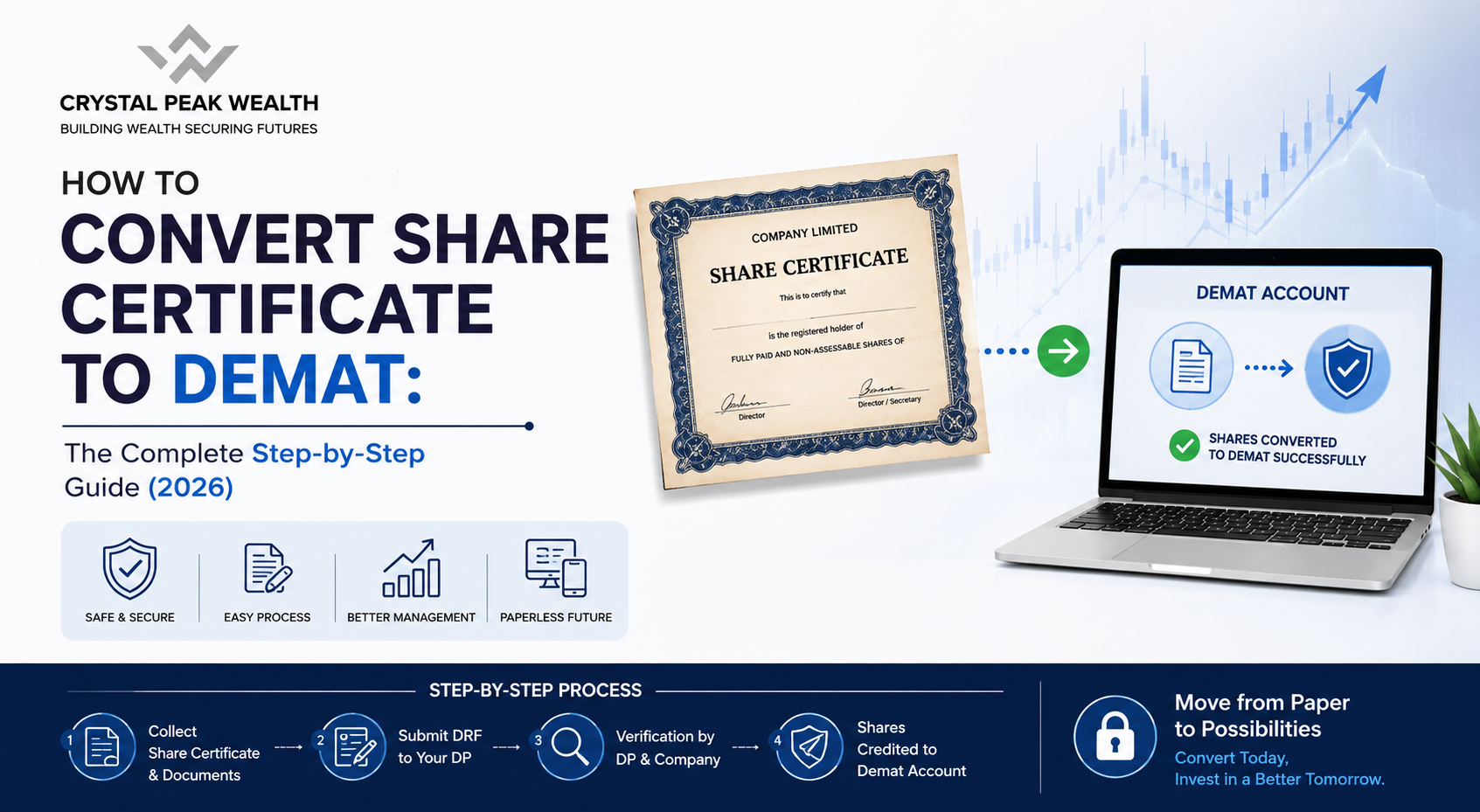
If you’ve inherited a stack of physical share certificates from a parent or grandparent, or discovered old paper shares tucked away in a locker, you’re not alone. Millions of Indian investors still hold physical equity — and every year, more of them search for how to convert share certificate to demat so they can actually access, trade, or transfer their wealth.
This guide walks you through every single step of the process. From gathering your documents to getting RTA approval to finally seeing your shares reflect in your demat account — we’ve covered it all. We’ve also dedicated an entire section to why demat requests get rejected, because that’s the part most guides skip, and it’s where most investors get stuck.
What Is Dematerialisation — and Why Does It Matter?
Before diving into how to convert share certificate to demat, it helps to understand what dematerialisation actually means. Dematerialisation (or demat) is the process of converting your physical paper share certificates into an electronic form held in a demat account with either NSDL or CDSL — India’s two central depositories.
Once dematerialised:
- Your shares are held securely in digital form
- You can sell, pledge, or transfer them within days
- You’re protected against physical loss, theft, or deterioration of paper certificates
- You become eligible to receive dividends, bonuses, and rights issues directly
SEBI has made it increasingly clear that the future of equity in India is fully digital. The sooner you learn how to convert share certificate to demat, the sooner you protect what’s rightfully yours.
Who Needs to Convert Share Certificates to Demat?
The need to learn how to convert share certificate to demat is more common than most people think. You may need this process if you:
- Inherited physical shares from a deceased family member
- Found old share certificates from companies you or your family invested in decades ago
- Received shares as part of an employee stock option plan (ESOP) in paper form
- Were gifted shares in physical form
- Hold shares in companies that have since merged, been acquired, or changed their name
In all of these cases, the share certificate to demat conversion process is the only legitimate route to turning paper into tradeable, liquid wealth.
Step-by-Step: How to Convert Share Certificate to Demat
Here is the complete, accurate process for how to convert share certificate to demat in India as it stands in 2026.
Step 1: Open a Demat Account (If You Don’t Already Have One)
The first step in how to convert share certificate to demat is having a demat account. You can open one with any SEBI-registered Depository Participant (DP) — this could be your existing broker like Zerodha, HDFC Securities, ICICI Direct, or a bank-backed DP.
When opening the account, make sure the name on your demat account exactly matches the name on the physical share certificate. This is a critical point and one of the top reasons for rejection — we’ll come back to this.
You’ll need:
- PAN card
- Aadhaar card
- Bank account details (cancelled cheque)
- Passport-size photograph
Step 2: Fill the Dematerialisation Request Form (DRF)
Once your demat account is active, ask your DP for the Dematerialisation Request Form (DRF). This is the official form that initiates the share certificate to demat conversion request.
Fill in:
- Your DP ID and client ID
- Company name and ISIN number of the shares
- Number of shares and certificate numbers
- Signature (matching the one on the share certificate and your bank records)
Make sure you defacing the physical certificates by writing “Surrendered for Dematerialisation” across each certificate before submission. This prevents misuse.
Step 3: Submit the DRF and Certificates to Your DP
Once you know how to convert share certificate to demat, the next step is submitting the DRF along with the original physical certificates to your Depository Participant. Keep a photocopy of everything you submit.
Your DP will:
- Verify the completeness of your submission
- Generate a Dematerialisation Request Number (DRN)
- Forward the request electronically to the relevant depository (NSDL or CDSL)
- Send the physical certificates to the Company’s Registrar and Transfer Agent (RTA)
Step 4: RTA Verification and Approval
This is the most critical — and often the most delayed — stage of how to convert share certificate to demat. The Registrar and Transfer Agent (RTA) is the intermediary appointed by the company to maintain shareholder records.
The RTA will:
- Cross-verify the certificate details against the company’s records
- Check for authenticity of the physical certificates
- Confirm the name, address, and signature match
- Verify that the shares are not pledged, frozen, or under dispute
If everything checks out, the RTA approves the dematerialisation request and notifies the depository. The shares are then credited to your demat account — typically within 15 to 30 working days after submission.
Step 5: Confirm Credit to Your Demat Account
Once RTA approval comes through, log into your demat account (via your broker’s portal or the CDSL/NSDL app) and verify that the shares have been credited in the correct quantity. If you notice any discrepancy, raise it with your DP immediately.
And that’s the complete process for how to convert share certificate to demat!
Documents Required to Convert Share Certificate to Demat
Getting the documents right is half the battle in learning how to convert share certificate to demat. Here’s the complete checklist:
Mandatory documents:
- Original physical share certificates (defaced with “Surrendered for Dematerialisation”)
- Duly filled and signed Dematerialisation Request Form (DRF)
- Self-attested copy of PAN card
- Self-attested copy of Aadhaar card or other address proof
- Cancelled cheque (for demat account verification)
For inherited / transmitted shares, additional documents include:
- Death certificate of the deceased holder
- Succession certificate or probate of will
- Legal heir certificate (if no nominee)
- Transmission request form (TRF) — separate from the DRF
If any of these are missing, your request for how to convert share certificate to demat will be returned or rejected.
Physical Share Verification: What the RTA Actually Checks
One reason people struggle with how to convert share certificate to demat is that they don’t understand what happens during the RTA verification stage. It’s not just a rubber stamp — the RTA conducts a detailed physical share verification that includes:
1. Certificate Authenticity Check
The RTA checks the certificate number, folio number, and distinctive numbers against the company’s original issuance records. Counterfeit or duplicate certificates will be flagged immediately.
2. Shareholder Name Matching
The name on the certificate must match the name in the company’s shareholder register AND the name on your demat account. Even minor discrepancies — like “Ramesh Kumar” vs “R. Kumar” — can trigger a rejection.
3. Signature Verification
Your signature on the DRF is matched against your existing signature in the company’s records. This is where many requests break down. If you’ve changed your signature over the years, or if the original holder is deceased, the signature mismatch must be resolved before the RTA can approve the request.
4. Lien / Lock-in Check
The RTA verifies that the shares are not under any lien (pledged against a loan), under court order, or in a lock-in period. If they are, the dematerialisation cannot proceed until the restriction is lifted.
Why Demat Requests Get Rejected — and How to Avoid It
This is the section most people searching for how to convert share certificate to demat actually need. Rejection is extremely common, and it almost always comes down to one of three issues.
Reason 1: Signature Mismatch
The signature on your DRF doesn’t match the signature the RTA has on file — typically the signature from when the shares were originally purchased. This could be because:
- You’ve changed your signature over decades
- The original shareholder is deceased and a legal heir is signing
- The handwriting was inconsistent on the original forms
How to resolve it: You may need to submit a banker’s attestation of your signature, or a notarised affidavit confirming the change in signature. In complex cases, especially for deceased shareholders, a legal indemnity bond is required.
Reason 2: Name Mismatch
Name mismatch is one of the most frustrating blockers when learning how to convert share certificate to demat. It occurs when:
- The name on the certificate is abbreviated or misspelled
- The shareholder changed their name after marriage or by deed poll
- The demat account is in a different name format than the certificate
How to resolve it: Submit a name change affidavit, gazette notification of name change, or marriage certificate — depending on the specific scenario. In cases involving inherited shares where the original holder’s name differs from the legal heir’s, additional succession documents are needed.
Reason 3: Missing or Incomplete Documents
Many rejections in the how to convert share certificate to demat process happen because supporting documents are missing. Common gaps include:
- PAN card not linked
- Incomplete DRF (unsigned, undated, or missing fields)
- No transmission documents for inherited shares
- Missing bank details
How to resolve it: Carefully audit your submission against your DP’s checklist before submitting. If a rejection has already occurred, gather the missing documents and resubmit — but be aware that some DP charges apply on resubmission.
Reason 4: Lost or Damaged Certificates
If the physical certificate itself is lost, damaged, or destroyed, you cannot directly proceed with the standard how to convert share certificate to demat process. You’ll first need to apply for a duplicate share certificate through the company’s RTA — a process that involves filing an FIR, placing a newspaper advertisement, and submitting an indemnity bond.
Only after receiving a duplicate share certificate can you begin the dematerialisation process.
Special Cases in Share Certificate to Demat Conversion
Converting Shares of a Deceased Holder
This is the scenario where most families get stuck when trying to understand how to convert share certificate to demat. When the original shareholder has passed away, the process becomes the Transmission of Shares — a legally distinct process.
You’ll need:
- Death certificate
- Succession certificate / probate / legal heir certificate
- Transmission Request Form (TRF)
- KYC of the legal heir
- Indemnity bond in some cases
Once transmission is complete, the shares are transferred to the legal heir’s name in the company’s records — after which, the normal how to convert share certificate to demat process can proceed.
Shares of Companies That No Longer Exist
If the company whose shares you hold has been wound up, merged, or de-listed, the process changes significantly. In many such cases, the shares may have been transferred to the IEPF (Investor Education and Protection Fund). You’ll need to file an IEPF claim to recover them before dematerialisation is possible.
Old or Pre-1996 Share Certificates
Shares issued before the advent of demat in India (pre-1996) can still be dematerialised — but the physical share verification process is more stringent. The RTA will cross-check against older paper registers, and the process may take longer.
How Long Does It Take to Convert Share Certificate to Demat?
Once you understand how to convert share certificate to demat, you naturally want to know how long it takes. Here’s a realistic timeline:
Stage | Typical Duration |
Demat account opening | 1–3 working days |
DRF filling and submission | 1 day |
DP processing and forwarding to RTA | 3–5 working days |
RTA physical share verification | 10–21 working days |
Credit to demat account after approval | 2–3 working days |
Total (clean case) | 15–30 working days |
Cases involving name mismatch, signature mismatch, missing documents, or deceased holders can take significantly longer — sometimes 3 to 6 months — without expert assistance.
Common Mistakes to Avoid When Converting Share Certificate to Demat
After years of handling demat conversions, here are the top mistakes investors make when figuring out how to convert share certificate to demat:
- Not defacing the certificates before submission — always write “Surrendered for Dematerialisation” across each certificate
- Submitting photocopies instead of originals — RTAs require original certificates
- Signature on DRF not matching registered signature — always check before signing
- ISIN number errors on the DRF — double-check the ISIN against NSE/BSE listings
- Ignoring company name changes — if the company has rebranded or merged, the ISIN may have changed
- Not following up — demat requests can get stuck at the RTA for weeks without a follow-up from the DP
SEBI’s 2024 Mandate and What It Means for Physical Share Holders
SEBI has been progressively tightening rules around physical shares. From 2019, transfer of physical shares was stopped entirely — you can only transmit (not sell or gift) physical shares now. To trade your shares, you must complete the how to convert share certificate to demat process.
In 2024, SEBI further emphasised the need for investors to dematerialise their holdings, particularly for shares in listed companies. Holding physical certificates of listed companies is now a serious limitation — you cannot participate in buybacks, open offers, or rights issues without a demat account with the shares properly credited.
The message is clear: the time to act on how to convert share certificate to demat is now.
Frequently Asked Questions
Q1. Can I convert share certificate to demat on my own without a broker? You’ll need a Depository Participant (DP) — which is typically your broker or bank. You cannot submit the DRF directly to the RTA. However, a specialist firm like Crystal Peak Wealth can manage the entire process on your behalf.
Q2. What if the share certificate has multiple holders? All holders must sign the DRF. The demat account must also be in all the same names and in the same order as mentioned on the share certificate.
Q3. Is there a fee for converting share certificate to demat? Yes, DPs typically charge a per-certificate dematerialisation fee ranging from ₹25 to ₹150. Some may charge courier and processing fees additionally.
Q4. Can shares be dematerialised if the company is unlisted? Yes, but only if the company has assigned an ISIN. Many unlisted public companies have ISINs and their shares can be dematerialised through NSDL or CDSL-registered DPs.
Q5. What happens if my demat request is rejected by the RTA? The RTA sends a rejection memo detailing the reason. You’ll need to resolve the issue (signature mismatch, document gap, etc.) and resubmit. This is where expert assistance can save significant time and money.
Q6. How do I track the status of my demat request? Your DP will give you a DRN (Dematerialisation Request Number). You can track the status through your DP’s portal or by calling their customer service.
Why Most Families Get Stuck — and How Crystal Peak Wealth Solves It
Understanding how to convert share certificate to demat in theory is very different from executing it successfully. The reality for most families — especially those dealing with inherited shares or old certificates — is that the process hits multiple roadblocks:
- Signature mismatch from the original holder
- Name discrepancies between the certificate and demat account
- Missing succession documents for deceased shareholders
- Shares lying unclaimed in IEPF or suspense accounts
- Companies that have merged or changed names
Each of these requires navigating regulatory frameworks, coordinating with RTAs, filing affidavits, and sometimes appearing before authorities. Without experience, this can take years.
Crystal Peak Wealth was built to solve exactly this problem. With 20+ years of average professional experience across the team and over 170 families helped, they specialise in the end-to-end execution of share dematerialisation — including the hard cases.
Their services include:
- Physical share dematerialisation
- Transmission of shares (for deceased holders)
- Duplicate share certificate recovery
- IEPF claims for unclaimed dividends and shares
- Name deletion and name correction
- Signature mismatch resolution
They are trusted by 2,400+ clients across India, and every piece of paperwork is handled with SEBI-registered third-party oversight.
Ready to Convert Your Share Certificate to Demat? Let the Experts Handle It.
If you’ve been putting off the how to convert share certificate to demat process because it feels overwhelming, you’re not alone — and you don’t have to figure it out alone.
Crystal Peak Wealth offers a free expert consultation where they’ll assess your certificates, identify any potential roadblocks, and lay out a clear path to getting your shares safely dematerialised.
📞 Call or WhatsApp: +91 98200 06665 📧 Email: info@crystalpeakwealth.com 🌐 Website: crystalpeakwealth.com 📍 Office: 3rd Floor, Oberoi Commerz 2, Goregaon East, Mumbai – 400063
👉 Schedule Your Free Expert Call Today →
Don’t let your family’s wealth sit locked in paper. Convert your share certificate to demat — and let Crystal Peak Wealth make it simple, legal, and stress-free.
Summary: How to Convert Share Certificate to Demat — Quick Recap
To wrap up, here are the key steps to convert share certificate to demat:
- Open a demat account with a registered DP
- Fill the Dematerialisation Request Form (DRF)
- Deface original certificates and submit with DRF to DP
- DP forwards request and certificates to the RTA
- RTA conducts physical share verification and approves the request
- Shares get credited to your demat account
Avoid rejection by ensuring no signature mismatch, name mismatch, or missing documents. For complex cases — inherited shares, lost certificates, IEPF claims — get expert help from Crystal Peak Wealth.
This article is for informational purposes. For specific guidance on your share certificate to demat conversion, consult a SEBI-registered expert.