
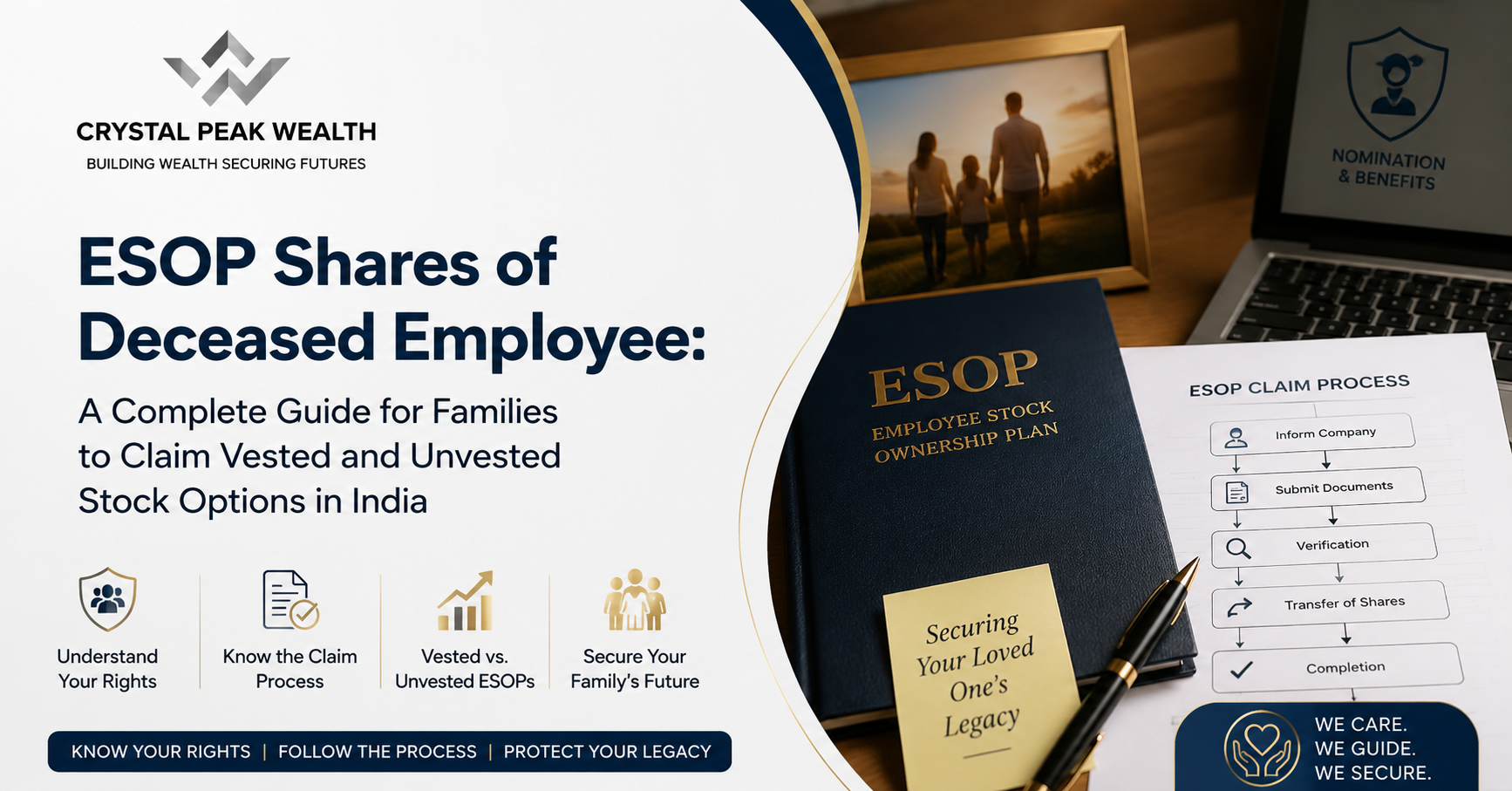
Why ESOP Claims After Death Are Becoming a Bigger Issue in India
For years, Employee Stock Ownership Plans (ESOPs) were treated as a side benefit — a nice-to-have that employees rarely thought about until they wanted to exercise their options. That has changed. As India’s IT and startup workforce has matured over the last two decades, a large number of employees now hold meaningful equity through ESOPs, often accumulated across multiple employers. When an employee passes away unexpectedly, their family is frequently left facing a confusing, opaque, and poorly documented process to claim the ESOP shares of deceased employee benefits that rightfully belong to them.
Unlike bank deposits or mutual funds, ESOPs sit in a strange middle ground between employment contracts and securities law. Companies rarely explain what happens to an employee’s stock options if they die, and HR departments — especially in fast-scaling startups — are often just as confused as the family about the correct procedure. This guide on ESOP shares of deceased employee claims is written specifically to help grieving families understand what happens to these holdings, how vested and unvested options are treated differently, who is legally entitled to claim them, and what documents and steps are required to complete the transmission.
If you are dealing with the ESOP shares of deceased employee situation right now, know that you are not alone — and that a legitimate, well-defined claim process almost always exists, even if the company has not proactively told you about it.
What Happens to ESOPs When an Employee Dies?
The treatment of ESOP shares of deceased employee holdings depends primarily on one distinction: whether the options were vested or unvested at the time of death. This single factor determines whether the family can claim the shares outright, whether they need to exercise the options within a limited window, or whether the options lapse entirely.
Most Indian companies structure their ESOP schemes under the SEBI (Share Based Employee Benefits and Sweat Equity) Regulations, 2021, for listed companies, or under the Companies Act, 2013 read with the Companies (Share Capital and Debentures) Rules, 2014, for private and unlisted companies. Both frameworks, along with the company’s own ESOP policy document (often called the ESOP Scheme or ESOP Trust Deed), typically contain a specific clause addressing death of the employee. This is the document your family’s advisor must review first when handling ESOP shares of deceased employee matters.
Vested ESOPs at the Time of Death
Vested options are those where the employee has already completed the required service period (the “vesting period”) and has earned the right to exercise the options — meaning they could have converted them into actual shares by paying the exercise price. Under nearly all standard ESOP policies in India, vested ESOPs of a deceased employee are not forfeited. Instead, the legal heirs, nominee, or executor of the estate typically has the right to exercise these options within a defined window (commonly 6 to 12 months from the date of death, though this varies by company).
This is one of the most important facts a family should know when researching ESOP shares of deceased employee rules: vested ESOP shares of deceased employee holdings generally survive the employee’s death and become an asset of the estate, transferable to the rightful heirs or nominee.
Unvested ESOPs at the Time of Death
This is where most confusion — and most disappointment — arises. Under the default position in most ESOP schemes, unvested options lapse immediately on the death of the employee, because the underlying condition (continued employment through the vesting period) can no longer be fulfilled. However, this is not universal. Many progressive companies, particularly larger IT firms and well-governed startups, have started inserting “accelerated vesting on death” clauses into their ESOP policies. These clauses may:
- Immediately vest all or a portion of the unvested options upon the employee’s death
- Pro-rate vesting based on time served during the current vesting tranche
- Leave the decision to the discretion of the company’s Nomination and Remuneration Committee (NRC) or ESOP Trust
Because this varies so significantly from company to company, any family dealing with ESOP shares of deceased employee questions must obtain a copy of the specific ESOP scheme document from the employer’s HR or company secretary — general assumptions about ESOP rules will not hold across every organization.
Vested vs. Unvested: A Quick Comparison
To summarize the default treatment of ESOP shares of deceased employee holdings before diving deeper, here is how the two categories generally compare:
Aspect | Vested ESOPs | Unvested ESOPs |
Default outcome on death | Survive, can be exercised by heirs/nominee | Usually lapse, unless scheme says otherwise |
Exercise window | Typically 6–12 months from death | Not applicable unless accelerated |
Who can act | Nominee, legal heirs, or executor | Depends entirely on company’s ESOP policy |
Key document to check | ESOP Grant Letter and Scheme | ESOP Scheme’s “death of employee” clause |
Common family mistake | Missing the exercise deadline | Assuming nothing can be done without checking |
This table is a useful starting point, but it is never a substitute for reading the actual ESOP shares of deceased employee scheme document issued by the specific company, since exact terms differ widely between employers.
Do Listed and Unlisted Companies Treat ESOP Deaths Differently?
Another layer of complexity in ESOP shares of deceased employee cases is whether the employer is a listed company, an unlisted public company, or a private startup.
Listed companies operating under SEBI’s Share Based Employee Benefits and Sweat Equity Regulations tend to have more standardized, well-documented ESOP schemes, often administered through a dedicated ESOP trust and a professional Registrar and Transfer Agent. Claims relating to ESOP shares of deceased employee situations at listed companies typically follow a more predictable, paper-trail-heavy process.
Unlisted and private companies, particularly early-stage and mid-stage startups, often have far less standardized documentation. ESOP pools may be managed informally by the founders or a small HR team, and the scheme document itself may lack clarity on death-related scenarios. In these cases, families pursuing an ESOP shares of deceased employee claim may need to rely more heavily on direct negotiation with the company’s leadership, alongside formal legal documentation of heirship, since there is often no dedicated administrator to guide the process.
Tax Implications on ESOP Shares of a Deceased Employee
Tax treatment is one of the most overlooked aspects of any ESOP shares of deceased employee claim, and it typically arises in two stages.
Stage 1: Exercise of Vested Options. When the nominee or legal heir exercises the deceased employee’s vested options, the difference between the Fair Market Value (FMV) of the shares on the exercise date and the exercise price paid is generally taxable as a “perquisite” in the hands of the estate or the claimant, similar to how it would have been taxed had the original employee exercised the options during their lifetime. This is a nuanced area, and tax treatment can vary depending on whether the exercise happens before or after formal transmission, so professional advice is strongly recommended.
Stage 2: Sale of Shares. Once the shares are transmitted and eventually sold, capital gains tax applies based on the holding period and the difference between the sale price and the FMV on the date of exercise (which becomes the cost basis). Long-term or short-term classification depends on how long the shares are held after exercise, not from the original grant date.
Because tax rules around ESOP shares of deceased employee transactions intersect employment income tax, estate/succession rules, and capital gains provisions, families are strongly encouraged to consult a qualified tax professional or wealth advisor before finalizing any exercise or sale decision.
What Companies Should — But Rarely — Do Proactively
Part of why the ESOP shares of deceased employee problem persists is that very few companies proactively reach out to a deceased employee’s family. Ideally, HR and company secretarial teams should:
- Maintain updated nomination records for every ESOP grant
- Reach out to the family within a reasonable period after being informed of an employee’s death
- Clearly communicate the applicable exercise window for vested options
- Provide a written explanation of how unvested options will be treated under the scheme
- Assign a single point of contact to guide the family through transmission
Until this becomes standard industry practice, the burden of initiating the ESOP shares of deceased employee claim will continue to fall on families — often at the worst possible time, while they are still grieving.
Why This Issue Is Growing in Relevance Across India
India’s technology and startup sector began scaling aggressively in the mid-2000s and accelerated further after 2015. Employees who joined early-stage startups in their late twenties and early thirties, and who received substantial ESOP grants, are now in their late thirties, forties, and fifties. As this workforce ages, the statistical likelihood of unexpected death — due to illness, accident, or other causes — naturally increases across a much larger base of ESOP holders.
At the same time, many of these employees never formally updated their nominee details, never informed their families about the existence or value of their vested ESOPs, and never left behind documentation explaining how to claim these benefits. The result is a growing number of cases where families of deceased employees are sitting on unclaimed or under-claimed equity worth lakhs or even crores of rupees, simply because nobody told them the ESOP shares of deceased employee claim process existed, or because the claim window quietly expired.
This trend mirrors what has already happened with unclaimed dividends, physical share certificates, and IEPF transfers in India — assets that sit dormant for years because families don’t know they exist or don’t know how to claim them. ESOPs are simply the newest addition to this category of “invisible inheritance.”
Who Can Claim ESOP Shares of a Deceased Employee?
Determining the rightful claimant is often the most legally sensitive part of handling ESOP shares of deceased employee matters, since the answer to “who can claim ESOP shares of deceased employee holdings” is rarely as simple as “the spouse” or “the eldest child.” There are generally three possible routes, depending on what documentation the deceased employee left behind.
1. The Registered Nominee
Most ESOP schemes require employees to file a nomination form at the time of grant, similar to nominations for bank accounts, PF, or insurance policies. If a valid nominee was registered with the company or the ESOP trust, this is usually the fastest and least contentious route. An ESOP nominee claim allows the nominee to step into the shoes of the deceased employee for the limited purpose of exercising vested options and receiving the resulting shares, without needing a succession certificate or probate in many cases — though company policies differ on this.
It’s worth noting that a nominee under company law does not automatically become the beneficial owner in the same way as under insurance law; in some cases, the nominee holds the shares as a trustee for the legal heirs until a formal succession document is furnished. Families should clarify this specific point with the company or their advisor before assuming the nominee has absolute ownership.
2. Legal Heirs (When No Nominee Exists)
When no valid nomination was filed — which is extremely common, especially at startups where onboarding paperwork is rushed — the ESOP shares of the deceased employee are claimed by the legal heirs as per succession law. This requires:
- A legal heir certificate or succession certificate from a competent court, or
- Letters of administration, or
- A registered will along with probate (where applicable), or
- In some cases, a notarized indemnity bond and affidavit accepted at the company’s discretion for smaller ESOP values
Because succession law in India varies by religion and personal law (Hindu Succession Act, Indian Succession Act, Muslim Personal Law, etc.), the exact list of legal heirs and their respective shares must be determined carefully before any claim is submitted.
3. The Executor of the Estate (Where a Will Exists)
If the deceased employee left a valid will naming an executor, the executor may be entitled to deal with the ESOP shares of deceased employee holdings on behalf of the estate, subject to obtaining probate where the will requires it (mandatory in some jurisdictions like Mumbai, Kolkata, and Chennai for wills of Hindus, Christians, and Parsis).
Step-by-Step Process to Claim ESOP Shares of a Deceased Employee
While every company’s internal process differs slightly, the general sequence for claiming ESOP shares of deceased employee benefits looks like this:
Step 1: Notify the Employer’s HR and Company Secretary
The first step is always formal written notification to the employer, typically addressed to HR and the Company Secretary or the ESOP Trust administrator, along with a certified copy of the death certificate.
Step 2: Request the ESOP Grant Letter and Scheme Document
Ask the company for the specific ESOP Grant Letter issued to the deceased employee, along with the governing ESOP Scheme document. This will confirm the number of options granted, vested, and unvested, the exercise price, and the specific clause dealing with death of the employee.
Step 3: Establish Claimant Status
Depending on whether a nominee was registered, gather the appropriate documents — nomination form copy, succession certificate, legal heir certificate, or probated will — to establish who is entitled to claim the ESOP shares of deceased employee holdings.
Step 4: Exercise the Vested Options Within the Window
Most companies impose a strict exercise window (commonly 6–12 months from date of death) for vested options. Missing this window can result in forfeiture, so this step should not be delayed. The claimant will typically need to pay the exercise price to convert options into actual shares.
Step 5: Complete Transmission of Shares
Once options are exercised, the resulting shares must be transmitted into the name of the nominee or legal heirs through the company’s Registrar and Transfer Agent (RTA). This is similar in spirit to the transmission of ESOP after death process used for other securities, and typically requires a Transmission Request Form (TRF), KYC documents of the claimant, PAN, bank details, and a demat account in the claimant’s name.
Step 6: Address Unvested Options Separately
If the company’s policy provides for accelerated or pro-rata vesting of unvested ESOP death of employee cases, a separate claim and calculation will need to be raised with the NRC or ESOP administrator, since these options do not follow the standard exercise timeline of already-vested grants.
Step 7: Update Tax and Compliance Records
Any income arising on exercise (treated as “perquisite” income) and subsequent capital gains on eventual sale must be reported correctly in the estate’s or heir’s income tax filings. This step is frequently overlooked and can create compliance issues years later.
Common Documents Required
When families begin the process to claim deceased employee stock options — that is, to formally claim ESOP shares of deceased employee holdings — they should be prepared to submit most or all of the following:
- Original or certified copy of the death certificate
- ESOP Grant Letter(s) and Scheme document
- Nomination form (if filed) or succession certificate/legal heir certificate/probated will
- PAN card and Aadhaar of the claimant(s)
- Demat account details of the claimant
- Bank account details for any exercise price payment or refund
- Indemnity bond/affidavit (as required by company policy)
- No Objection Certificate from other legal heirs, where applicable
Pain Points Families Commonly Face
Based on patterns seen across India’s IT and startup sector, families dealing with ESOP shares of deceased employee situations repeatedly encounter the same set of problems, and understanding these pain points around ESOP shares of deceased employee claims early can save months of delay:
- Not knowing the options exist at all. Many employees never discuss their equity compensation with family members, and vesting statements often live only in a company portal the family cannot access.
- Confusion over vested vs. unvested treatment. Families frequently assume all ESOPs are simply lost on death, when in fact vested options usually remain claimable.
- Missed exercise windows. Because companies rarely proactively reach out, families can lose valuable vested options simply by not acting within the 6–12 month exercise deadline.
- No registered nominee. Without a nominee, the family must pursue a legal heir certificate or succession certificate — a court process that can take months.
- Lack of company transparency. HR teams at smaller companies or startups are often unfamiliar with the correct procedure themselves, leaving families to figure out the process largely on their own.
- Valuation and tax confusion. Families rarely understand how the exercise price, fair market value, and subsequent capital gains tax will apply to the eventual sale of shares.
These pain points are precisely why professional guidance matters — the ESOP shares of deceased employee claim process touches employment law, securities regulations, succession law, and taxation simultaneously, and a misstep in any one area can delay or jeopardize the claim.
How CrystalPeakWealth.com Can Help
At CrystalPeakWealth.com, we specialize in helping Indian families untangle exactly these kinds of dormant and complex asset claims — from physical shares and unclaimed dividends to IEPF transfers and, increasingly, ESOP shares of deceased employees. Our team works directly with companies, RTAs, and legal channels to identify what is owed, determine the correct claimant route (nominee, legal heir, or executor), compile the required documentation, and pursue the claim to completion.
If your family is trying to determine whether a loved one held vested or unvested stock options, or you’ve already started the process and hit a wall with HR or the company’s ESOP administrator, reach out to CrystalPeakWealth.com today for a consultation. We’ll review the ESOP scheme document, map out the exact claim path available to you, and help you recover what rightfully belongs to your family — without the guesswork.
Frequently Asked Questions
Q1. Do all ESOP shares of a deceased employee automatically pass to the legal heirs? Not automatically. Vested options generally can be claimed by the nominee or legal heirs, but this requires a formal claim process with the company — it doesn’t happen without action being taken.
Q2. What happens to unvested ESOPs when an employee dies? By default, unvested options usually lapse on death. However, many companies now include accelerated or pro-rata vesting clauses for such cases, so the specific ESOP scheme document must be checked.
Q3. Is a nominee automatically the full owner of the ESOP shares? Not always. In many schemes, the nominee receives the shares as a trustee for the legal heirs unless the company’s policy explicitly grants absolute ownership to the nominee.
Q4. How long do families have to exercise vested options after an employee’s death? This varies by company but is commonly between 6 and 12 months from the date of death, as specified in the ESOP scheme document.
Q5. What if the deceased employee never registered a nominee? The family will need to obtain a legal heir certificate, succession certificate, or probated will, depending on the value involved and the personal law applicable, before the company will process the claim.
Q6. Can CrystalPeakWealth.com help even if the company is unresponsive? Yes. We routinely help families navigate unresponsive HR departments and ESOP administrators by escalating through the correct regulatory and legal channels.
Conclusion
Claiming ESOP shares of deceased employee benefits is a process every family should understand well before they ever need it. As this guide has shown, the process of claiming these benefits is rarely straightforward, but it is almost always possible when approached correctly. Understanding the distinction between vested and unvested options, identifying the correct claimant — whether through an ESOP nominee claim, legal heirship, or an executor’s authority — and moving quickly within the company’s exercise window are the three factors that most determine whether a family successfully recovers this asset.
As India’s startup and IT workforce continues to age, more families will face this exact situation in the years ahead. If you believe your family may be entitled to unclaimed vested or unvested stock options belonging to a deceased loved one, don’t leave this asset unclaimed.
Contact CrystalPeakWealth.com today to get expert help navigating the transmission of ESOP shares, unclaimed dividends, and other dormant financial assets — and secure what belongs to your family.