
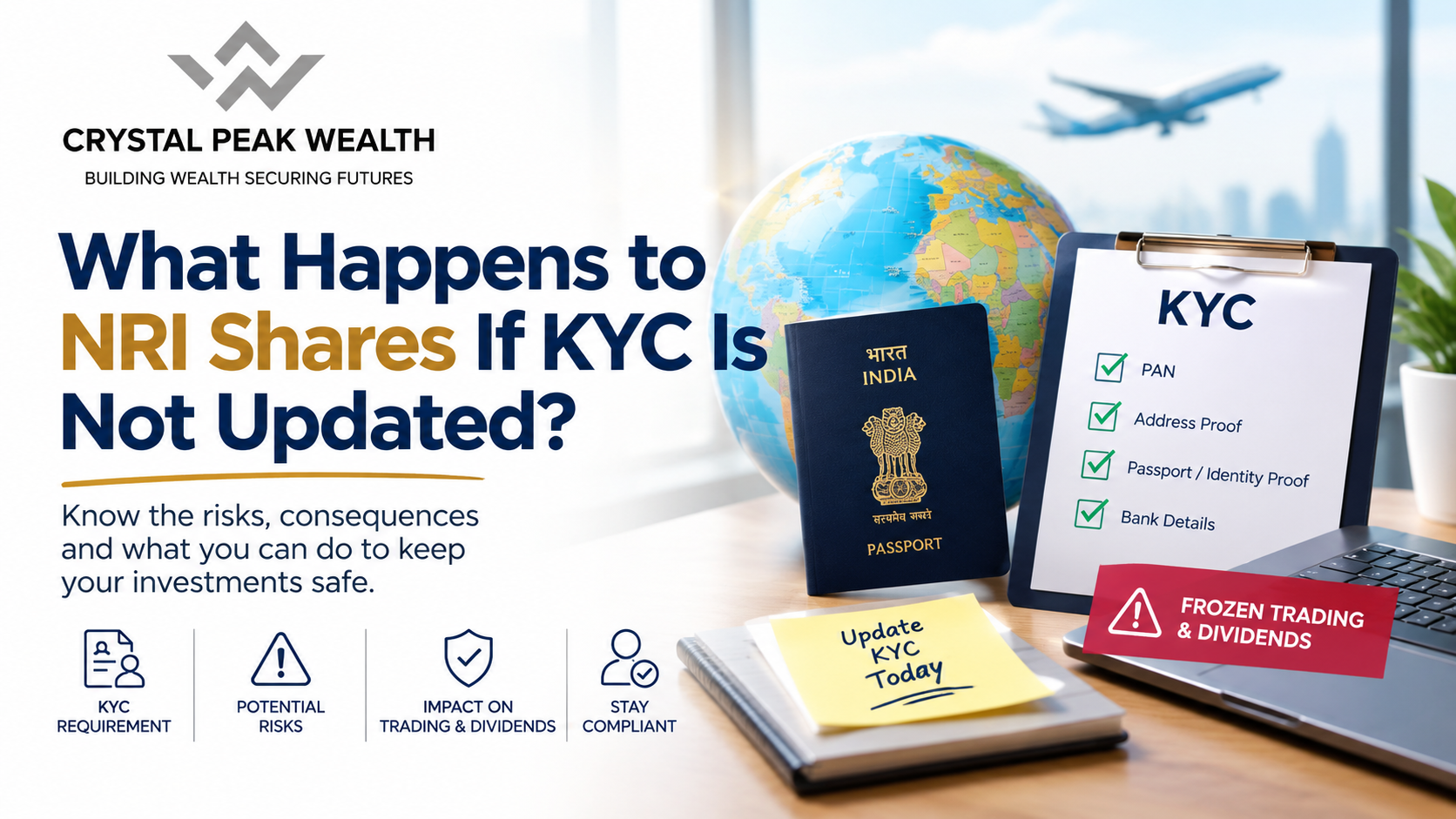
If an NRI’s KYC details go stale, three things can follow. A demat account can be suspended for debit and credit, dividends stop reaching you, and once a dividend stays unclaimed for seven consecutive years, the shares themselves can be moved to the Investor Education and Protection Fund (IEPF). Your ownership is not wiped out, but getting access back needs a formal process, and that process is slower from abroad.
Picture a family holding shares worth ₹13.5 crore that nobody could touch for 19 years. There was no court order, no dispute and no fraud. The shareholder’s spouse simply lived in Kuala Lumpur and never came back to India to update a single record. That is the real answer to what happens to NRI shares if KYC is not updated: nothing dramatic at first, and then a lock that is far harder to open than anyone expects.
This guide explains how that lock forms, how to check whether your own holdings are at risk, and what the way back looks like, including the formal route to claim shares back from the Investor Education and Protection Fund once they have already been moved there.
A real case: ₹13.5 crore locked for 19 years
This is a case from our own files, with identifying details removed.
The shareholder’s spouse had been living in Kuala Lumpur for 19 years and never returned to India during that time. The holding was never touched. There were no KYC updates, no dividend claims and no change of address. By the time the family realised something was wrong, the shares were frozen and legally inaccessible. The holding was worth ₹13.5 crore.
Getting it back was a long, document-heavy exercise rather than a single form. Our team had to:
- Fly to Malaysia twice to complete the paperwork
- Get embassy attestations on multiple documents
- Arrange the company’s mandatory “in-person” online verification
It took 14 months of meticulous legal and compliance work. In the end, the dormant holding was recovered and fully transferred to its rightful owner.
For the family, it was not just money. It was a legacy restored. The uncomfortable part is how ordinary the cause was. Nobody did anything wrong. Nobody did anything at all, and that was enough.
“Frozen” can mean three different things
When people say “my shares are frozen”, they could be describing three separate situations. Each has its own trigger and its own fix, so working out which one you are dealing with is the first job. The wrong fix can cost months.
Situation | What triggers it | What you cannot do | How it is fixed |
Physical share folio with incomplete details | PAN, contact, bank or signature details missing with the company’s registrar (RTA) | Payments, including dividends, and some service requests can be held back | Submit the SEBI-prescribed ISR-1 form and supporting documents to the RTA |
Demat account with invalid KYC | KYC record fails validation at the KYC Registration Agency (KRA) | Debit and credit, because the depository suspends the account | Correct and re-validate the KYC through your depository participant |
Shares moved to the IEPF | Dividend unclaimed for seven consecutive years | Hold, sell or transfer the shares, which now sit in the IEPF Authority’s account | File a formal Form IEPF-5 claim and follow it through |
Physical folios
For paper certificates, SEBI once told registrars to freeze any folio missing PAN, KYC and nomination details. That rule has changed. In its circular of November 17, 2023 (SEBI/HO/MIRSD/POD-1/P/CIR/2023/181), SEBI removed the “freezing” wording and dropped the plan to refer such folios to authorities under the Benami and anti-money-laundering laws. The duty to furnish PAN and KYC details has not gone away, though. Without them, your folio cannot be served or paid normally. If you come across an older article that still says folios will be frozen and referred after December 31, 2025, it is out of date.
Demat accounts
For demat holdings, the depositories are actively enforcing KYC validation. The KRAs report PANs whose KYC records fail validation, and NSDL and CDSL then direct depository participants to freeze the linked demat accounts for both debit and credit. CDSL did this through its circular of May 14, 2026 (CDSL/OPS/DP/POLCY/2026/325). NSDL has issued similar circulars through the year, and the latest one we reviewed is dated August 21, 2026 (NSDL/POLICY/2026/0119). A lapsed Indian mobile number is a common way for an NRI to end up on such a list.
Shares moved to the IEPF
This is the most serious of the three, and it is where long-dormant holdings usually end up. The next section shows how the first two situations often lead to it.
How a missed KYC update turns into an IEPF transfer
The three situations frequently chain together. A typical sequence looks like this:
- The holder moves abroad. The address, bank account or mobile number held by the company or depository participant goes stale.
- A dividend is declared. It cannot be credited, or the warrant never arrives, so it sits in the company’s unpaid dividend account.
- Nobody claims it. Small dividends are easy to ignore, and the holder may not even know they exist.
- Seven consecutive years pass. Section 124 of the Companies Act, 2013 then requires the company to transfer the unclaimed dividend, and the shares it relates to, to the IEPF.
Transfers of shares to the IEPF began in October 2017, according to Business Standard’s reporting on IEPF data. The scale is now very large. A BusinessToday report puts the shares held by the IEPF Authority at roughly ₹89,004 crore across 1,671 listed companies as of November 2025. The government also told the Lok Sabha in July 2026 that about ₹9,000 crore sits in the fund as unclaimed dividends, as Outlook Money reported. Taken together, that is close to ₹1 lakh crore of investor money.
The rules require companies to notify shareholders before a transfer, but the notice goes to the last address on record. For an NRI, that is often the address they left years ago.
There is one reassuring fact. The IEPF is a custodian, not a confiscation. The shares can be claimed back, and there is no deadline for the claimant to do so.
Why NRIs are hit harder than resident investors
Resident investors can fix most of these problems with a visit to a branch. NRIs face a different set of obstacles:
- Indian mobile numbers lapse. KRAs validate the email and mobile on a KYC record. When neither validates, the status moves to “KYC On Hold”. SEBI has accepted validation of either one for NRIs, so keeping at least one of them live protects you. Confirm the current position with your KRA, because these relaxations have been time-bound.
- Old addresses. Dividend warrants, annual reports and IEPF transfer notices go to the address on record.
- Different identity documents. NRIs often rely on a passport or OCI card rather than Aadhaar, which can add cross-checks.
- Cross-border paperwork. Indemnity bonds and affidavits may need notarisation, an apostille or embassy attestation.
- Time zones and couriers. Every query and every dispatch takes longer.
- Family unaware. Spouses and children often do not know what is held where, so the paperwork sits in an old drawer.
How to check whether your shares are affected
You can do most of this check from abroad, in an afternoon.
- Check your KYC status. Enter your PAN on a KRA website such as CVL KRA. The status will read “Validated”, “Registered” or “On Hold”. If it is “On Hold”, validate your email or mobile number.
- Ask your depository participant about your demat account. Confirm whether it is active or suspended, and ask for a Client Master Report (CMR). You will need it for any claim.
- Trace any paper certificates. Identify the company’s registrar and your folio number, then ask whether PAN, bank and contact details are on file and when the last dividend was paid.
- Search the IEPF portal. Use the unclaimed shares and dividends search on iepf.gov.in with your name, PAN or folio number. Try every spelling and initial variation, because the database matches on the details as recorded.
- Read the company’s investor page. Listed companies publish unpaid dividend lists and notices of shares liable to move to the IEPF.
- Ask the family. Look for old certificates, annual reports, letters from registrars and dividend warrants. Ask a relative in India to check the post at your old address.
How to recover shares from abroad
Recovery has two stages. First, repair the cause. Then, if the shares have already moved, claim them back.
Stage one: fix the KYC trail. Validate your email and mobile with the KRA, update your details with your depository participant and, for physical folios, submit Form ISR-1 with supporting documents to the registrar.
Stage two: file the IEPF claim. If the search shows your shares sit with the IEPF Authority, the process runs like this:
- File Form IEPF-5 online on the MCA portal and note the Service Request Number (SRN).
- Print the form, sign it and send it with the indemnity bond and supporting documents to the company’s nodal officer.
- The company verifies your claim against its records and reports to the IEPF Authority.
- The Authority processes the claim and issues a sanction order.
- Shares are credited to your demat account, and any dividend amount is paid to your registered bank account.
NRIs should plan for a few extra steps. Documents may need notarisation, an apostille or embassy attestation. The portal sends OTPs to an Indian mobile number, so you may need a relative’s number. You will also need your demat CMR and NRE or NRO bank details. A power of attorney can help someone in India handle dispatch and follow-ups, but check with the company what it will accept. Our step-by-step guide for NRIs recovering shares from the IEPF lists the full document set.
How long it takes depends mostly on the company’s verification. Straightforward claims commonly take several months. The case above took 14. The same Lok Sabha reply reported that the IEPF Authority received 1,32,545 applications over two years and approved 75,417 of them. Those numbers show the route works, and they are also a reminder of why getting the paperwork right the first time matters.
When the shareholder is not the one acting
Sometimes the person who needs to act is a spouse, a child or a legal heir, because the holder is abroad, unwell or has passed away. If the registered holder has died, the shares must usually be transmitted into the heir’s name before an IEPF claim can be filed. The paperwork depends on whether a nominee was registered, and on whether a will, a succession certificate or a legal heir certificate is needed. Our guide to the documents needed to transmit shares to a nominee or legal heir covers both routes.
For joint holdings, the surviving holder generally leads, but each company has its own requirements, so ask the registrar early.
How to stop it happening again
Prevention costs almost nothing compared with recovery:
- Keep at least one valid email address, and ideally an Indian mobile number, linked to your KYC record.
- Check your KRA status once a year and set a calendar reminder.
- Update your address and bank details with your depository participant, registrars and fund houses after every move.
- Keep an NRO account active so dividends have somewhere to land.
- Register a nominee on every holding.
- Dematerialise any paper certificates you still hold.
- Claim even small dividends, because the seven-year clock does not care about the amount.
- Keep a one-page register of your holdings, with the company name, folio or DP ID, registrar and last dividend date, and share it with a trusted family member.
Sources referenced
- SEBI circular of November 17, 2023 (copy hosted by BSE)
- NSDL circular NSDL/POLICY/2026/0119, August 21, 2026
- CDSL communiqués and circulars, including CDSL/OPS/DP/POLCY/2026/325
- IEPF Authority portal
- Business Standard on IEPF share transfers
- BusinessToday on IEPF unclaimed shares
- Outlook Money on the Lok Sabha reply of July 27, 2026
- Outlook Money on SEBI’s NRI KYC relaxation
This article is general information, not legal or investment advice. Rules and circulars change, so confirm the current position with the relevant authority before you act.
Frequently asked questions
1. Can an NRI lose shares permanently if KYC is not updated?
No. A KYC lapse does not end your ownership. Your demat account can be suspended, dividends can go unpaid, and unclaimed holdings can be moved to the IEPF. In each case the shares can be recovered through the right process, and there is no deadline for the claimant to file an IEPF claim.
2. How long before unclaimed dividends lead to shares moving to the IEPF?
Seven consecutive years. If a dividend on a shareholding stays unpaid or unclaimed for that long, the company must transfer the dividend and the underlying shares to the IEPF under Section 124 of the Companies Act, 2013.
3. Can an NRI claim shares back from the IEPF without travelling to India?
In most cases, yes. The form is filed online, and the documents are notarised or attested abroad and couriered to the company’s nodal officer. Some companies also require a live online verification. You will need an Indian mobile number for OTPs, which is often a relative’s.
4. How do I know if my KYC status is “On Hold”?
Enter your PAN on a KRA website such as CVL KRA. If the status reads “On Hold”, it usually means your email or mobile number failed validation. Validating a working email or mobile number through the KRA or your intermediary normally restores the status.
5. How long does it take to recover frozen or IEPF-transferred shares?
Straightforward claims commonly take several months, depending mainly on how quickly the company verifies and forwards the claim. Complex cases take longer. A case from our files, involving cross-border attestations and a mandatory online verification, took 14 months.
Don’t wait 19 years to find out
If you are an NRI, or the family member managing an NRI’s investments in India, a short review today is far cheaper than a long recovery later. The Crystal Peak Wealth team can trace your holdings, repair the KYC trail and, where shares have already moved to the IEPF, follow the claim through to credit in your demat account. We are trusted by 2,400+ clients across India.
Schedule a free call with an expert or message us on WhatsApp at +91 98200 06665. You can also email info@crystalpeakwealth.com.
Know an NRI friend or family member who should double-check their shares? Send them this guide today.