
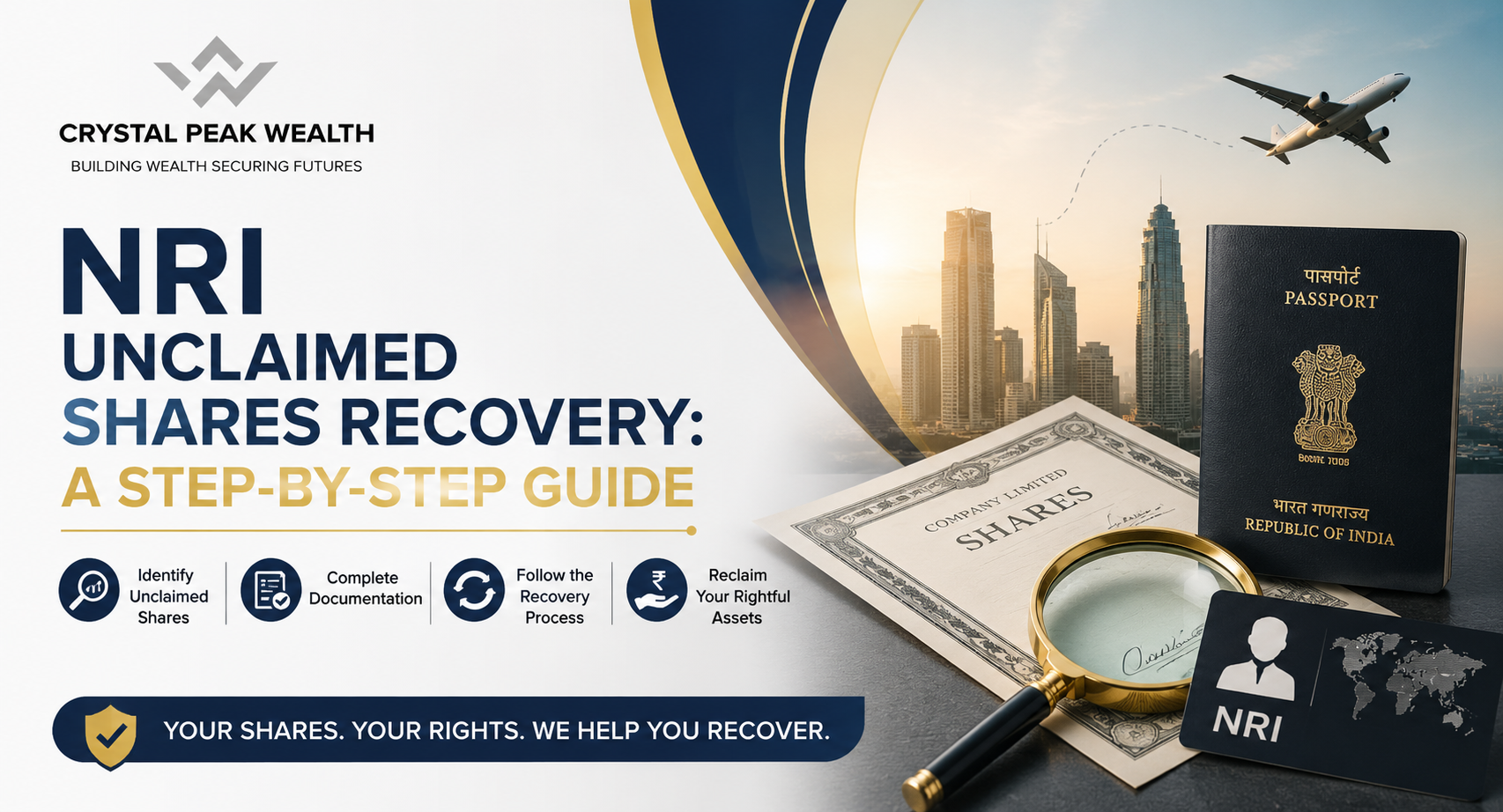
Billions in Forgotten Wealth Waiting to Be Reclaimed
If you are an NRI with parents, grandparents, or relatives who once invested in Indian equities, there is a real chance that unclaimed shares — worth lakhs or even crores — are sitting idle in company folios or locked inside the Investor Education and Protection Fund (IEPF), simply waiting to be recovered.
NRI unclaimed shares recovery is not just a legal right; for millions of overseas Indians, it is an urgent financial priority. India’s NRI diaspora is one of the largest in the world — over 32 million strong — and a significant portion holds forgotten, inherited, or dormant equity in Indian companies. The Government of India alone has transferred over ₹6,000 crore worth of shares to the IEPF in recent years, a large chunk of which belongs to NRIs who were simply unaware of the process or unable to navigate it from abroad.
This guide is your definitive resource on NRI unclaimed shares recovery. We will walk you through why shares go unclaimed, how the IEPF system works, what the step-by-step process looks like, how to handle a Power of Attorney, how to open an NRI demat account, and how to avoid the most common mistakes that cause claim rejections. By the end, you will know exactly how to pursue NRI unclaimed shares recovery with confidence — and when to bring in a specialist to handle it for you.
What Makes Shares “Unclaimed” in the First Place?
Before diving into the NRI unclaimed shares recovery process, it helps to understand how shares become unclaimed to begin with.
Inherited Shares from Deceased Family Members
The most common scenario: a parent, grandparent, or relative passed away holding physical share certificates or demat holdings. The shares were never transmitted to legal heirs. This is perhaps the most emotionally charged aspect of NRI unclaimed shares recovery — not only is there a financial loss, there is often a sense of unfulfilled duty to one’s family.
Dividends Left Uncollected for 7+ Years
When a shareholder does not claim dividends declared by a company for seven consecutive years, the company is legally required to transfer both those dividends and the underlying shares to the IEPF. Once transferred, NRI unclaimed shares recovery must happen through the IEPF’s formal claim process — which is significantly more involved than a simple bank withdrawal.
Change of Address and Outdated Contact Details
Many NRIs moved abroad years or decades ago. Old share certificates were registered at a family home address in India. Letters from registrar and transfer agents (RTAs) never reached the actual shareholder. Over time, the folio fell dormant, dividends remained uncollected, and the shares were eventually transferred to IEPF — making NRI unclaimed shares recovery necessary.
Physical Shares Never Converted to Demat
Shares purchased before 1996 exist as physical certificates — paper documents that may be sitting in a locker, a drawer, or may even be lost. These must first be dematerialized and then, if dividends were missed, the IEPF process also applies. NRI unclaimed shares recovery in such cases involves two parallel tracks: dematerialization and IEPF claim.
Understanding the IEPF: The Gateway to NRI Unclaimed Shares Recovery
The Investor Education and Protection Fund is a statutory body under the Ministry of Corporate Affairs. Under Section 124 of the Companies Act, 2013, companies must transfer unclaimed dividends to the IEPF after seven consecutive years of non-payment. Once those dividends are transferred, the corresponding shares are also compulsorily deposited into the IEPF Suspense Account.
NRI unclaimed shares recovery from the IEPF is governed by the IEPF (Accounting, Audit, Transfer and Refund) Rules, 2016, and subsequent amendments. The refund mechanism exists — but it is procedurally intensive, especially for NRIs who cannot be physically present in India.
Key facts every NRI must know:
- Form IEPF-5 is the official claim form, available on the MCA portal (www.iepf.gov.in)
- Claims must be submitted online; physical presence is not required for filing the form itself
- Supporting documents, however, must be sent physically to the company’s Nodal Officer
- The entire NRI unclaimed shares recovery process, from submission to refund, can take anywhere from 3 to 12 months depending on the company and completeness of documentation
Step-by-Step: How NRI Unclaimed Shares Recovery Works
Here is a detailed walkthrough of the NRI unclaimed shares recovery process, designed specifically with overseas investors in mind.
Step 1: Identify and Verify Your Unclaimed Holdings
The first step in any NRI unclaimed shares recovery journey is knowing what you have. You can check:
- IEPF Portal (iepf.gov.in) — enter the company name and shareholder name to see if shares have been transferred
- MCA21 Portal — for corporate filings and IEPF-specific data
- Company RTA databases — CAMS, KFintech, and Datamatics maintain folio-level records
- Physical share certificates — if you have old paper certificates at home in India, these confirm ownership even if the demat trail is broken
For inherited shares, you will also need to establish legal heirship — either through a Will, a succession certificate, or a legal heir certificate issued by the appropriate civil court or notary.
Step 2: Gather Your Documents
NRI unclaimed shares recovery documentation is more extensive than a standard claim because regulators need to verify both identity and NRI status. Here is what you typically need:
- Self-attested copies of PAN card (the deceased’s and claimant’s)
- Passport (valid) — mandatory for NRIs
- OCI / PIO card if applicable
- Proof of NRI status — bank statement from NRE/NRO account or foreign address proof
- Death certificate of original shareholder (for inherited claims)
- Legal heir or succession certificate
- Original share certificates (if physical)
- Cancelled cheque from NRO account (IEPF refunds go to NRO accounts)
- Indemnity bond on non-judicial stamp paper
- Affidavit verifying claim details, notarized as per IEPF rules
- Client Master List from your demat account (to receive shares post-recovery)
Missing even one of these documents is one of the top reasons why NRI unclaimed shares recovery claims get rejected or delayed. This is why professional assistance makes a significant difference.
Step 3: Open an NRI Demat Account
One of the prerequisites for NRI unclaimed shares recovery is having an active NRI demat account in India. The IEPF will only credit recovered shares to a demat account — they cannot be re-issued as physical certificates.
NRIs can open either:
- NRE Demat Account — for repatriable investments (earnings can be sent abroad freely)
- NRO Demat Account — for non-repatriable investments (including inherited shares, which are typically held under NRO)
For most NRI unclaimed shares recovery scenarios involving inheritance, an NRO demat account is the appropriate choice, since inherited Indian assets fall under non-repatriable categories by default (though exceptions exist under FEMA with proper documentation).
Opening the account requires:
- Passport and visa
- Overseas address proof
- PAN card
- NRE/NRO bank account details
- FATCA/CRS declaration (mandatory for NRIs)
This step is often underestimated in the NRI unclaimed shares recovery timeline. It can take 2 to 4 weeks if paperwork is submitted correctly, and longer if there are discrepancies.
Step 4: Set Up a Power of Attorney (POA) — And Do It Safely
One of the biggest pain points for NRIs in the NRI unclaimed shares recovery process is the physical paperwork that must be submitted in India. Since NRIs cannot always travel, a Power of Attorney (POA) is often the solution — but it comes with legitimate concerns about misuse.
Here is how to set up a safe, limited POA for NRI unclaimed shares recovery:
- a) Use a specific, limited POA — not a general one
A General POA grants sweeping powers over all your financial affairs. For NRI unclaimed shares recovery, you only need an authority to: collect documents, submit forms to the company’s Nodal Officer, and coordinate with RTAs. Limit the scope explicitly in the POA document. - b) Get it notarized in your country of residence
POAs executed abroad must be notarized by a Notary Public in the country of execution. They also typically require apostille attestation (if the country is a signatory to the Hague Convention) or consular attestation (if not). - c) Register it in India if required
Depending on the type of actions your representative will perform, the POA may need to be registered with the Sub-Registrar in India. For IEPF claims, a notarized and apostilled POA is usually sufficient, but check the specific company’s Nodal Officer requirements. - d) Work with a trusted firm
If you are engaging a professional service provider for NRI unclaimed shares recovery, ensure they are SEBI-registered (or work with SEBI-registered intermediaries), have a verified office address, and have a clear, documented engagement agreement. Crystal Peak Wealth, for example, operates with full transparency — your documents are always handled by SEBI-registered third parties, and all paperwork is tracked end-to-end.
Step 5: File Form IEPF-5
The IEPF-5 form is the official mechanism for NRI unclaimed shares recovery from the Fund. Here is how to navigate it:
- Go to www.iepf.gov.in and access the IEPF-5 form under “Claim Refund”
- Login using your PAN
- Select the company name, folio number, and the specific shares/dividends you are claiming
- Fill in demat account details (DP ID and Client ID)
- Provide NRO bank account details for dividend refund
- Upload required digital documents
- Submit the form and save the SRN (Service Request Number) — this is your tracking reference for the entire NRI unclaimed shares recovery process
One common mistake: NRIs sometimes enter the wrong year of dividend transfer or incorrect folio numbers, which triggers automatic rejection. Always cross-verify with company records or your service provider before submitting.
Step 6: Dispatch Physical Documents to the Nodal Officer
After online submission, you must print the completed IEPF-5 form and send the entire physical document packet to the company’s Nodal Officer (typically the Company Secretary or RTA). This is where NRI unclaimed shares recovery often hits a wall for overseas claimants — courier delays, incorrect addresses, and missing original documents can all cause setbacks.
Best practices:
- Use a trackable courier service (FedEx, DHL, Blue Dart)
- Include an index of all documents
- Send from India through your POA representative if possible
- Retain copies of everything
Step 7: Track Your Claim and Follow Up
Once the Nodal Officer receives your documents, they forward the verified claim to the IEPF Authority. The IEPF then processes the refund — shares are credited to your demat account and dividends to your NRO bank account.
NRI unclaimed shares recovery claims can be tracked on the MCA portal using your SRN. However, status updates are not always real-time. Professional service providers who maintain direct relationships with IEPF authorities and RTAs can significantly reduce delays and proactively flag any discrepancies.
Why NRI Unclaimed Shares Recovery Is More Complex Than Resident Indian Claims
Let us be direct: NRI unclaimed shares recovery carries additional layers of complexity that standard resident Indian claims do not face.
FEMA Compliance
All investments by NRIs are governed by the Foreign Exchange Management Act (FEMA). Inherited shares have specific rules around repatriation, and failure to comply can attract penalties. NRI unclaimed shares recovery must be structured in a FEMA-compliant way from the very beginning.
TDS on Dividends Received by NRIs
When dividends are credited to an NRO account as part of NRI unclaimed shares recovery, they are subject to TDS at 20% (plus surcharge and cess) under Section 195 of the Income Tax Act — unless a DTAA (Double Taxation Avoidance Agreement) between India and your country of residence provides a lower rate. An expert can help you apply for the correct TDS certificate.
Apostille and Consular Attestation Requirements
Documents executed outside India require specific attestation. Countries like the USA, UK, Canada, Australia, UAE, and Singapore have different attestation requirements. Getting this wrong means your NRI unclaimed shares recovery application is returned, adding months to the process.
Multiple Jurisdictions for Deceased Estates
When pursuing NRI unclaimed shares recovery for a deceased relative, especially if that relative was also an NRI, probate may be required in the country where the Will was made, as well as in India. Coordinating across jurisdictions is a legal and logistical challenge that requires experienced handling.
Common Mistakes That Derail NRI Unclaimed Shares Recovery
Learning from others’ errors is the fastest way to protect your claim. Here are the most common reasons NRI unclaimed shares recovery applications fail:
- Incorrect or incomplete IEPF-5 form — wrong company name, folio number, or ISIN
- Mismatch in name — slight spelling differences between the share certificate, PAN, and passport trigger rejections
- Missing succession certificate — for inherited claims, this is non-negotiable
- Wrong demat account type — submitting an NRE demat instead of NRO for inherited shares
- Expired or improperly attested POA — must be current and correctly apostilled
- Sending documents to the wrong Nodal Officer — companies change RTAs; always verify the current RTA before dispatching
- No follow-up after submission — claims can stall indefinitely without proactive tracking
Each of these mistakes can delay your NRI unclaimed shares recovery by months or even cause permanent rejection if deadlines are missed.
Timeline: How Long Does NRI Unclaimed Shares Recovery Take?
Here is a realistic timeline for NRI unclaimed shares recovery, assuming all documents are correctly prepared:
Stage | Estimated Time |
Document gathering & verification | 2–4 weeks |
NRI demat account opening | 2–4 weeks |
POA execution & attestation | 2–3 weeks |
IEPF-5 filing and SRN generation | 1–3 days |
Physical document dispatch | 1–2 weeks |
Nodal Officer verification | 4–8 weeks |
IEPF processing & credit | 6–12 weeks |
Total (typical) | 4–8 months |
With expert assistance, the overall NRI unclaimed shares recovery timeline can be compressed significantly — particularly at the document preparation, Nodal Officer coordination, and IEPF follow-up stages.
NRI Unclaimed Shares Recovery for Inherited Holdings: Special Considerations
Inheritance-related NRI unclaimed shares recovery deserves its own section because it involves an additional layer of legal process — establishing heirship.
If There Is a Valid Will
If the original shareholder left a registered Will naming you as a beneficiary, the process is relatively straightforward. You need a Probate (court-certified copy of the Will) or, for smaller amounts, a Letter of Administration or Succession Certificate.
If There Is No Will (Intestate Succession)
Without a Will, Indian succession laws apply. For Hindus, the Hindu Succession Act governs; for Muslims, Muslim Personal Law; for Christians, the Indian Succession Act. In most cases, a Succession Certificate from a Civil Court is required. This is a court process that can take 3–12 months in India, making early action on NRI unclaimed shares recovery critical.
Transmission Process Before IEPF Claim
If the shares are still in the company folio (not yet transferred to IEPF), you first need to apply for transmission of shares — formally registering the change of ownership from the deceased to the legal heir. Only after transmission can the shares be dematerialized. If the shares have already moved to IEPF, then IEPF-5 is the route.
Frequently Asked Questions About NRI Unclaimed Shares Recovery
Q1: Can I do NRI unclaimed shares recovery entirely from abroad without visiting India?
Yes, in most cases NRI unclaimed shares recovery can be completed without physically traveling to India. Online IEPF-5 filing and document dispatch through a POA representative make it possible. However, some courts for succession certificates do require personal appearance in India for the initial petition.
Q2: What if the share certificates are lost?
Lost certificates do not prevent NRI unclaimed shares recovery. You can apply for duplicate share certificates with the company’s RTA by submitting an FIR, indemnity bond, and affidavit. Crystal Peak Wealth handles lost share certificate recovery as a dedicated service.
Q3: How do I know if shares have been transferred to IEPF?
Visit iepf.gov.in and use the “Investor Education” search tool. You can search by company name or PAN. For a more thorough audit, especially for NRIs with multiple folios, a professional firm can run a comprehensive check across all IEPF databases.
Q4: Will I pay tax on the shares or dividends recovered?
Dividends credited as part of NRI unclaimed shares recovery are subject to TDS in India. Capital gains tax applies when you later sell the recovered shares — the holding period calculation begins from the original date of purchase, not the date of recovery.
Q5: What is the minimum value threshold for NRI unclaimed shares recovery?
There is no minimum value. Even a single share can be claimed from the IEPF. Given that many Indian blue-chip stocks have grown significantly in value, even “small” old holdings in companies like Infosys, Reliance, or TCS could be worth substantial amounts today.
Q6: Can NRI unclaimed shares recovery be done for shares in any company?
Yes, for any company listed on Indian stock exchanges whose dividends were transferred to IEPF. Unlisted company shares follow a different process.
Why Professional Help Is Worth It for NRI Unclaimed Shares Recovery
At its core, NRI unclaimed shares recovery is a right — but exercising that right is not simple. Between IEPF portals, RTAs, Nodal Officers, courts, FEMA regulations, and international document attestation, the paperwork alone is a full-time project. For an NRI managing professional responsibilities abroad while handling family matters in India, the cost of errors — in time, money, and stress — is genuinely high.
Professional firms like Crystal Peak Wealth specialize in exactly this. With 20+ years of average professional experience, a team that has handled 170+ families across India, and a track record of successful NRI unclaimed shares recovery cases, Crystal Peak Wealth offers:
- End-to-end case management from first eligibility check to final demat credit
- Document preparation and verification to prevent rejections
- Demat account assistance to ensure the right account type is used
- POA guidance so you stay in control without misuse risk
- Direct coordination with IEPF and RTAs for faster resolution
- SEBI-registered third-party handling of all sensitive paperwork
- Transparent communication with status updates at every milestone
The firm has recovered crores worth of physical equity for clients across India, including inherited holdings, dormant folios, and IEPF-transferred shares — all with zero paperwork stress for the client. As one client put it: “Banks gave me the runaround with endless paperwork, but nothing worked until I found Crystal Peak Wealth.”
Getting Started: Your First Step Toward NRI Unclaimed Shares Recovery
The longer you wait, the more complicated NRI unclaimed shares recovery can become. Companies change RTAs. Addresses become outdated. Court processes for succession take time. And the IEPF process itself requires current, valid documentation — which means documents that expire (passports, legal heir certificates) need to be valid at the time of filing.
The best time to start your NRI unclaimed shares recovery journey was when you first realized you had forgotten holdings. The second-best time is right now.
Ready to Recover What’s Rightfully Yours?
Crystal Peak Wealth is India’s trusted specialist in unclaimed investment recovery, IEPF claims, share dematerialization, and transmission of physical shares. Trusted by over 2,400 clients across India, with paperwork handled by SEBI-registered third parties and 20+ years of combined professional expertise, Crystal Peak Wealth makes NRI unclaimed shares recovery simple, safe, and stress-free.
📞 Call us: +91 98200 06665
📧 Email us: info@crystalpeakwealth.com
🌐 Visit: crystalpeakwealth.com/iepf-claim
📍 Office: 3rd Floor, Oberoi Commerz 2, Goregaon East, Mumbai – 400063
Schedule Your Free Expert Consultation Today →
Your shares waited patiently. Let us bring them home.
Disclaimer: This article is for informational purposes only and does not constitute legal, tax, or financial advice. NRI investors should consult a qualified professional for advice specific to their situation. All IEPF processes and timelines referenced are based on regulations current as of July 2026.