
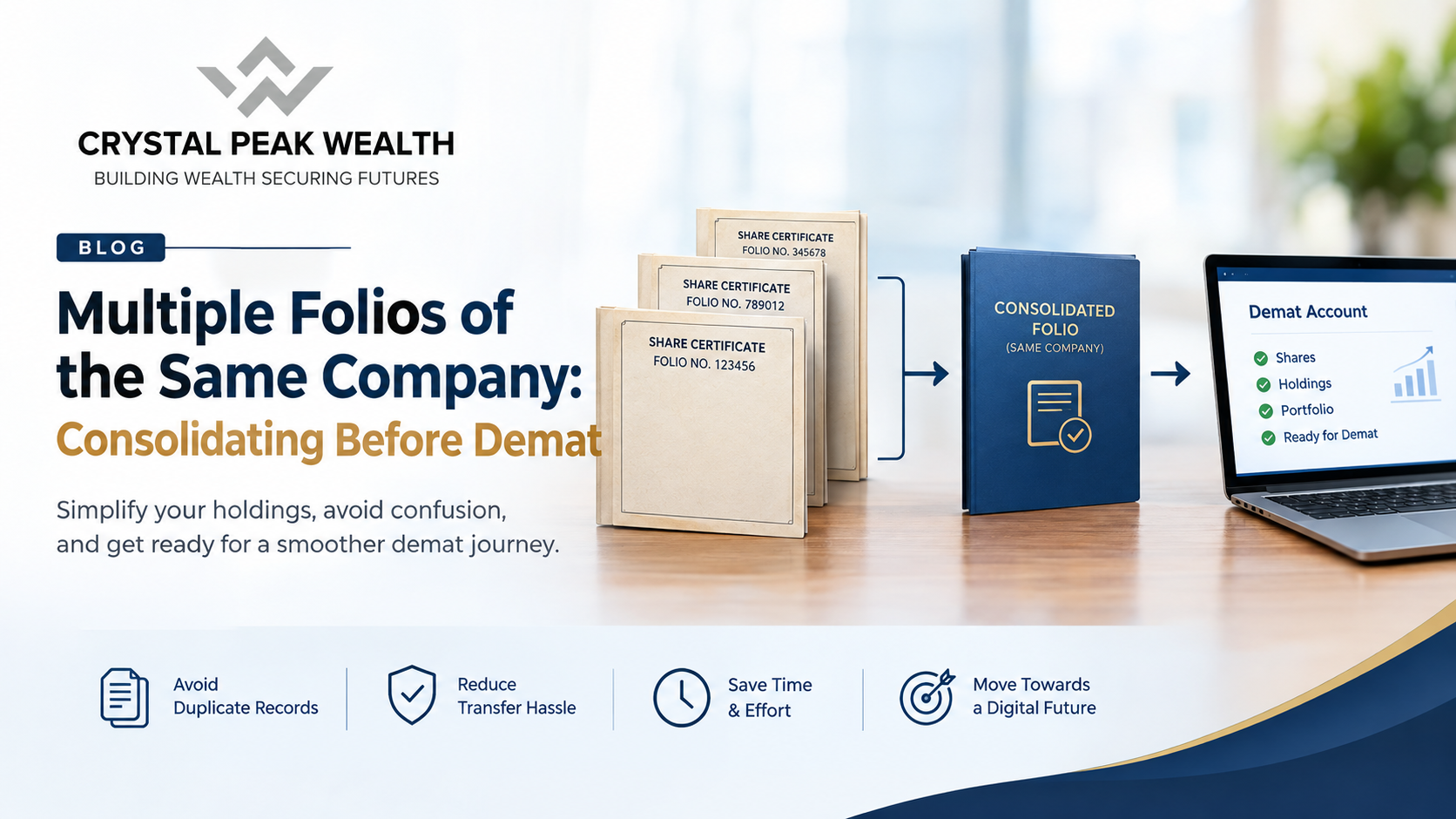
If you have inherited shares, invested over several years, or simply applied for shares using slightly different details each time, there is a good chance you own more than one folio in the same company. Before you can dematerialize these physical share certificates, you need to consolidate multiple folios into a single, clean holding. Skipping this step is one of the most common reasons investors get stuck midway through the dematerialization process, watching their requests sit unprocessed for weeks or even get rejected outright.
This guide walks you through why multiple folios exist, why you must consolidate multiple folios before you approach a Depository Participant, and exactly how to do it — from the documents you will need to the timelines you should expect.
What Are Multiple Folios, and Why Do They Happen?
A folio number is the unique account identifier a company’s Registrar and Transfer Agent (RTA) assigns to a shareholder when physical shares are first allotted or transferred. In theory, every shareholder should have one folio per company. In practice, it is extremely common for the same person to end up holding several folios in the same company, each representing a separate batch of physical share certificates.
This usually happens for a handful of predictable reasons. An investor might have bought shares at different points in time through different application forms, and each application created a fresh folio instead of being added to an existing one. Someone may have written their name slightly differently on separate occasions — “R. Sharma” on one form and “Ramesh Sharma” on another — and the RTA’s system treated these as two distinct shareholders. Address changes, spelling variations, and even the order of joint holder names can all result in a new folio being opened rather than an existing one being updated.
Inherited shares add another layer of complexity. If shares were transmitted from a parent or relative, the resulting folio may sit alongside folios the investor already holds independently, again in the same company. Over a couple of decades of investing, it is not unusual for a single shareholder to discover three, four, or even more folios attached to one company when they finally sit down and sort through their old certificates.
Consider a typical case: an investor bought 100 shares of a company in 1998 under the name “Suresh K. Rao,” then bought another 150 shares in 2006 after moving cities, this time filling in the form as “Suresh Kumar Rao” with a new address. A decade later, they inherited 200 more shares from a parent, transmitted into yet another folio. On paper, this is one person with a long-standing, genuine interest in the company — but on the RTA’s books, it looks like three unrelated shareholders holding three separate folios. This kind of scenario is far more common than most people expect, and it is precisely why folio consolidation exists as a formal process.
The problem only becomes visible when the investor decides to dematerialize their shares — that is, convert the physical certificates into an electronic form held in a demat account. This is exactly the point at which you need to consolidate multiple folios, because most Depository Participants and RTAs will not process a dematerialization request cleanly across scattered, mismatched folios.
Why You Must Consolidate Multiple Folios Before Demat
It is technically possible to dematerialize shares from separate folios one at a time, but doing so is inefficient, slower, and far more prone to rejection. There are several concrete reasons experienced investors and advisors recommend completing this consolidation before you even begin the demat request.
Name and signature mismatches trigger rejections. When folios were opened years apart, the name spelling, signature specimen, or even the father’s name recorded against each folio can differ slightly. RTAs cross-check every dematerialization request against their existing records, and inconsistencies across folios are a leading cause of requests being sent back for correction. Consolidating first lets you resolve these mismatches in one coordinated exercise rather than fighting the same battle multiple times.
A single demat account works best with a single, unified holding. Once you consolidate multiple folios, your entire shareholding in that company sits under one reference, which makes reconciliation, dividend tracking, and future corporate actions like bonus issues or rights issues far simpler to manage from your demat account.
It saves time and paperwork. Every separate folio submitted for dematerialization generally means a separate Dematerialization Request Form (DRF), separate share certificates to be couriered, and separate tracking with the RTA. When you consolidate multiple folios first, you cut this down to one clean set of paperwork instead of two, three, or more parallel processes.
It reduces the risk of certificates going missing or being misfiled. Physical share certificates that move through the post multiple times, across multiple requests, carry more risk of loss or delay. A single consolidated submission is simpler for both you and the RTA to track.
Future transactions become far easier. If you ever want to sell, gift, or transfer these shares after dematerialization, having a single demat holding avoids the confusion of figuring out which lot came from which original folio.
For all these reasons, the standard, recommended approach is to consolidate multiple folios first and only then submit the combined holding for dematerialization.
Step-by-Step Process to Consolidate Multiple Folios
Here is the practical sequence most investors follow when they decide to consolidate multiple folios of the same company before approaching their Depository Participant.
Step 1: Identify Every Folio You Hold in the Company
Start by gathering every physical share certificate you have for the company in question. Note down the folio number printed on each certificate, along with the number of shares, the distinctive numbers range, and the name exactly as it appears. This is the foundation of the exercise — you cannot consolidate multiple folios you have not first identified.
Step 2: Contact the Company’s Registrar and Transfer Agent (RTA)
Every listed company appoints an RTA (such as Link Intime, KFin Technologies, or a similar agency) to maintain its shareholder records. Reach out to the RTA and request the consolidation of folios — most RTAs have a specific application format for this. You will typically need to provide the list of folio numbers you wish to merge, along with the folio you want retained as the primary one.
Step 3: Submit a Letter of Request
The RTA will usually ask for a signed letter of request (sometimes called a folio consolidation request) listing all the folios involved and confirming that you are the same person or joint holders across each one. This letter is the formal instruction that tells the RTA to merge these folios into a single account.
Step 4: Attach Identity and Address Proof
To prove that all the folios genuinely belong to the same shareholder, RTAs typically require self-attested copies of PAN card, Aadhaar card, and a canceled cheque or bank proof. If the name varies slightly across folios, you may also need an affidavit or a name-difference declaration, notarized, to support your request to consolidate multiple folios without dispute.
Step 5: Submit Original Share Certificates (If Required)
Depending on the RTA’s process, you may be asked to submit the original share certificates from the folios that are being merged into the primary folio. Always send these by registered post or courier with tracking, and retain photocopies for your own records before you part with the originals.
Step 6: Wait for Confirmation from the RTA
Once the RTA verifies your documents and confirms that the details match, they will process the request and issue a confirmation that the folios have been consolidated. Only after you receive this confirmation should you proceed to the dematerialization step, since attempting to consolidate multiple folios and dematerialize simultaneously often causes delays.
Step 7: Proceed to Dematerialization
With a single, consolidated folio in hand, you can now submit one Dematerialization Request Form through your Depository Participant, attaching the (now consolidated) share certificate and a clean set of supporting documents. This is significantly faster and cleaner than trying to dematerialize multiple mismatched folios separately.
Documents Required to Consolidate Multiple Folios
Requirements can vary slightly by RTA, but in general, when you consolidate multiple folios of the same company, you should be ready with the following:
- Original share certificates for each folio being consolidated
- A signed letter or application requesting consolidation of folios, listing all folio numbers involved
- Self-attested copy of PAN card
- Self-attested copy of Aadhaar card or another government-issued address proof
- A canceled cheque leaf or recent bank statement for verification
- An affidavit or notarized declaration if there is a variation in name, spelling, or signature across folios
- Passport-size photographs, in some cases
- Proof of joint holding order, if the folios involve the same joint holders in different sequences
Keeping this documentation organized before you approach the RTA is one of the simplest ways to speed up the process. Investors who consolidate multiple folios with complete, consistent paperwork on the first attempt typically avoid the back-and-forth that stretches this process out over months.
It helps to make a simple checklist before you begin, ticking off each document against every folio individually rather than treating the paperwork as one bulk pile. RTAs frequently reject applications not because a document is missing altogether, but because it was only submitted against one folio when it needed to accompany each one. A little extra care with organizing your paperwork upfront can shave weeks off the overall timeline.
Common Challenges When You Consolidate Multiple Folios
Even with the right documents, a few recurring issues can slow down your attempt to merge these folios. Knowing about them in advance can save you significant time.
Name mismatches across records. As mentioned earlier, small variations in how your name appears — initials versus full names, maiden name versus married name, transliteration differences — are the single most common hurdle. Supporting these with a notarized affidavit usually resolves the issue.
Missing or damaged original certificates. If a certificate has been lost, torn, or is otherwise not presentable, you may need to first apply for a duplicate certificate before you can consolidate multiple folios, which adds extra time to the process.
Deceased or joint holders. If one of the folios includes a joint holder who has since passed away, transmission formalities usually need to be completed first, before the RTA will agree to consolidate multiple folios into a single, updated account.
Outdated address or contact details. RTAs will often want to confirm your identity through your registered address and contact details. If these are outdated across one or more folios, expect a request for an update before consolidation is approved.
Inconsistent RTA turnaround times. Different RTAs move at different speeds. Some can process a request to consolidate multiple folios within a couple of weeks, while others take considerably longer, particularly if the company has changed its RTA in the past and records need to be pulled from an older system.
Timeline and Costs Involved
There is no single, fixed timeline across every company, since it depends heavily on the RTA involved and how complete your documentation is. As a general guide, investors who consolidate multiple folios with clean, matching records can expect the RTA’s verification and confirmation to take anywhere from two to six weeks. Cases involving name mismatches, missing certificates, or transmission issues can take considerably longer, sometimes stretching to a few months. Working with an advisor who regularly liaises with RTAs can help you avoid unnecessary back-and-forth, since they typically know each RTA’s exact documentation preferences and can flag gaps before submission rather than after a rejection.
Most RTAs do not charge a separate fee simply to consolidate multiple folios, though you should budget for incidental costs such as notarization of affidavits, courier charges for sending original certificates by registered post, and any charges associated with obtaining a duplicate certificate if one is missing. Once the folios are consolidated and you move on to dematerialization, your Depository Participant may charge a nominal fee per certificate for the demat request itself.
Benefits of Consolidating Multiple Folios Before Demat
Taking the time to consolidate multiple folios before you dematerialize pays off in several concrete ways.
A cleaner, simpler demat account. Instead of tracking several small holdings that originated from different folios, your entire position in the company sits in one place, making it easier to review your portfolio at a glance.
Fewer errors in corporate action processing. Dividends, bonus shares, stock splits, and rights issues are processed against your demat holding. When this consolidation happens first, there is no risk of a corporate action being applied inconsistently across fragmented records.
Faster future transactions. Selling or transferring shares later becomes a single, straightforward transaction rather than a series of smaller ones drawn from different original folios.
Reduced risk of unclaimed shares or dividends. Fragmented folios are more likely to have outdated contact details on at least one of them, which increases the risk of dividends or shares eventually being transferred to the Investor Education and Protection Fund (IEPF) due to non-encashment. A consolidated folio with updated details is easier to keep track of.
A smoother experience if shares need to pass to heirs. Should these shares ever need to be transmitted to a nominee or legal heir, a single consolidated holding is far simpler to transfer than several scattered folios, each requiring its own transmission paperwork.
Better visibility for financial planning. When your holding in a company is split across several folios, it is easy to lose track of your true total exposure, especially if some certificates are older and easy to overlook. A single, consolidated position makes it much easier for you, or an advisor helping you plan, to see exactly where you stand.
How CrystalPeakWealth Can Help
Sorting through decades-old certificates, chasing an RTA for updates, and getting affidavits notarized can feel like a full-time job on top of your regular responsibilities. This is exactly where working with an experienced advisor makes a real difference. CrystalPeakWealth has helped numerous investors trace scattered folios, prepare accurate documentation, and follow through with RTAs until the consolidation is confirmed and the shares are safely dematerialized. Rather than juggling multiple RTA communications on your own, you get a single point of contact managing the entire process on your behalf, so nothing falls through the cracks and your shares end up correctly reflected in your demat account.
Frequently Asked Questions
Can I consolidate multiple folios if the names are spelled slightly differently? Yes, in most cases. You will likely need to submit a notarized affidavit or name-difference declaration confirming that all the folios belong to the same individual, along with your PAN and address proof.
Do I need to consolidate multiple folios before dematerializing, or can I dematerialize each folio separately? You can technically dematerialize folios separately, but it is far more time-consuming and increases the chance of rejected requests. Most RTAs and Depository Participants recommend completing this step first for a smoother, single dematerialization request.
How long does it take to consolidate multiple folios of the same company? It typically takes two to six weeks with complete, matching documentation, though cases involving name mismatches or transmission issues can take longer.
Is there a fee charged to consolidate multiple folios? Most RTAs do not charge a direct fee for consolidation itself, though you may incur costs for notarization, courier, or obtaining duplicate certificates if any are missing.
What happens if one of the folios belongs to a joint holder who has passed away? You will generally need to complete transmission formalities for that folio first. Once the transmission is processed and the folio reflects the surviving holder(s) correctly, it can then be folded into the consolidation.
Can I consolidate multiple folios across different companies at once? No. Consolidation happens company by company, since each company (through its RTA) maintains its own independent set of folio records. You will need to repeat the process separately for each company where you hold multiple folios.
What if I only discover a second folio after I have already dematerialized shares from the first one? You can still request the RTA to link or merge the remaining folio’s shares once they too have been dematerialized into the same demat account, though it is generally smoother to identify and merge every folio upfront, before you begin the dematerialization process at all.
Final Thoughts
Owning shares under several folios of the same company is more common than most investors realize, and it is rarely a sign of anything wrong — usually it is simply the result of buying shares at different times, moving addresses, or making small variations on application forms over the years. The good news is that folio consolidation is a well-established, routine process for every RTA, so there is no need to treat it as a complicated or unusual request. What matters is addressing it correctly before you move to dematerialization. Taking the time to consolidate multiple folios first, with complete and consistent documentation, is the single most effective way to ensure your dematerialization request goes through smoothly on the first attempt, without the delays and rejections that come from fragmented, mismatched records.
If you are unsure where to start, sorting through old certificates, or want help navigating your RTA’s specific process, CrystalPeakWealth can guide you through every step of the process — from identifying your folios and preparing documentation, to consolidating them and completing dematerialization. Consolidate multiple folios with expert support and get your shares safely into your demat account without the back-and-forth. Get in touch with CrystalPeakWealth today to begin.
