
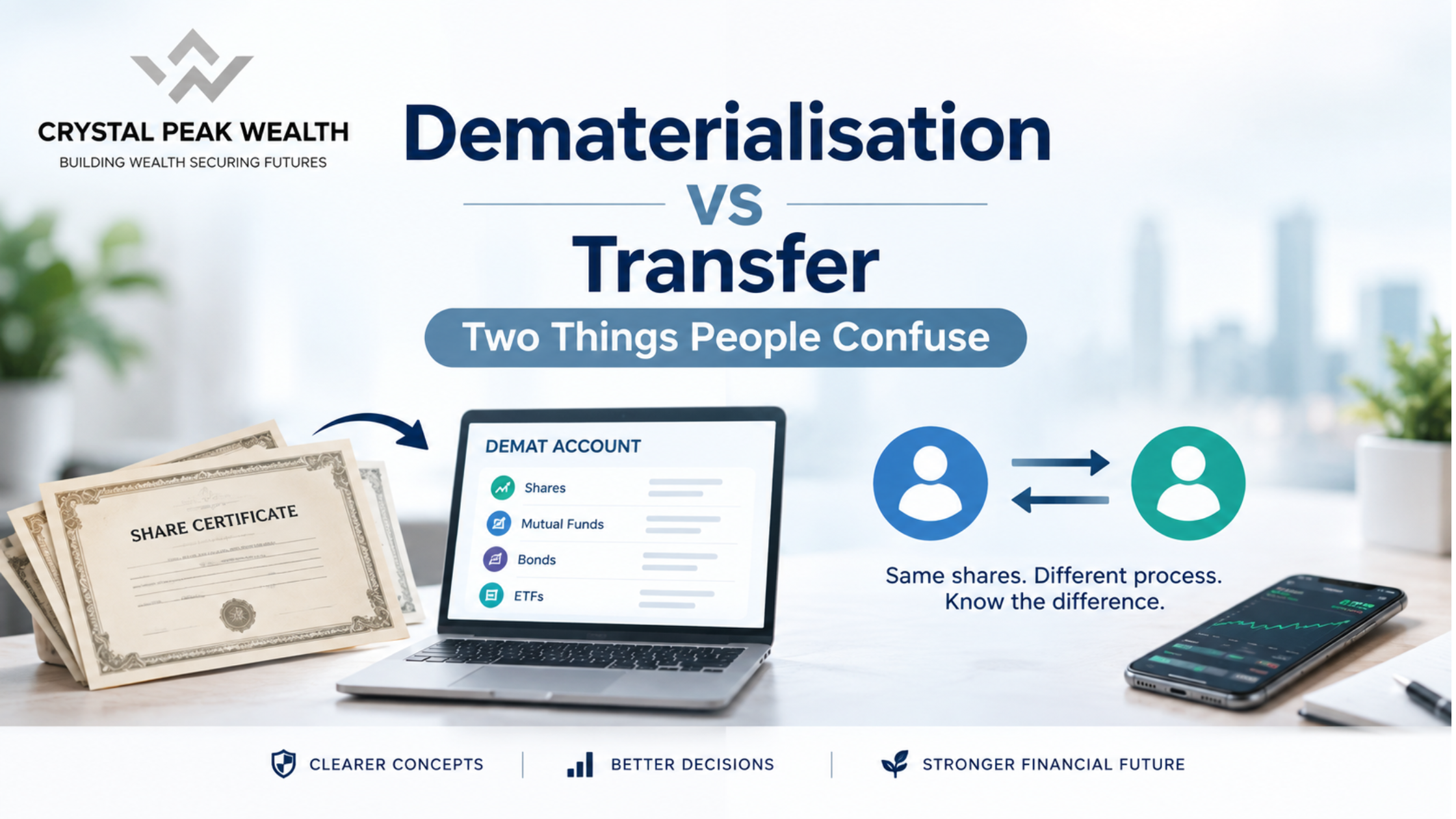
Finding an old bundle of paper share certificates in a cupboard is a strange mix of excitement and worry. Are they still valid? Can you sell them? Do they need to be moved into someone else’s name first? Most investors in this position end up muddling dematerialisation vs transfer of shares, two very different processes, and that mix-up can cost weeks of delay, rejected forms and real money.
The confusion around dematerialisation vs transfer of shares is one of the most common problems Indian investors face when they hold physical certificates. They solve completely different problems. One changes the form in which you hold your shares. The other changes who holds them.
This checklist walks you through both processes in plain language: what each one means, why dematerialisation vs transfer of shares trips so many people up, the steps and documents involved, and how to decide which route you need.
Dematerialisation vs Transfer of Shares: The Short Answer
Here is the one-line version. Dematerialisation converts your paper share certificates into electronic holdings in a demat account, and you remain the owner. Transfer of shares moves ownership from one person to another through a sale, gift or similar arrangement.
If you remember only one thing about dematerialisation vs transfer of shares, remember this: dematerialisation changes the format, while transfer changes the owner.
A quick test you can apply right now:
- Same owner, paper to electronic form: that is dematerialisation.
- New owner, whatever the form: that is a transfer.
- The registered holder has passed away: that is transmission, a special process covered later in this checklist.
- The order of names on a joint holding needs to change: that is transposition.
For listed companies in India, the two processes are also linked by regulation. Since 1 April 2019, SEBI does not allow physical shares of listed companies to be transferred, except in cases of transmission and transposition. So if you want to sell or gift listed shares that are still on paper, dematerialisation usually has to come first. That link is exactly why the dematerialisation vs transfer of shares question matters so much in practice.
What Is Dematerialisation?
Dematerialisation, usually shortened to “demat”, is the process of converting physical share certificates into electronic form. Instead of holding paper certificates with your name printed on them, you hold the shares as electronic entries in a demat account. That account is opened through a depository participant (DP), such as a bank or a broker registered with NSDL or CDSL, the two depositories in India.
Here is what you should know about it:
- Ownership does not change. The person who held the paper certificate is the holder of the electronic shares.
- The certificates are cancelled. Once the company or its registrar and transfer agent (RTA) confirms the request, the physical certificates are cancelled and the shares are credited to your account.
- Names must match. The demat account must be in the same name or names, and in the same order, as on the certificate.
- It is not a sale. Because nothing is sold, dematerialisation is not a taxable event by itself.
Why do it? Paper certificates can be lost, damaged, stolen or forged. Electronic shares are safer, easier to sell and simpler to track, and you can add a nominee. In the dematerialisation vs transfer of shares picture, dematerialisation is the doorway to any future sale of listed shares.
What Is Transfer of Shares?
Transfer of shares is the legal movement of ownership from one person, called the transferor, to another, called the transferee. It can happen because of a sale, a gift, a family arrangement or a settlement. Unlike dematerialisation, a transfer always involves two parties and always changes the name on the company’s records.
How a transfer works depends on how the shares are held:
- Shares in a demat account: A sale on the stock exchange happens through your broker and settles automatically. An off-market transfer, such as a gift to a family member, is done by instructing your DP to move the shares to the recipient’s demat account, using a delivery instruction slip or an online instruction.
- Physical shares of an unlisted company: The transfer is usually made with a share transfer deed (Form SH-4 under the Companies Act), signed by both parties, stamped as required, and lodged with the company along with the certificate.
- Physical shares of a listed company: Since April 2019, these cannot be transferred in physical form. They must be dematerialised first.
Every transfer must be recorded by the company, and stamp duty may apply. That is one more difference to keep in mind when weighing dematerialisation vs transfer of shares.
Why People Confuse Dematerialisation vs Transfer of Shares
If the difference is this clear, why does dematerialisation vs transfer of shares confuse so many people? There are a few ordinary reasons.
The word “transfer” is used loosely. Many people say, “I want to transfer my physical shares to my demat account.” Strictly speaking, that is dematerialisation, not a transfer. When the wrong word reaches a clerk or a helpline, the wrong form often follows.
Both processes involve the same players. The company, its RTA and a DP can all appear in either process, so the paperwork looks alike from the outside.
Brokers give shorthand advice. “Demat first, then sell” is good advice, but it compresses two separate steps into one sentence, and people assume both are the same task.
Inheritance adds a third process. When a family member passes away, heirs often assume they can simply dematerialise the certificates. In reality, transmission of shares to the legal heirs comes first, and then the shares can be held in a demat account.
The practical cost of this mix-up is real. A transfer deed sent with a demat request will be rejected. A demat request for shares still in a deceased person’s name will be stuck. Understanding dematerialisation vs transfer of shares before you start saves you from both.
Dematerialisation vs Transfer of Shares: Key Differences at a Glance
Point | Dematerialisation | Transfer of shares |
Purpose | Convert paper shares into electronic form | Move ownership to another person |
Owner after the process | Same owner | New owner |
Parties involved | You, your DP, the RTA | Transferor, transferee, company or broker |
Main form | Dematerialisation Request Form (DRF) | Share transfer form (SH-4) or delivery instruction |
Stamp duty | Not applicable | May apply, as per prevailing rules |
Tax impact | None by itself | Capital gains may arise on a sale |
Reversible? | Yes, through rematerialisation | Only by a fresh transfer |
Typical trigger | Safekeeping, or preparing to sell | Sale, gift or settlement |
The table shows why dematerialisation vs transfer of shares is not a choice between two alternatives. In many cases, you need both, in that order.
Checklist 1: Preparation for Dematerialisation vs Transfer of Shares
Whichever route you take, spend an hour on these preparation steps. Most rejections are decided at this stage, not at the counter.
- Locate every certificate. Note the company name, folio number, certificate number, distinctive numbers and the names of all holders.
- Check the company’s current status. Confirm that the company still exists under the same name. If the name has changed, the RTA may need the name-change documents.
- Check for unclaimed dividends. If dividends have gone unclaimed for seven years, the shares may have been moved to the Investor Education and Protection Fund (IEPF). In that case, you must file a claim there before anything else.
- Match your details. Your name, signature, PAN and address should be consistent with the company’s records. A signature that has changed over the decades is one of the most common causes of delay.
- Look for damage or loss. Torn or missing certificates need a duplicate certificate first.
- Confirm KYC. Keep PAN, Aadhaar, bank details and a cancelled cheque or bank statement ready.
- Decide your goal. Are you keeping the shares, selling them, or handing them to someone? Your answer decides the next checklist.
Being clear about your goal is the fastest way to resolve dematerialisation vs transfer of shares for your own case.
Checklist 2: Dematerialisation, Step by Step
Follow these steps if your goal is to bring your own paper shares into a demat account.
- Open or choose a demat account. The names and their order must match the certificates. For joint holdings, the demat account must have the same holders in the same sequence.
- Collect the DRF. Get the Dematerialisation Request Form from your DP. Fill a separate form for each company, and separate ones for different holder combinations.
- Prepare the certificates. Do not sign on the back, cut or staple them. Your DP will mark them as surrendered for dematerialisation.
- Submit to your DP. Hand over the DRF, the certificates and the identity proof. Collect the acknowledgement slip.
- Wait for verification. The DP sends the request to the depository and the certificates to the company’s RTA, who checks the certificate details, signatures and records.
- Resolve queries quickly. If the RTA raises a query about a signature mismatch or a missing document, respond fast. Delays usually start here.
- Receive the credit. Once approved, the shares appear in your demat account. Regulations generally expect the process to complete within about 30 days, though timing varies by case.
- Verify the holding. Check your statement for the correct quantity and ISIN, and store the acknowledgement.
Checklist 3: Transfer of Shares, Step by Step
Use this checklist when the shares are going to a different person.
If the shares are already in a demat account:
- Choose the mode. A sale is done on the exchange through your broker. A gift or family transfer is done off-market.
- Get the recipient’s details. For an off-market transfer, you need their DP ID and client ID.
- Give the instruction. Submit a delivery instruction slip to your DP, or use the online facility if your DP offers it.
- Mind the stamp duty. Depending on the transaction, stamp duty may apply. Ask your DP for the prevailing rate.
- Confirm the credit. Ask the recipient to check the account and keep the records for future tax reporting.
If the shares are physical and the company is unlisted:
- Complete the share transfer form. Form SH-4 must be signed by both parties, with the transferee’s details.
- Pay the stamp duty. The duty is paid as per the rules of the relevant state.
- Lodge the documents. Submit the form, the certificates and the identity proofs to the company.
- Wait for registration. The company records the transfer and issues fresh certificates or credits the shares, depending on how it operates.
If the shares are physical and the company is listed, stop. You cannot transfer them directly. Go back to Checklist 2 first, and only then return here.
This is where dematerialisation vs transfer of shares becomes a sequence rather than a choice.
Transmission and Transposition: The Two Cousins
Two more terms complicate dematerialisation vs transfer of shares, so it helps to keep them apart.
Transmission happens when shares pass to another person by operation of law, most often due to the death of the holder. It is not a sale or a gift, and it needs different documents. Typically these include the death certificate, the claimant’s KYC, and proof of the claimant’s right, such as a nomination, a will with probate, a succession certificate or a legal heir certificate.
Transposition is a change in the order of names of joint holders, for example from “A and B” to “B and A”. No ownership changes, but the order matters because dividends, voting and communication are directed to the first holder. It also matters for dematerialisation, since the demat account must follow the same order as the certificate.
Since January 2022, when a listed company’s RTA processes service requests such as transmission and transposition, it issues the securities in demat form only. The RTA issues a letter of confirmation, which is valid for 120 days. You must use it within that window to get the shares credited to your demat account. Missing that deadline can mean starting again.
Documents Checklist at a Glance
Keep these together in one folder.
- Original share certificates
- Filled DRF (for dematerialisation)
- Share transfer form SH-4 or delivery instruction slip (for transfer)
- PAN card of every holder and transferee
- Cancelled cheque or bank statement
- Specimen signature proof or bank attestation, where asked
- Name-change or merger documents, if the company changed
- Death certificate and succession documents, in case of transmission
- Indemnity or affidavit, for lost or damaged certificates
Missing documents are the number one reason for a delayed request, whichever side of dematerialisation vs transfer of shares you are on.
Costs, Timelines and Tax: What to Expect
Costs. Dematerialisation itself usually involves modest charges, such as a per-certificate fee that varies by DP, along with courier costs. Transfers can involve stamp duty and broker or DP charges. Rates change, so confirm them before you begin.
Timelines. Dematerialisation typically takes a few weeks, depending on the RTA’s speed and the quality of your documents. A transfer through a demat account can be completed in a day or two, while physical transfers of unlisted shares can take longer.
Tax. Dematerialisation does not trigger tax, since no sale occurs. A sale, however, can attract capital gains tax, and the holding period is generally counted from the original purchase date, even if the shares were on paper for years. Gifts to close relatives are generally not taxed in the recipient’s hands under Indian income tax rules, but a later sale by the recipient will be. Because the rules are detailed and updated often, speak to a chartered accountant before you sell or gift.
Common Mistakes in Dematerialisation vs Transfer of Shares
- Filing a transfer form when you need dematerialisation. This is the classic error, and the heart of the dematerialisation vs transfer of shares confusion.
- Trying to sell physical listed shares. Since 2019, they must be dematerialised first.
- Opening a demat account in a different name order. The RTA will reject the request, and you will need to open a new account or correct the certificate records first.
- Signing the back of certificates. Signing on the back can create problems. Leave them untouched until instructed.
- Ignoring the IEPF. Shares moved to the IEPF cannot be dematerialised the usual way.
- Skipping transmission. Heirs cannot dematerialise a deceased person’s certificates without completing transmission first.
- Missing the 120-day window. A letter of confirmation that lapses means repeating the request.
Each of these mistakes traces back to one issue: not knowing which side of dematerialisation vs transfer of shares your situation falls on.
Which One Do You Need? Five Common Scenarios
- You hold paper shares in your own name and want to keep them. You need dematerialisation. There is no transfer involved.
- You hold paper shares of a listed company and want to sell. Dematerialise first, then sell through your broker. This is a textbook example of dematerialisation vs transfer of shares working in sequence.
- You want to gift paper shares to your child. Dematerialise them first. Then do an off-market transfer to your child’s demat account, and check the stamp duty and tax position.
- You inherited paper shares after a parent’s death. Begin with transmission, submitting the succession documents to the RTA. After that, the shares can be credited to your demat account.
- Your name or company name has changed. Update the records with the RTA first, and then start dematerialisation.
If your dematerialisation vs transfer of shares case does not fit neatly into any of these, get personal guidance before submitting anything.
Frequently Asked Questions
Is dematerialisation the same as transfer of shares? No. Dematerialisation converts the form of your shares while you remain the owner, whereas a transfer changes the owner. That is the simplest way to explain dematerialisation vs transfer of shares.
Do I have to dematerialise before I transfer physical shares? For listed companies, yes. Since April 2019, physical shares of listed companies cannot be transferred, so they must be dematerialised first. For unlisted companies, the rules depend on the company, so check with it directly.
Can I dematerialise the shares of a deceased person? Not directly. The shares must first go through transmission to the legal heirs or the nominee. After that, they can be held in the claimant’s demat account.
How long does dematerialisation take? Usually a few weeks. It depends on your DP, the RTA, and how well your documents match the company’s records.
Is any tax payable on dematerialisation? No, because there is no sale. Tax arises only when you later sell the shares.
Which is cheaper in dematerialisation vs transfer of shares? They are not alternatives, so the cost comparison is not like-for-like. Many investors pay for both, one after the other. The dematerialisation vs transfer of shares question is about sequence, not savings.
Conclusion: Get the Order Right
Most trouble around dematerialisation vs transfer of shares comes down to one thing: doing the right step in the wrong order, or the wrong step altogether. Dematerialisation keeps you as the owner and moves your shares into electronic form. Transfer hands ownership to somebody else.
Use the dematerialisation vs transfer of shares checklists above: prepare your documents, decide your goal, dematerialise if you hold listed paper shares, and only then transfer. If your case involves inheritance, a name change, lost certificates or shares that may have moved to the IEPF, get help early.
Need help sorting out your physical shares? The team at CrystalPeakWealth guides investors through every stage of the process, from document checks to getting the shares credited to your demat account. Talk to CrystalPeakWealth and get clarity on dematerialisation vs transfer of shares for your holding, before you submit any form.