
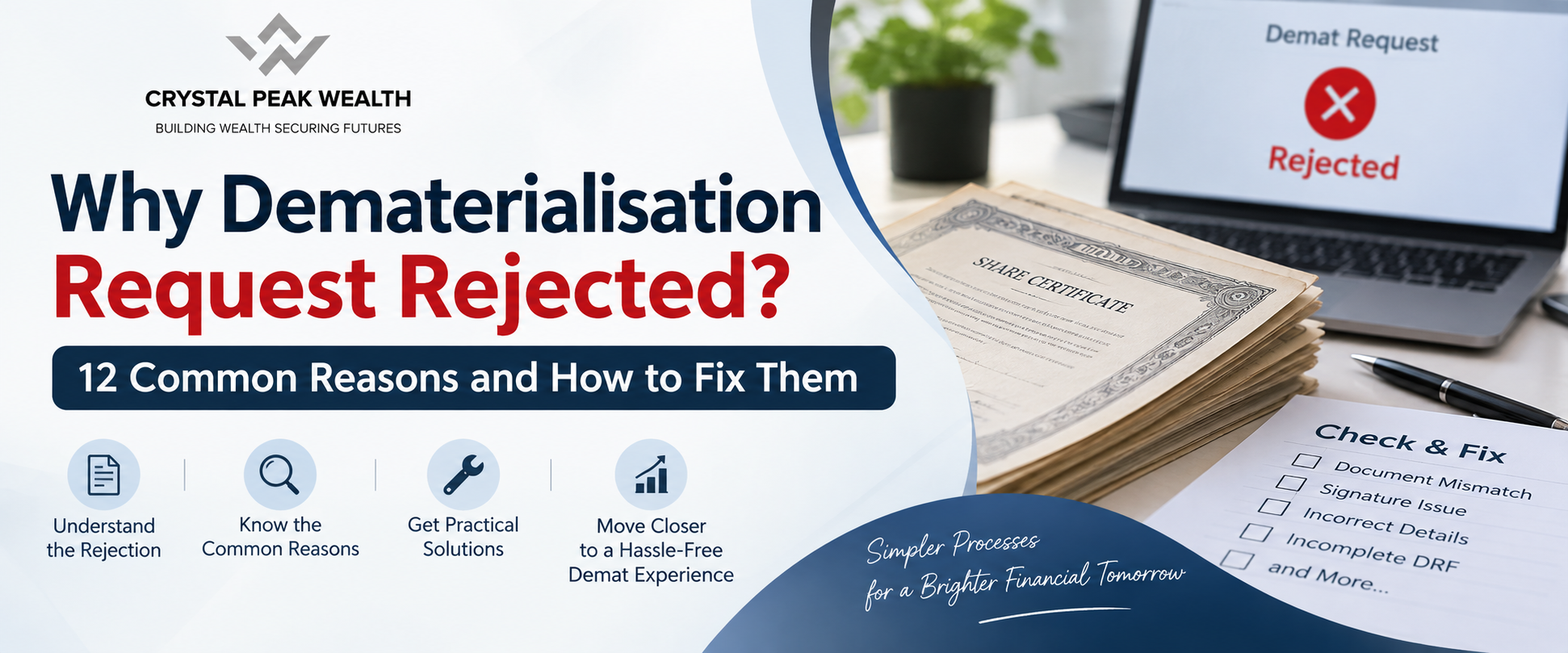
If you have submitted your Dematerialisation Request Form (DRF) and it has bounced back, you are not alone. A huge number of investors ask the same question every single day: why dematerialisation request rejected, even after they filled the form carefully and attached the original share certificates. The frustrating part is that most rejections are not because something is fundamentally wrong with your shares. They happen because of small, avoidable mismatches between what is written on your paper certificate and what is recorded with your Depository Participant (DP), the Registrar and Transfer Agent (RTA), or your bank.
In this guide, we will walk through exactly why dematerialisation request rejected cases happen, how the dematerialisation process actually works behind the scenes, and what you can do at each stage to prevent your own request from getting stuck. Whether you are converting shares inherited from a family member, shares bought decades ago in a now-renamed company, or shares held jointly with a relative, this article covers the real-world reasons your DRF may not sail through on the first attempt.
Understanding Dematerialisation Before We Get to Rejections
Before we dig into why dematerialisation request rejected situations occur, it helps to understand what dematerialisation actually is. Dematerialisation is the process of converting physical share certificates into an equivalent electronic form, held in a demat account with a Depository Participant. Once shares are dematerialised, they exist only as electronic entries with depositories like NSDL or CDSL, making them easier to trade, transfer, and track.
The process sounds simple on paper: you fill a DRF, attach your original share certificates, submit it to your DP, and the DP forwards it to the company’s RTA for verification. The RTA checks the request against its records and either approves it (leading to your shares appearing in your demat account) or rejects it, sending the documents back with a reason. It is at this verification stage, on the RTA’s end, that most of the “why dematerialisation request rejected” cases originate.
Understanding this flow matters because it tells you where the problem usually lies. It is rarely your DP’s fault. In most cases, the rejection happens because the RTA’s records do not match what you have submitted.
Reason 1: Name Mismatch Between Certificate and PAN/Demat Account
By far the most common answer to why dematerialisation request rejected is a mismatch in the shareholder’s name. This can happen in several ways:
- The name on the physical certificate is spelled differently from the name on your PAN card or demat account (for example, “Mohd.” instead of “Mohammed,” or a missing middle name).
- Your name changed after marriage, but the shares are still in your maiden name.
- There are minor differences in the order of first name, middle name, and surname.
Even a single-letter difference is enough for an RTA to flag a name mismatch, and that mismatch is why dematerialisation request rejected notices get issued. To fix this, you generally need to submit a linking document, such as a gazette notification, marriage certificate, or an affidavit confirming that both names belong to the same person.
Reason 2: Signature Mismatch
Another frequent cause behind why dematerialisation request rejected outcomes occur is signature mismatch. RTAs compare the signature on your DRF against the specimen signature they hold on file, often from decades-old company records. If your signature has evolved over the years (which is extremely common), the RTA may reject the request as a precaution against fraud.
The fix here usually involves getting your signature attested by your bank manager, or providing a fresh specimen signature along with supporting KYC documents.
Reason 3: Incomplete or Incorrect DRF
A surprisingly large share of why dematerialisation request rejected complaints trace back to a simple, avoidable issue: the DRF itself was filled out incorrectly. Common errors include:
- Missing folio number or leaving it blank
- Incorrect distinctive number range for the shares
- Missing signatures of all joint holders
- DRF not matching the exact number of shares mentioned on the certificate
Since the DRF is essentially a legal instrument connecting your physical holding to your demat account, even a small clerical slip can trigger a rejection.
Reason 4: Certificate Details Do Not Match RTA Records
Old share certificates sometimes carry folio numbers, distinctive numbers, or certificate numbers that do not match what is currently on file with the RTA, especially if the company has undergone a merger, demerger, stock split, or bonus issue since the certificate was issued. This is a technical but very real reason behind why dematerialisation request rejected cases keep coming up for legacy shareholders.
If your company has changed its name, merged with another entity, or been renamed, the RTA needs updated documentation connecting your old certificate to the current company structure before it can process the request.
Reason 5: Deceased Shareholder’s Shares Without Transmission
When shares are held in the name of someone who has since passed away, you cannot simply dematerialise them in your own name without first completing the transmission process. Many nominees and legal heirs try to skip this step, which is exactly why dematerialisation request rejected for such cases. The RTA requires:
- Death certificate of the original shareholder
- Succession certificate, will, or legal heirship certificate
- Transmission request form
- Indemnity bond, in many cases
Only after transmission is completed in favour of the legal heir can a fresh dematerialisation request be filed under the new holder’s name.
Reason 6: Jointly Held Shares With One Holder’s KYC Incomplete
If shares are held jointly, every single joint holder needs a demat account (or at least, all holders’ names must appear in the same order on the account you are dematerialising into) and updated KYC. It is common for one joint holder to have completed KYC while the other has not, and this incomplete status is why dematerialisation request rejected letters get sent back to households with old family holdings.
Before resubmitting, confirm that PAN, address proof, and bank details are updated and consistent for every joint holder listed on the certificate.
Reason 7: PAN Not Linked or KYC Not Updated With DP
SEBI regulations require your PAN and KYC details to be current with your DP. If your KYC has lapsed, or your PAN is not linked to your demat account, your DRF can be rejected purely on compliance grounds. This administrative gap is frequently why dematerialisation request rejected, particularly for older demat accounts that have been dormant for years.
A quick KYC refresh with your DP, including updated address proof, PAN verification, and bank account linking, usually resolves this.
Reason 8: Certificate Is Torn, Mutilated, or Illegible
Physical certificates that are decades old can suffer wear and tear. If the certificate number, folio number, or shareholder details are not clearly legible due to fading, tearing, or water damage, the RTA may not be able to verify authenticity. This is a purely physical reason why dematerialisation request rejected happens, and unfortunately it often requires you to apply for a duplicate certificate from the company before you can proceed.
Reason 9: Company Has Been Delisted, Struck Off, or Is Under Investigation
If the company whose shares you are trying to dematerialise has been delisted from the stock exchange, struck off by the Ministry of Corporate Affairs (MCA), or is currently under SEBI investigation, the RTA may pause or reject dematerialisation requests entirely. This regulatory freeze is an important, often overlooked, reason why dematerialisation request rejected for shares of smaller or older companies that have gone inactive.
In such cases, you may need to check the company’s current status with the MCA or SEBI before taking further steps, since dematerialisation may not be possible until the company’s status is resolved.
Reason 10: Address Mismatch Between Certificate and Current Records
Similar to the name mismatch issue, if the address on your old physical certificate does not match your current KYC address, some RTAs flag this as a discrepancy requiring clarification. While address mismatch alone is a less common answer to why dematerialisation request rejected compared to name or signature issues, it can still delay processing, particularly when combined with other minor inconsistencies.
Reason 11: DP-Level Processing Errors
Sometimes the issue is not with your documents at all, but with how your DP has processed and forwarded the request to the RTA. Delays or errors in data entry, incorrect ISIN codes, or missing forwarding letters from the DP can all result in rejection. If you have checked everything on your end and still cannot understand why dematerialisation request rejected, it is worth asking your DP directly whether the request was forwarded correctly and completely.
Reason 12: Odd Lot or Fractional Shares Issues
In certain older holdings, especially those affected by mergers, demergers, or bonus issues over the years, the number of shares on the certificate may not correspond to a clean, tradable lot as per current RTA records. This mismatch in unit calculation is a more technical reason why dematerialisation request rejected, and it usually requires RTA intervention to reconcile the numbers before dematerialisation can proceed.
Documents That Help You Avoid a Second Rejection
Once you have identified why dematerialisation request rejected the first time, having the right supporting paperwork ready before you resubmit can save you weeks of back-and-forth. Depending on the specific reason for rejection, RTAs typically ask for a combination of the following:
- PAN card copy, self-attested and matching the name on the certificate
- Aadhaar or other address proof, current and consistent with your DP records
- Bank account proof, such as a cancelled cheque, for the account linked to your demat holding
- Affidavit or gazette notification, if there is any variation in name spelling
- Marriage certificate, if the shares are in a maiden name
- Death certificate and succession documents, if the shares belonged to a deceased relative
- Board resolution, for shares held in the name of a company or HUF
- Letter of indemnity, in cases involving lost, torn, or damaged certificates
Keeping a folder with all of these documents ready, even before you file your first DRF, is one of the most practical ways to prevent a second round of rejection frustration.
The Cost of Ignoring a Rejected Dematerialisation Request
Many shareholders receive a rejection letter and simply set it aside, assuming they will deal with it later. This is a mistake. Shares that remain in physical form cannot be traded on the stock exchange under current SEBI rules, and physical certificates are far more vulnerable to loss, damage, or disputes among family members over time. Every month that you leave the underlying issue unresolved is a month your investment stays illiquid.
Beyond liquidity, there is also a compliance angle. Companies and RTAs periodically run investor awareness and unclaimed shares drives, and holdings that remain undematerialised for extended periods can end up flagged for transfer to the Investor Education and Protection Fund (IEPF) under certain conditions. Understanding why dematerialisation request rejected and acting on it quickly protects both the liquidity and the long-term safety of your investment.
How Long Does Dematerialisation Normally Take?
Under normal circumstances, dematerialisation takes between 15 to 30 days from the date your DP forwards the request to the RTA. If you are still wondering why dematerialisation request rejected after this window has passed with no update, it is a good idea to follow up directly with your DP for a status report, rather than waiting indefinitely.
Step-by-Step: What to Do If Your DRF Is Rejected
- Read the rejection letter carefully. RTAs are required to specify the reason for rejection. This single document is often the fastest way to understand why dematerialisation request rejected in your specific case.
- Match your documents against the reason given. Whether it is a name mismatch, signature issue, or missing transmission paperwork, identify exactly which document needs correction.
- Gather the correct supporting documents. This could include an affidavit, gazette notification, succession certificate, or updated KYC forms, depending on the rejection reason.
- Resubmit through your DP. Once corrected, your DP will forward the updated DRF along with supporting documents to the RTA again.
- Track the status regularly. Many RTAs and DPs now offer online tracking; use it so you are not left guessing why dematerialisation request rejected a second time.
- Escalate if needed. If there is no resolution within a reasonable time, you can escalate to the RTA’s grievance cell or SEBI’s SCORES portal.
How to Prevent Dematerialisation Rejection in the First Place
- Verify that your name matches exactly across your PAN card, demat account, and physical share certificate before submitting.
- Update your KYC with your DP well in advance, including PAN linkage and current address.
- If shares are inherited, complete transmission before attempting dematerialisation.
- Double-check folio numbers, distinctive numbers, and certificate numbers against your certificate before filling the DRF.
- Get your signature attested by your bank if it has changed significantly since the certificate was issued.
- Store certificates carefully to avoid damage that could later make them illegible.
Taking these precautions upfront significantly reduces the odds you will ever need to ask why dematerialisation request rejected, because you will have addressed the most common triggers before the RTA even reviews your file.
Rejection vs. Delay: Knowing the Difference
It is worth pausing here to separate two things that investors often lump together: an outright rejection and a simple processing delay. A rejection means the RTA has actively reviewed your DRF and sent it back with a specific reason attached, as covered in the twelve scenarios above. A delay, on the other hand, usually means your request is still sitting somewhere in the pipeline, either with your DP or the RTA, without a formal decision yet.
If your DRF has crossed the standard 15-to-30-day window without any communication, that is a delay, not necessarily a rejection, and the appropriate action is a status follow-up rather than a fresh document correction. If, however, you have received a written communication specifying a defect, that is a genuine rejection, and you will need to work through the relevant fix from the list above.
This distinction matters because the corrective steps are different. Chasing your DP for a status update will not help if the real issue is a name mismatch sitting in the RTA’s queue, and gathering fresh KYC documents will not speed up a request that is simply delayed due to processing volume. Correctly diagnosing which situation you are in is often the fastest route to resolution.
A Quick Real-World Example
Consider a shareholder who inherited physical certificates from a grandparent nearly twenty years ago. The certificates were issued under a company name that has since merged into a larger entity, the grandparent’s name was spelled slightly differently across two certificates, and no transmission had ever been completed. When this shareholder finally submitted a DRF, the RTA rejected it for three separate reasons at once: pending transmission, a name spelling discrepancy, and outdated company details tied to the pre-merger entity.
Cases like this illustrate why dematerialisation request rejected outcomes are often the result of multiple overlapping issues rather than a single clean mistake, particularly for shares that have been sitting untouched in a drawer for decades. Working through each issue systematically, starting with transmission, then the name correction, and finally the company-merger documentation, is usually the only way forward. Attempting to resubmit without addressing all three at once typically leads straight back to another rejection letter.
Frequently Asked Questions
Q1: What is the most common reason dematerialisation requests get rejected? Name mismatch between the physical share certificate and the shareholder’s PAN or demat account records is the single most common answer to why dematerialisation request rejected across most RTAs.
Q2: Can I dematerialise shares of a deceased family member directly? No. You must first complete the transmission process in your name (or the legal heir’s name) before submitting a fresh dematerialisation request. Skipping this step is why dematerialisation request rejected for many nominees.
Q3: How do I know exactly why my request was rejected? The RTA is required to issue a rejection letter or communication specifying the reason. If this is unclear, contact your DP, who can usually get clarification directly from the RTA.
Q4: Can a rejected dematerialisation request be resubmitted? Yes. Once you have corrected the issue that led to rejection, whether it is a document mismatch, missing signature, or incomplete KYC, you can resubmit the DRF through your DP.
Q5: Does a rejected DRF affect my ownership of the shares? No. Rejection only means the electronic conversion has not been completed. You remain the legal owner of the physical shares while the paperwork is being corrected.
Get Expert Help With Your Dematerialisation Process
Understanding why dematerialisation request rejected is only half the battle; actually resolving the mismatch, gathering the right legal documents, and getting your RTA and DP to process the correction can be time-consuming and confusing, especially for inherited or decades-old holdings.
If you are stuck figuring out what went wrong in your case, or want expert guidance to get your physical shares converted smoothly the first time, why dematerialisation request rejected is exactly the kind of complexity CrystalPeakWealth’s team handles every day. Reach out to CrystalPeakWealth today to get your dematerialisation request reviewed, corrected, and resubmitted without the guesswork. From verifying folio and distinctive number details to drafting the affidavits and indemnity letters RTAs ask for, the team can help you move from a rejected DRF to a fully dematerialised, tradable holding with far less back-and-forth than doing it alone.