
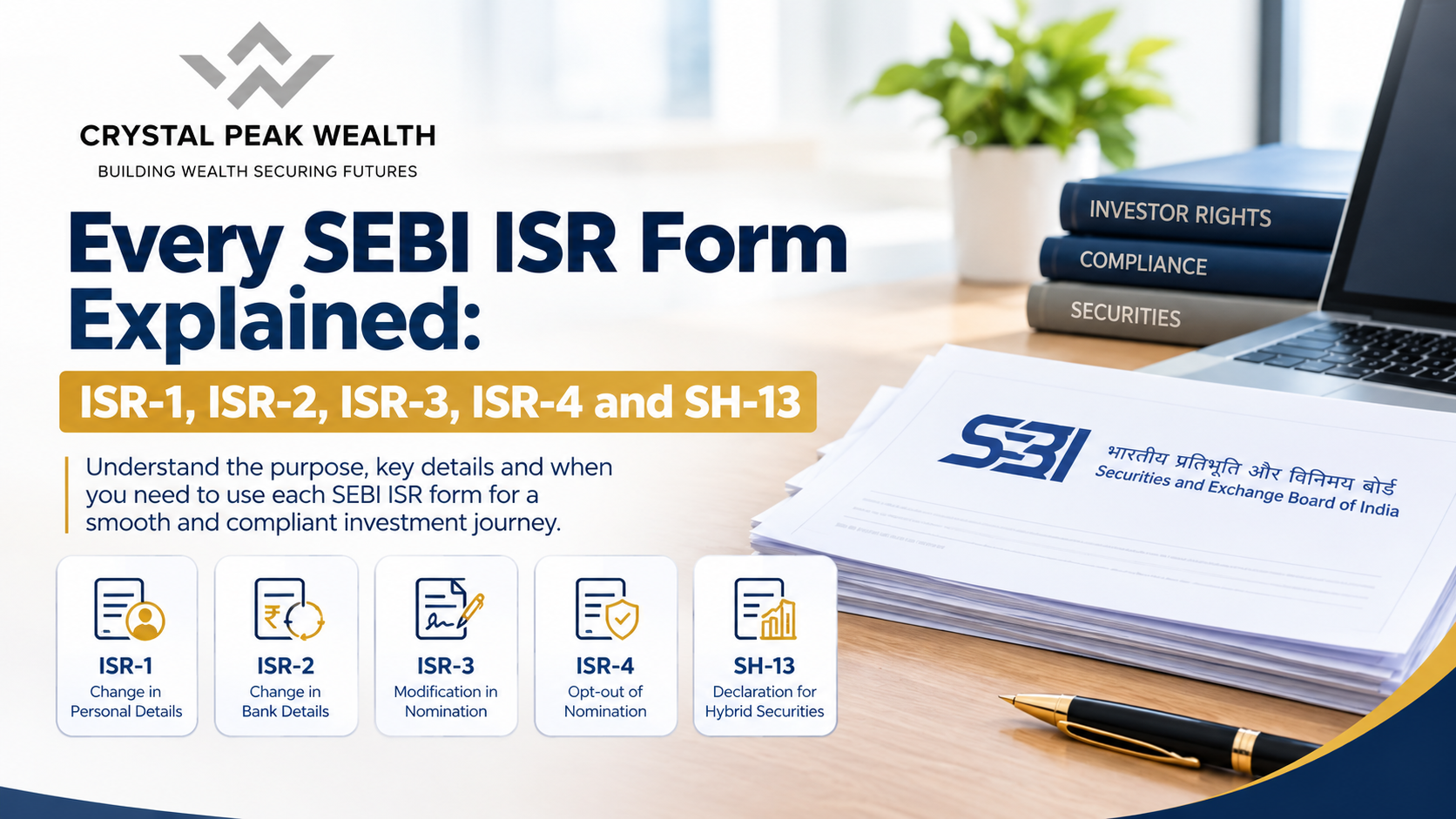
By Crystal Peak Wealth Research Team | Last updated: October 11, 2026
Investors holding physical share certificates often discover that updating their records, correcting a signature mismatch, registering a nominee, or claiming old investments requires more paperwork than expected. One of the first things they encounter is a set of standard forms prescribed under the Securities and Exchange Board of India (SEBI) framework.
Understanding sebi isr forms helps investors identify which document applies to their situation, what information they must provide, and how to avoid common submission errors. Although these forms may appear similar at first, each serves a different purpose, from updating Know Your Customer (KYC) details to verifying signatures and handling duplicate securities.
This guide explains ISR-1, ISR-2, ISR-3, ISR-4 and SH-13 in practical terms. It also covers the documents investors should prepare, the submission process, common mistakes, and how these forms relate to converting physical shares into demat holdings.
If you have inherited old certificates, discovered an outdated address in your folio, or want to make your physical investments easier to manage, understanding the applicable paperwork is an important first step.
What Are SEBI ISR Forms?
Investor Service Request (ISR) forms are standardised documents used for specific investor services involving listed companies and their Registrars and Transfer Agents (RTAs). They help investors submit requests concerning their records, signatures, nomination preferences and certain issues involving physical securities.
The framework aims to make investor servicing more consistent and reduce discrepancies between the information held by an issuer or its RTA and the details supplied by a shareholder.
In practical terms, sebi isr forms help establish what an investor is requesting and provide the supporting information required to process that request.
For example, an investor who has changed their address may need to update their registered details. Another investor whose bank records or signature require verification may need a different form. A shareholder seeking a duplicate certificate will follow a separate procedure from someone simply updating KYC information.
These processes are related, but they are not interchangeable.
Investors should also distinguish ISR forms from the Dematerialisation Request Form (DRF). A DRF is used to initiate the conversion of eligible physical securities into electronic holdings through a Depository Participant (DP). ISR forms generally address investor servicing and related record or securities requests.
The exact requirements depend on the nature of the request, the applicable SEBI circulars, and the issuer’s or RTA’s current instructions.
For authoritative information, consult the SEBI investor FAQ and the current SEBI FAQ published in January 2026.
Why Are These Forms Important for Physical Shareholders?
Paper share certificates may represent valuable investments, but the records associated with them can become outdated over time. A shareholder might move to another city, change their signature, lose an original document, or discover that nomination details were never registered.
In such cases, incomplete documentation can delay an otherwise straightforward request.
Understanding sebi isr forms helps investors prepare the appropriate documents before approaching the company or its RTA.
The main benefits of using the correct form include:
Accurate investor records: Helps maintain consistent PAN, address, contact, bank and signature information.
Clearer processing: Identifies the service requested and the information relevant to it.
Fewer avoidable rejections: Reduces the likelihood of submitting an incorrect form or omitting required evidence.
Better recordkeeping: Creates a clearer documentary trail for future investor service requests.
More effective demat preparation: Helps resolve certain record-related issues before initiating a physical-to-demat process.
It is important to remember that submitting a form does not automatically guarantee approval. The RTA may still need to verify the request, supporting documents, folio details and applicable regulatory requirements.
ISR-1: For KYC Details and Investor Record Updates
ISR-1 is used for registering or updating specified investor details associated with physical securities. Depending on the request, this may include PAN, contact information, postal address, bank details and signature-related information.
For many physical shareholders, ISR-1 is the starting point when they discover that their existing records are incomplete or no longer accurate.
When should you use ISR-1?
You may need ISR-1 when:
Your registered postal address has changed.
Your mobile number or email address needs updating.
Your bank account information needs to be registered or corrected.
Your PAN or other prescribed KYC details need to be recorded.
You need to submit an eligible investor information update to the issuer or RTA.
Not every request requires every field or supporting document. Follow the current form and the RTA’s instructions for your specific requirement.
Documents to prepare
Depending on the details being updated, you may need:
A completed and signed ISR-1.
A self-attested PAN copy, where required.
Prescribed address or identity proof, where applicable.
Bank proof, such as a cancelled cheque or bank-verified document.
Supporting evidence for any additional requested change.
Use the document checklist provided by the relevant RTA rather than assuming that one standard set will cover every situation.
How to avoid ISR-1 errors
Check that the folio number, shareholder name and other identifying details match the existing records. Provide the requested supporting documents in the required format and sign the form as instructed.
If you hold shares in multiple companies, do not assume that updating one folio automatically updates every other issuer’s records. Confirm the applicable requirements for each issuer and folio.
The purpose of ISR-1 is to keep investor records accurate. It does not, by itself, convert physical certificates into demat holdings.
ISR-2: For Banker’s Verification of Signature
ISR-2 is associated with bank verification of an investor’s signature. It is particularly relevant when the investor needs to establish that the signature submitted for a service request is genuine and corresponds with the bank’s records.
Signature verification can become important when a shareholder’s signature has changed over the years or when the RTA needs additional verification before processing a request.
When is ISR-2 required?
An RTA may ask for the prescribed banker-verification document in circumstances where signature verification is necessary under the applicable procedure.
For example, a shareholder may have signed physical certificates decades ago but now uses a different signature. The difference can lead to additional verification requirements.
ISR-2 should not be treated as a universal requirement for every investor service request. Check whether the RTA specifically requires it for your case.
What does the bank verify?
The applicable process may require the bank to verify the shareholder’s signature and certify the relevant particulars in the prescribed format.
The investor should:
Confirm the correct form version with the RTA.
Provide the bank with the information needed to identify the account and shareholder.
Follow the bank’s instructions for verification and certification.
Ensure that the completed form is legible and appropriately authenticated.
Do not alter the bank’s certification or fill in fields that are reserved for bank officials.
Practical example
Suppose an investor holds shares in an old folio and the signature on the company’s records differs from the signature currently used. The RTA may request supporting verification before accepting the signature for the relevant transaction.
In that situation, ISR-2 may form part of the documentation process, subject to the RTA’s instructions.
The important distinction is that banker’s verification supports the investor’s identity or signature verification process; it does not independently establish ownership of every disputed security or resolve all other record discrepancies.
ISR-3: Declaration for Opting Out of Nomination
ISR-3 is used by an eligible security holder to declare that they do not wish to make a nomination for the relevant securities, subject to the applicable regulatory requirements.
Nomination allows an investor to record a nominee who may be recognised under the prescribed process when the investor dies. Some investors choose not to register a nominee, but that choice must be documented in the manner required by the applicable rules.
What is ISR-3 used for?
An investor may need ISR-3 when formally opting out of nomination instead of registering a nominee.
The form helps document the investor’s decision. It is not the same as the form used to appoint a nominee, and it should not be confused with a request to transfer shares to a family member.
ISR-3 versus SH-13
These forms serve different purposes:
ISR-3: Records the prescribed declaration to opt out of nomination.
SH-13: Is used to make a nomination under the applicable process.
An investor who wants to nominate a family member should not submit an opt-out declaration as a substitute for the nomination form.
Likewise, opting out of nomination should not be treated as a transfer of ownership or a guarantee that succession will be straightforward. Legal heirs and claimants may still need to follow the applicable transmission procedure.
What should investors check?
Before submitting an opt-out declaration, review the current form, eligibility conditions and RTA instructions. Make sure the declaration reflects your actual preference.
Keep a copy of the completed form and the acknowledgement or reference issued after submission.
Nomination decisions can have practical consequences for the administration of investments after death. Investors with complicated family arrangements, joint holdings or succession concerns may wish to obtain appropriate professional advice before deciding how to proceed.
ISR-4: For Duplicate Securities and Related Requests
ISR-4 is associated with requests for duplicate securities and certain other securities-related investor service requests under the applicable framework.
It becomes relevant when an investor needs to address an issue involving missing or unavailable physical certificates, subject to the form’s scope and the prescribed procedure.
Because duplicate-security cases may involve additional verification, investors should confirm the current form version and supporting document requirements before submission.
When might ISR-4 be relevant?
Consider an investor who has located an old dividend statement but cannot find the corresponding share certificate. The investor may need to approach the company or its RTA to establish the status of the holding and determine the appropriate route for obtaining the securities in an acceptable form.
ISR-4 may be relevant to the prescribed request, but it should not be assumed that the same process applies to every missing-certificate case.
The RTA may need to establish the investor’s identity, verify the folio and holding, check for conflicting claims and determine whether additional documents are necessary.
Documents and information to prepare
Depending on the case, the RTA may ask for:
The prescribed completed request form.
Folio details and information identifying the securities.
PAN and other applicable KYC documents.
Available evidence of the holding.
An affidavit, indemnity or other supporting document where prescribed.
Additional declarations or evidence appropriate to the specific case.
This list is indicative, not a universal checklist. Requirements can differ according to the nature and value of the securities, the circumstances of the loss, and the rules in force.
What if the certificates are damaged or lost?
Do not assume that a missing certificate means the investment no longer exists. Start by contacting the relevant issuer or RTA and providing the available folio, company and shareholder details.
Ask for written instructions covering the applicable procedure, the documents required and the next steps for obtaining the securities in demat form where relevant.
For a more detailed explanation, read Crystal Peak Wealth’s guide to dematerialising shares without the original certificate.
The key is to identify the correct procedure before sending original documents or preparing declarations.
SH-13: For Registering a Nominee
SH-13 is the prescribed form used to make a nomination for eligible securities under the applicable process.
While ISR-3 records an opt-out declaration, SH-13 is intended for an investor who wants to nominate a person in accordance with the relevant requirements.
Who should consider SH-13?
An investor who wishes to nominate an eligible person for their holdings may need SH-13, depending on the applicable process and the nature of the investment.
Nomination can help make the subsequent administration of investments clearer, but it should not be confused with a substitute for all succession or legal requirements.
Information to check before submission
Use the current prescribed form and follow the RTA’s instructions for the relevant folio. Depending on the form and applicable requirements, information may include:
Details identifying the security holder.
The relevant folio or holding details.
The nominee’s prescribed personal particulars.
Any required declarations, signatures and supporting information.
Check whether additional requirements apply to joint holdings or other special circumstances.
What if you want to change your nominee?
Do not assume that submitting a new form automatically updates every folio or holding. Confirm the correct procedure with the RTA and retain proof of the request.
If your intention is to opt out of nomination entirely, review ISR-3 instead. If your intention is to register a nominee, SH-13 is the relevant form to examine.
Quick Comparison: ISR-1, ISR-2, ISR-3, ISR-4 and SH-13
The following table provides a practical overview of sebi isr forms and the different purposes they serve.
Form | Main purpose | Typical situation |
|---|---|---|
ISR-1 | Register or update specified investor details | Address, bank, PAN or other eligible KYC updates |
ISR-2 | Banker’s verification of signature | Signature verification when required |
ISR-3 | Declaration to opt out of nomination | Investor chooses not to nominate |
ISR-4 | Duplicate securities and specified related requests | Missing certificates or an applicable securities request |
SH-13 | Register a nomination | Investor wishes to nominate an eligible person |
This comparison is intended as a quick reference. The latest prescribed form and the RTA’s instructions should always take precedence over a general summary.
How to Choose the Correct ISR Form
Choosing the right document starts with identifying the service you need. Instead of collecting every available form, define the problem and then confirm the appropriate procedure.
Step 1: Identify the issue
Ask yourself what you need to accomplish.
Is your address outdated? Do you need to verify your signature? Do you want to appoint a nominee, opt out of nomination, or resolve a missing-certificate problem?
A clearly defined request makes it easier to identify the applicable form.
Step 2: Check the issuer or RTA instructions
Locate the company’s official investor-services page or contact its RTA. Check the latest version of the prescribed form and its submission instructions.
Do not rely solely on an old form saved on your computer or a third-party document repository.
Step 3: Assemble the relevant documents
Prepare the information and evidence required for your specific request. Verify the spelling of names, folio numbers and other identifying details before completing the form.
Where signatures, bank details or identity documents need verification, follow the prescribed authentication method.
Step 4: Submit through the specified channel
The permitted submission method depends on the request and current requirements. Follow the instructions for physical delivery, electronic submission or any other accepted channel.
Keep copies of the form and supporting documents. Record the date of submission and the acknowledgement or reference number.
Step 5: Monitor the request
Check the request status with the RTA and respond promptly if further information is requested.
If the request is rejected, ask for the specific reason and the corrective action required. Repeatedly resubmitting the same documents without addressing the objection may create further delays.
This structured approach makes the process easier to manage and helps prevent unnecessary paperwork.
Common Mistakes to Avoid When Submitting ISR Forms
Even when an investor uses the correct form, small inconsistencies can cause problems.
1. Using the wrong form
A nomination request, an opt-out declaration and a signature-verification request are different services. Confirm the purpose of the form before completing it.
2. Providing inconsistent information
Differences in names, folio numbers, bank details or signatures may require clarification. Compare the information on the form with the relevant records and supporting documents.
3. Missing required evidence
Do not assume that a signed form alone is sufficient. Check the accompanying document checklist, authentication requirements and any applicable declarations.
4. Using an outdated form
Forms and regulatory procedures can change. Download the current version from an official source or obtain it from the relevant RTA.
5. Sending documents without keeping copies
Maintain copies of submitted forms, supporting documents and acknowledgement receipts. These records can help if the request needs follow-up.
6. Assuming one form resolves every issue
An investor may need more than one service request if the records contain several discrepancies. For example, a signature issue and a missing certificate may require different procedures.
7. Confusing ISR forms with a DRF
A DRF is associated with dematerialisation through a Depository Participant. It does not replace every investor service form, and ISR documentation does not automatically complete the demat process.
How SEBI ISR Forms Relate to Converting Physical Shares to Demat
Completing the appropriate investor-service request is sometimes an important part of preparing physical shares for dematerialisation. However, the exact steps depend on the investor’s circumstances.
If the shareholder’s records are correct and the certificates are available, the process may be more straightforward. If the name, signature, bank details or other records need correction, additional work may be necessary.
For investors who want to convert physical holdings into electronic form, the general process is as follows.
1. Identify the holding
Gather the physical certificates, folio details and relevant company information. Establish which company issued the shares and which RTA handles its investor records.
2. Review the records
Check the shareholder names, signatures and other identifying details against the available documentation. Identify discrepancies that may need to be resolved before the demat request can proceed.
3. Complete any necessary investor service requests
Determine whether an applicable KYC update, signature verification, nomination-related request or duplicate-security procedure is required.
Not every investor will need every form.
4. Open or use an eligible demat account
Confirm that you have an active demat account with a Depository Participant and that the account details are appropriate for the holding.
5. Submit the Dematerialisation Request Form
Follow the DP’s current instructions for the DRF, certificates and any supporting documents. The DP and issuer’s RTA will carry out the applicable verification and processing.
6. Follow up until completion
Monitor the request and address any objections raised by the DP or RTA. Once approved, the securities can be credited electronically in accordance with the applicable process.
For a more detailed overview, read Crystal Peak Wealth’s step-by-step guide to converting physical shares into demat form.
You can also explore the brand’s physical-share dematerialisation service page for information about the broader conversion process.
What If You Have Inherited Physical Shares?
Inherited shares can involve additional questions beyond routine KYC updates. The original shareholder may have died, the certificates may be missing, or the legal heirs may not know which company or RTA maintains the records.
In these cases, it is important to distinguish between an investor service request and a transmission request.
Transmission refers to the process through which securities are transmitted to the surviving joint holder, nominee or eligible legal heir under the applicable rules. The relevant documentation depends on the circumstances of the claim.
An ISR form should not be used as a substitute for the required transmission procedure.
If you are dealing with inherited holdings, start by identifying the issuer, the registered shareholder and the current status of the folio. Then request the applicable checklist from the RTA.
Useful supporting resources from Crystal Peak Wealth include:
Transmission of physical shares in India — for understanding the general transmission process.
Documents required to convert physical shares to demat — for an overview of the paperwork associated with dematerialisation.
Dematerialising shares without the original certificate — for cases where certificates are unavailable.
The correct route should be determined from the actual facts of the case, not simply from the age of the certificates or the relationship between the investor and the deceased shareholder.
Where Can You Find Official ISR Forms?
Use official sources wherever possible to ensure you are working with the correct form and current instructions.
The following resources provide a starting point:
The applicable procedure can change through regulatory updates. Always confirm that the form, supporting documents and submission method remain valid for your particular request.
Frequently Asked Questions
1. What are SEBI ISR forms used for?
They are prescribed documents for specific investor-service requests relating to physical securities, including eligible KYC updates, signature verification, nomination preferences and certain duplicate-securities requests.
2. What is the difference between ISR-1 and ISR-2?
ISR-1 is used to register or update specified investor information. ISR-2 relates to banker’s verification of signature. They serve different purposes and should not be treated as interchangeable.
3. Is ISR-3 mandatory for every physical shareholder?
No. ISR-3 is associated with the declaration to opt out of nomination. Whether it is applicable depends on the investor’s circumstances and the current regulatory requirements.
4. Can I use SH-13 to nominate a family member?
SH-13 is the prescribed nomination form. Check the current instructions, eligibility requirements and details requested by the relevant issuer or RTA before submitting it.
5. Is ISR-4 the same as a Dematerialisation Request Form?
No. ISR-4 relates to specified duplicate-securities and related requests, while the DRF is used to initiate dematerialisation through a Depository Participant.
6. Can I submit these forms online?
The permitted submission method depends on the particular request and the issuer’s or RTA’s current instructions. Check the official investor-services channel before submitting documents.
7. Will submitting an ISR form automatically convert my physical shares into demat?
No. An ISR request does not automatically complete dematerialisation. You may need a separate DRF submission and the relevant verification through your DP and RTA.
8. What should I do if my signature does not match the company’s records?
Contact the RTA to identify the prescribed verification process. Banker verification or additional supporting documents may be required, depending on the circumstances.
9. What if my share certificates are lost?
Contact the issuer or RTA and explain the circumstances. Ask for the current duplicate-security or alternative procedure applicable to your holding. The required evidence depends on the case.
10. Where can I get help with physical-to-demat conversion?
You can review the official RTA instructions and your Depository Participant’s requirements. If the case involves old certificates, missing records, inherited shares or repeated documentation objections, professional assistance may help you understand the steps involved.
Conclusion
Understanding the purpose of each form makes it easier to approach investor servicing with the right documents and realistic expectations. ISR-1 deals with specified investor record updates, ISR-2 supports signature verification, ISR-3 records an opt-out declaration for nomination, ISR-4 covers prescribed duplicate-securities and related requests, and SH-13 is used for nomination.
The most important step is to identify the service you actually need, confirm the latest requirements with the issuer or RTA, and ensure that your documentation is complete before submission.
For physical shareholders, these administrative steps may also form part of a wider effort to organise old investments and prepare eligible holdings for electronic ownership. A clear understanding of the paperwork can help reduce avoidable errors and make the next steps easier to manage.
If you are holding old physical share certificates and want to understand the process, Crystal Peak Wealth can help you navigate the documentation and dematerialisation requirements for your circumstances. Visit the service page to learn more about sebi isr forms and the process of converting physical shares into demat holdings.
Disclaimer: This article is for general educational purposes and is not legal, tax or investment advice. Regulatory requirements and prescribed forms may change. Confirm the applicable procedure with SEBI, the issuer, its RTA or your Depository Participant before submitting a request.
[…] in more depth. For a form-by-form breakdown of ISR-1 to ISR-4 and SH-13, read our explainer on SEBI ISR forms. For the CML specifically, including how to get it attested, see what a Client Master Report […]
[…] in more depth. For a form-by-form breakdown of ISR-1 to ISR-4 and SH-13, read our explainer on SEBI ISR forms. For the CML specifically, including how to get it attested, see what a Client Master Report […]