
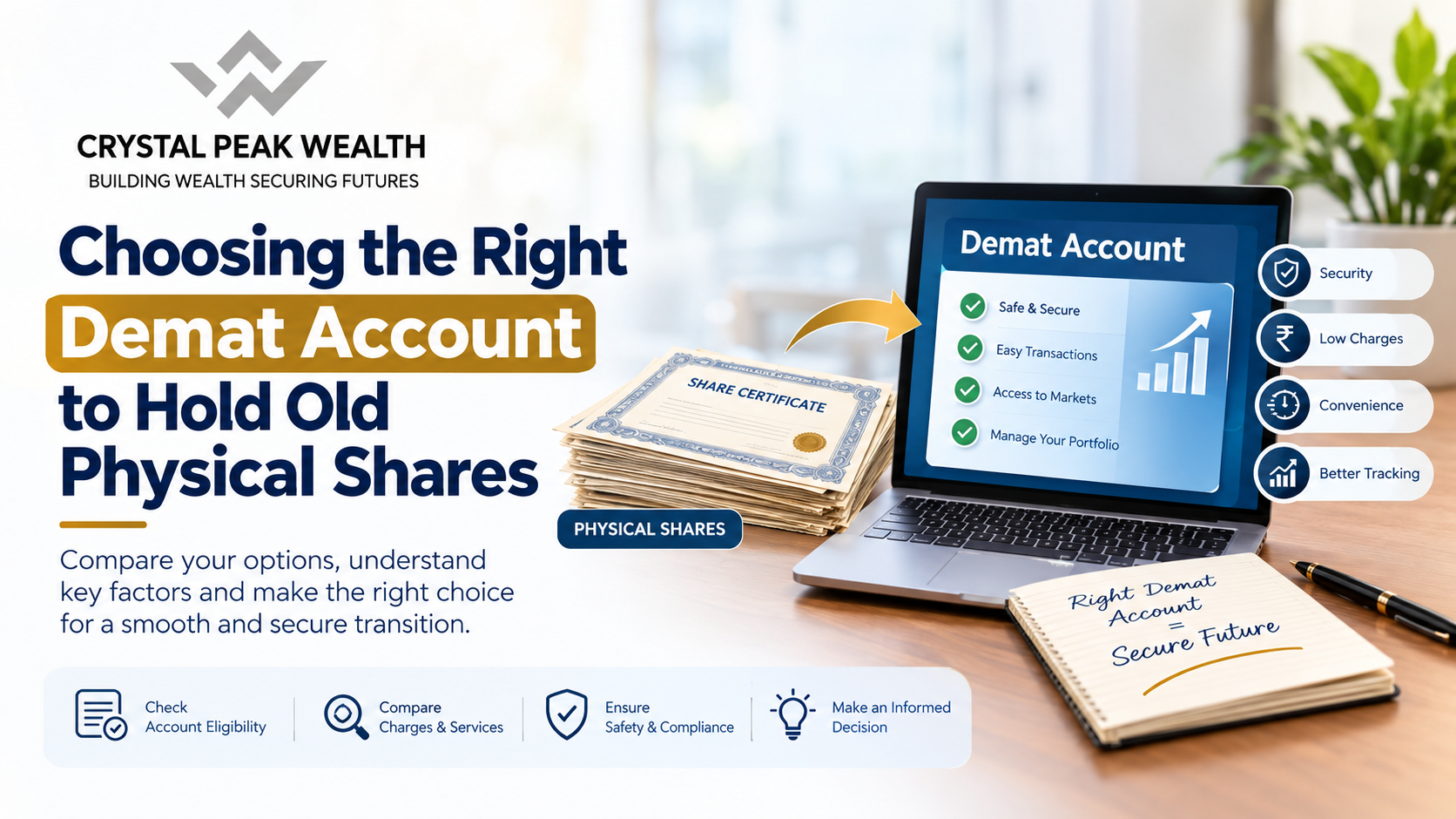
Somewhere in a cupboard, locker or old file there may be a bundle of paper share certificates. Perhaps a parent bought them in the 1990s, or perhaps you applied for an IPO two decades ago and never looked at the allotment again. You know they carry value. What you may not know is that paper certificates cannot be sold on the stock exchange as they stand, and that the first decision you face is which demat account for physical shares to use.
That decision matters more than it looks. Most guides treat it as a ten-minute formality, but the account you pick decides whether your conversion request is accepted, how much you pay every year, whether joint holders can be added, and how easily you can later sell, gift or pass on the shares. A mismatch between the account and the certificate is one of the most common reasons a request comes back rejected. If you would rather have specialists manage the whole journey, see how our physical-to-demat service works.
This guide explains what a demat account for physical shares does, the five checks that decide the right one, how a Basic Services Demat Account compares with a regular account, whether a bank or a broker suits you better, and the steps from opening the account to seeing shares credited. It is written for individual investors and families in India.
Quick answer: The right demat account for physical shares is one opened in exactly the same name, and the same order of names, as on your certificates, with a Depository Participant (DP) that accepts dematerialisation requests for paper certificates and quotes its charges clearly. For an individual whose holdings stay within ₹10 lakh, a Basic Services Demat Account (BSDA) is usually the cheapest choice. Certificates in joint names need a matching joint account.
Why the demat account for physical shares matters before you touch a certificate
Dematerialisation is the conversion of paper certificates into electronic holdings. Your certificates are surrendered and cancelled, and an equal number of shares is credited to the demat account named on your request form. The demat account for physical shares is therefore not an afterthought. It is the destination, and everything else in the process is checked against it.
There are three reasons to get it right the first time. First, the DP that holds your account is the gatekeeper: it gives you the Dematerialisation Request Form (DRF), forwards your certificates, and raises the request that you track until credit. Second, the Registrar and Transfer Agent (RTA) compares the names on your account with the names on the company’s register, and a mismatch sends the request back. Third, the account carries recurring costs for as long as you hold it, so a badly chosen account quietly drains a small portfolio year after year.
The regulatory direction leaves little room for delay either. Physical shares can be transferred only in demat form, which is why paper certificates cannot be sold on the exchange. Under SEBI’s master circular for Registrars to an Issue and Share Transfer Agents, dated 6 February 2026, securities issued on investor service requests, such as claims and duplicate certificates, are credited only in demat mode. Even if you are not ready to sell, you will almost certainly need a demat account for physical shares at some point.
What a demat account for physical shares actually does
A demat account works like a bank account for securities. Purchases appear as credits, sales as debits, and your holdings sit as electronic entries rather than paper. The account is opened with a DP, usually a bank or a broker, and the DP is linked to one of India’s two depositories. You can read about each depository’s services on the NSDL and CDSL websites.
A demat account for physical shares does two separate jobs. It receives the converted shares once the request is approved, and it gives you a Client ID, which is the reference the DP and RTA use to process your request. Nothing happens to your certificates until that account exists, because the DRF asks for the account details up front.
The five checks that decide the right demat account for physical shares
You do not need to compare dozens of providers. Five practical checks will narrow the field quickly, and they matter in roughly the order listed.
1. Match the name, and the order of names, on the certificate
This is one of the checks that causes the most rejections. The name on the demat account for physical shares must match the name on the certificate, and for joint holdings the order of names must be identical. A certificate in a single name cannot simply be credited to a joint account, and a joint certificate needs a joint account with the holders listed in the same order. Every co-holder must also sign the DRF, and each signature must match the specimen the company holds.
Check the spelling of initials and surnames as well. Certificates issued decades ago often carry abbreviated names, a maiden name, or a spelling that differs from your PAN. If your name has changed since the shares were issued, sort out the update with the RTA first. Our explainer on why some dematerialisation requests are rejected or delayed lists the mismatches that most often cause problems, so you can spot them before you open anything.
2. Decide whose account the shares belong in
Sometimes the shares are not really yours yet. If the certificate stands in the name of a family member who has passed away, you cannot dematerialise it straight into your own account. The shares must first be transmitted to the legal heir with the right legal documents, and that step can be combined with the demat step so the shares are credited to the heir’s account. In that situation the demat account for physical shares should be opened in the legal heir’s name, never in the name of the deceased.
3. Confirm the DP actually handles physical certificates
Not every DP is equally comfortable with paper. Opening a demat account for physical shares online is easy almost everywhere, but processing a DRF with original certificates is a physical process, and some providers handle it smoothly while others make it slow or awkward. Before you open an account, ask these questions:
- Do you accept DRFs for physical certificates, and is there any restriction by company or number of certificates?
- Where must I send the certificates: a local branch, a head office, or by courier?
- Will you give me an acknowledgement and a request number so I can track progress?
- What is the fee per certificate, and what postage or handling do you add?
- Who do I contact if the RTA raises an objection?
A DP that answers these clearly, in writing, is usually a better choice than one with a slightly lower annual fee and vague answers.
4. Compare the full cost, not just the opening fee
Many providers advertise zero account-opening charges, and that headline hides the costs that matter for old shares. Look at four items together:
- Annual maintenance charge (AMC): the yearly fee for keeping the account, which varies widely between DPs.
- Dematerialisation fee: charged per certificate, commonly quoted in the region of ₹150 plus GST, though some DPs charge more.
- Postage and handling: added by the DP for sending certificates onward.
- Transaction charges: applied when you eventually sell.
Ask each DP for its tariff sheet and add up what you would pay in the first year and in each year afterwards. For a small holding, the AMC usually outweighs the one-time conversion fee over time.
5. Think about what happens after the conversion
Once the shares are credited, you will manage the account for years. Check for easy online access, free electronic statements, a simple nomination process and responsive support. If you plan to sell soon, trading features matter; if you plan to hold, low cost and reliable statements matter more. Either way, a clear nomination facility protects your family.
BSDA or regular: which demat account for physical shares costs less?
A Basic Services Demat Account (BSDA) is a low-cost version of a regular demat account introduced by SEBI to reduce charges for small investors. Under SEBI’s circular of 28 June 2024 on the BSDA facility, the value limit rose from ₹2 lakh to ₹10 lakh. For a retired parent with a handful of old certificates, that can make a real difference to the yearly bill.
Feature | BSDA | Regular demat account |
Holding value limit | Up to ₹10 lakh | No limit |
Annual maintenance charge | Nil up to ₹4 lakh; up to ₹100 between ₹4 lakh and ₹10 lakh | As per the DP’s tariff |
Who can hold it | An individual, with only one BSDA across all depositories | Individuals, joint holders and other entities |
Joint certificates | Confirm with the DP, as many offer BSDA only for single holders | Suitable, with names in the certificate’s order |
What happens above the limit | Converts to regular-account charges | Not applicable |
A few practical points follow from these rules.
First, the BSDA conditions require that you have only one demat account in which you are the sole or first holder. If you already trade through an account in your own name, opening a second demat account for physical shares can cost you the BSDA benefit. In that case, the better route is usually to use the existing account, provided the names match the certificates.
Second, the value limit applies to everything in the account, not only the converted shares. DPs generally value listed shares at market prices and unlisted shares at face value. Add up your existing holdings and the shares you are about to convert at today’s prices. If the total is likely to cross ₹10 lakh, a regular account may be the simpler choice from day one, because a BSDA that crosses the limit is charged as a regular account anyway.
Third, SEBI has continued to refine how some securities are valued for the BSDA test, so confirm the current rules with your DP. The saving is real, but it should not be the only factor in choosing a demat account for physical shares.
Bank, broker or discount broker: who should hold your account?
India has several kinds of DP, and the right one depends on how you expect to use the account. Many banks are DPs, so a broker is not compulsory for dematerialisation.
Type of DP | Where it tends to work well | What to watch |
Bank | A familiar branch, in-person help with the DRF, easy linking to your savings account | Charges can be higher, and branch staff may have limited experience with old certificates |
Full-service broker | A relationship manager and hands-on help with paperwork | Fee structures vary, so ask for the complete tariff |
Discount or app-based broker | Low or nil AMC and quick online opening | Check how they accept paper certificates and where you must send them |
None of these is automatically best. What matters is that the specific DP you pick can handle a DRF with original certificates without friction.
Which demat account for physical shares suits which situation?
The examples below are illustrative, but they show how the checks combine in real families.
A retired parent with three certificates in one name. The holding is modest, the holder is a single person, and the total is well under ₹10 lakh. The demat account for physical shares that usually costs least here is a BSDA with a bank or broker that accepts DRFs, as long as the parent has no other demat account in a sole name.
A couple holding certificates jointly. The account must carry both names in the certificate’s order, and both must sign the DRF. A regular joint demat account for physical shares is the practical answer here, since many DPs restrict BSDA to single holders.
Siblings who inherited shares from a parent. The shares must be transmitted to the legal heirs first. The demat account for physical shares should be opened in the names of the heirs who will hold the shares after transmission, so agree among the family who will hold what before choosing a DP.
Step-by-step: opening and using a demat account for physical shares
Here is the route from first decision to credited shares.
Step 1: List your certificates. Note the company name, folio number, certificate numbers, quantity and the names of all holders.
Step 2: Shortlist two or three DPs. Use the five checks above. Ask for the tariff sheet and the DRF process in writing.
Step 3: Open the demat account for physical shares. You will need your PAN, identity proof, address proof, bank proof such as a cancelled cheque, and a photograph. After verification you receive a Client ID and access details. Choose the account type (BSDA or regular) deliberately instead of accepting the default.
Step 4: Add a nominee. Do this at the start. It costs nothing and spares your family a long process later.
Step 5: Collect the DRF. Your DP provides it. Fill in the company name, the ISIN, the folio number and the number of shares for each company. Our DRF submission checklist shows exactly what to include.
Step 6: Prepare the certificates. Write “Surrendered for Dematerialisation” across the face of each certificate, and make sure every holder’s signature matches the company’s specimen.
Step 7: Submit and keep the acknowledgement. Hand over the DRF and certificates to the DP and keep the receipt safely. It is your tracking reference.
Step 8: Wait for verification. The DP forwards the request to the RTA, which checks it against its records. If anything does not match, the request may be returned.
Step 9: See the shares credited. A clean request usually takes about 15 to 30 days. Once approved, the certificates are cancelled and an equal number of shares appear in your account.
A worked example with illustrative numbers
Suppose a family holds four certificates in a single name, valued together at about ₹3 lakh. They choose a BSDA, which carries no AMC at that value. The DP charges a dematerialisation fee of ₹150 per certificate plus GST, which comes to ₹600 before tax, or about ₹708 once GST at 18 per cent is added. Add a modest amount for postage, and the one-time cost is under a thousand rupees.
If the same family had picked a regular account with a yearly AMC, five years of AMC could add up to more than the one-time conversion fee. These figures are examples only, but for small holdings the recurring charge is usually the bigger cost, which is why the full cost matters.
Common mistakes when choosing a demat account for physical shares
Most delays trace back to avoidable errors made at the choosing stage:
- Opening an account in a name or order that does not match the certificate.
- Choosing a DP on the headline opening fee without checking per-certificate and postage charges.
- Assuming every broker will accept paper certificates without asking how.
- Opening a second sole-holder account and losing BSDA eligibility on both.
- Opening an account in your own name for shares that first need transmission from a deceased holder.
- Skipping the nominee form and leaving the family to sort out the account later.
Frequently asked questions
Can I use my existing demat account for physical shares?
Yes, provided the name on the account, and the order of names for joint holders, matches the certificates exactly. If it does not, you will need a new account that does. Using an existing matching account avoids extra charges and keeps you within the single-account condition for a BSDA.
Which is the best demat account for physical shares: bank or broker?
There is no single best option. A bank can suit someone who wants in-person help with the DRF, while a broker may offer lower charges. The best demat account for physical shares is the one whose DP clearly accepts DRFs for paper certificates, explains its charges in writing and supports you if the RTA raises an objection.
Do joint certificates need a joint demat account for physical shares?
Yes. A certificate in joint names must be dematerialised into a joint account with the holders in the same order, and every holder must sign the DRF. A single-name account will not work for joint certificates.
How long does it take for physical shares to show in a demat account?
A clean request usually takes about 15 to 30 days from submission. It can take longer if names or signatures do not match the company’s records, if a duplicate certificate is needed first, or if the RTA has a backlog.
What does it cost to convert physical shares to demat?
Your DP typically charges a dematerialisation fee per certificate, commonly in the region of ₹150 plus GST, along with postage or handling and the yearly maintenance charge on the demat account for physical shares. Rates differ between providers, so ask for the fee schedule before you begin.
Conclusion: choose the demat account for physical shares before you start the paperwork
Old certificates do not expire, but they cannot be sold on the exchange until they are converted. Match the names and their order to the certificates, decide whose account the shares belong in, pick a DP that handles paper properly, compare the full cost, and weigh a BSDA against a regular account honestly. Do those five things and the rest of the process becomes routine.
If you would rather not manage the paperwork yourself, Crystal Peak Wealth can help. With 20+ years of experience helping investors and families convert paper shares, our team handles the process end to end: guiding you through opening the account, verifying your certificates, coordinating with the DP and RTA, fixing mismatches and following the request through to credit. Call us on +91 98200 06665, message us on WhatsApp, or write to info@crystalpeakwealth.com for a no-obligation assessment of your holding, and start by choosing the right demat account for physical shares.