
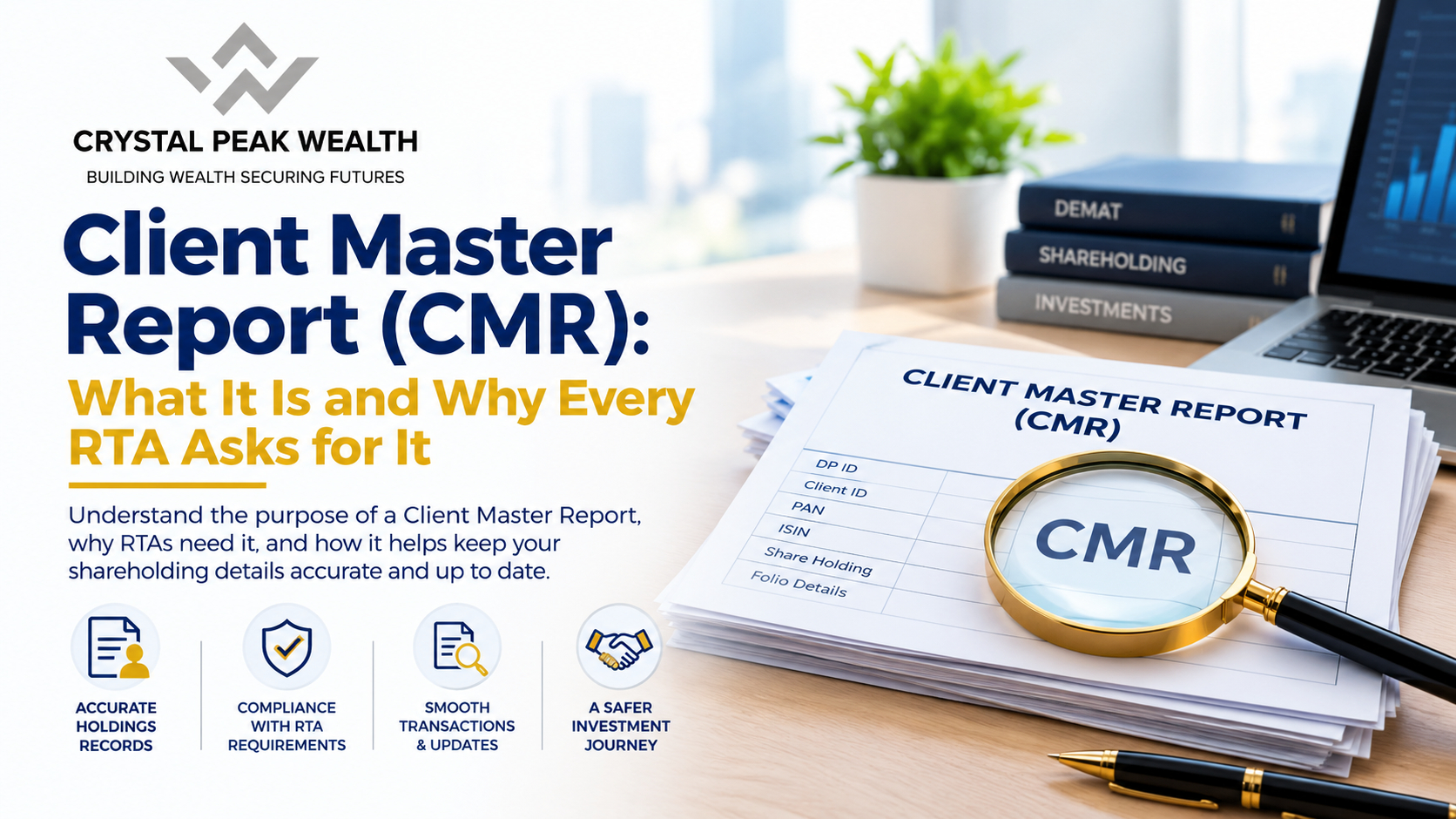
When you begin converting old physical share certificates into electronic holdings, you may be asked to submit a document that appears simple but plays an important role in the verification process. This document is commonly called a Client Master Report (CMR) or Client Master List (CML), depending on the depository participant and the process involved.
A client master report for demat contains essential information about your demat account, including the account holder’s name, account identifiers, and other registered details. The company’s Registrar and Transfer Agent (RTA) may need this information to verify where eligible securities should be credited and whether the account details match the documents submitted.
For investors holding shares purchased decades ago, the requirement can raise several questions. Where can you obtain the report? Does it have to be attested? What happens if the name on your share certificate differs from the name in your demat account? Can an outdated report delay your application?
Understanding these details before submitting your paperwork can help you avoid preventable errors.
At Crystal Peak Wealth, the focus is on helping investors navigate the complexities of physical share dematerialisation, documentation, and unclaimed investment recovery. This guide explains the purpose of the report, the information it contains, how to obtain it, and how to prepare it for an RTA or other authorised recipient.
What Is a Client Master Report for Demat?
A client master report for demat is a record of the details associated with an investor’s demat account, maintained through the systems of the relevant Depository Participant (DP). The DP is the intermediary through which an investor accesses the services of a securities depository.
India has two principal securities depositories:
Investors generally access their demat accounts through a DP, such as an eligible bank, stockbroker, or other registered intermediary.
The report helps establish the identity and account details of the intended securities recipient. Depending on the document and the DP, it may contain the investor’s name, DP ID, Client ID or other account identifiers, account type, holder configuration, and relevant registered information.
A client master report for demat is particularly useful when documentation must be checked before securities are credited to an electronic account.
For example, suppose you discover physical share certificates issued to you many years ago. You open a demat account and submit a dematerialisation request through your DP. The RTA must verify the certificates and associated records before the shares can be credited. The account details in your supporting documentation help establish the intended destination.
The report does not prove by itself that you own the physical shares or that a dematerialisation request has been approved. Ownership, eligibility, certificate validity, and other supporting documents may also need to be verified.
Why Do RTAs Ask for This Document?
An RTA manages shareholder records and processes various investor service requests for companies. Depending on the request, it may coordinate with the issuer, the investor, and the relevant DP.
A client master report for demat helps the relevant parties verify the receiving account and reduce errors during document processing.
1. To verify the receiving account
The account details must correspond to the intended recipient of the securities. If the account identifier or holder information is incorrect, the recipient’s details may need clarification before processing can continue.
2. To check the holder configuration
The names and order of holders can matter when the shares are held jointly. If the physical certificate lists two holders but the receiving account has a different holder configuration, the mismatch may require resolution before the request can proceed.
3. To support document verification
The report can help the RTA or other authorised recipient compare the account details against the investor’s application and supporting records.
4. To reduce processing errors
Incorrect account details can create additional correspondence, resubmissions, or delays. Supplying the requested report in the required format helps the reviewing organisation complete its checks more efficiently.
5. To facilitate certain investor service requests
A client master report for demat may be requested for processes beyond the initial conversion of physical shares. These can include eligible transmission claims, credit of securities following an investor service request, and certain account-related transfers.
The exact requirements depend on the type of request and the applicable regulatory and operational procedures.
What Information Does a Client Master Report Contain?
The precise fields vary according to the DP, depository, account type, and report format. A client master report for demat commonly contains several categories of information.
Information | Why it matters |
Account holder’s name | Helps verify the intended recipient |
DP name and identifier | Identifies the intermediary maintaining the account |
Client ID or account number | Helps identify the relevant demat account |
Account type | Indicates whether the account is individual, joint, or another permitted category |
Holder configuration | Helps establish the registered account ownership pattern |
Registered contact details | May support communication and verification |
Bank or KYC-related information | May appear in the report, depending on the format and account settings |
Not every report contains every field listed above. Some details may be masked, omitted, or presented differently.
Before submitting a client master report for demat, review the actual document supplied by your DP and follow the receiving organisation’s instructions. Do not assume that a screenshot of an account dashboard or a routine holding statement is an acceptable substitute.
CMR versus CML: Are They the Same?
The terms Client Master Report (CMR) and Client Master List (CML) are sometimes used interchangeably in everyday discussions. However, the exact document name and format can differ across systems and procedures.
For example, NSDL’s participant guidance refers to a duly certified Client Master Report in certain dematerialisation-related documentation. SEBI circulars also refer to a Client Master List for specified investor service requests.
SEBI’s circular dated 30 January 2026 provides that, for the covered investor service requests, the latest CML must be no more than two months old and attested by the DP. The circular states that the relevant changes come into force on 2 April 2026. These requirements should be read in the context of the specific requests covered by the circular, rather than assumed to apply identically to every transaction.
Sources:
The safest approach is to ask the requesting RTA or institution which document it requires, whether certification is necessary, and how recent the report must be.
How to Obtain a Client Master Report for Demat
Investors can generally request the document from the DP maintaining their account. The available method depends on the intermediary’s online facilities and internal procedures.
Follow these steps to obtain a client master report for demat.
Step 1: Identify your Depository Participant
Check your demat account statement, account-opening documents, or the official application through which you manage your holdings.
Confirm whether your account is maintained through an NSDL or CDSL participant and identify the DP’s official contact channel.
Step 2: Log in to your account
Open the DP’s official website or application and look for account documents, profile information, service requests, or downloadable account reports.
Some providers allow customers to download account details directly. Others require a service request or a message to customer support.
Step 3: Request the correct report
If you cannot find the document online, contact your DP and specifically request a Client Master Report or Client Master List, as applicable.
Explain why you need it—for example, to submit supporting documents for the dematerialisation of physical shares or to complete an RTA-related investor service request.
Step 4: Request certification if required
Ask whether the report must be certified, digitally authenticated, or physically attested by the DP.
Do not assume that an ordinary downloaded PDF will meet the recipient’s requirements. Similarly, do not arrange notarisation unless it has been requested or is otherwise applicable.
Step 5: Check the report before submitting it
Review the account holder’s name, account identifiers, and holder configuration. Confirm that the document is complete and readable.
If the receiving organisation has specified a validity period, verify that the report falls within that period.
Step 6: Submit it through the authorised channel
Send the document using the method specified by the DP, RTA, company, or other authorised recipient. Keep a copy of the submitted document and any acknowledgement or reference number.
Following these steps helps ensure that your client master report for demat is obtained and submitted in the appropriate format.
Documents Required Along With the Report
A client master report for demat is only one part of the documentation that may be needed for physical share conversion or an RTA service request. The complete list depends on the circumstances of the holding.
For a standard dematerialisation request, you may need the following:
- Original physical share certificates, where required.
- A completed and signed Dematerialisation Request Form (DRF).
- The appropriate demat account details.
- The requested CMR or CML in the required format.
- Additional identity, KYC, or supporting documents if requested.
- Further documents to resolve discrepancies in names, signatures, addresses, or ownership records.
For other investor service requests, such as transmission or claims involving unclaimed securities, additional forms and supporting evidence may be required.
For a detailed document checklist, read Documents Required to Convert Physical Shares to Demat.
It is important to distinguish between a standard dematerialisation request and a request involving lost certificates, inherited holdings, or securities held in a suspense account. These situations may require different procedures.
Why the Complete Document Set Matters
Submitting a client master report for demat without the other required documents will not necessarily make an application complete.
For example, an investor may have a correctly issued account report but may have signed the DRF incorrectly. Another investor may provide all the requested forms but discover that the names on the certificates do not match the registered records.
The documents must be assessed together. A correct account report helps verify the receiving account, but it cannot resolve every issue related to the underlying shareholding.
How the Report Supports Physical Share Dematerialisation
Dematerialisation converts eligible physical securities into electronic holdings in an investor’s demat account.
Although the process may appear straightforward, older share certificates can present practical challenges. The company may have changed its name, the shareholder may have moved, the original signature may differ from current records, or the certificates may belong to a deceased family member.
A client master report for demat helps identify the receiving account while the other parts of the application establish the relevant holding and satisfy the applicable requirements.
Step 1: Review the physical certificates
Check the company name, shareholder name, folio number, certificate number, distinctive numbers where applicable, and number of shares.
If a company has undergone a merger, name change, or other corporate action, the historical details may need to be reconciled with the current records.
Step 2: Verify the demat account details
Make sure the account information supplied by your DP corresponds to the intended holder or holders.
Do not make changes to the account details simply to force a match. Any genuine discrepancy should be resolved through the relevant authorised process.
Step 3: Complete the dematerialisation request
Complete the DRF as instructed by your DP. Check that the details on the form correspond to the certificates and the relevant account information.
Step 4: Submit the documents for verification
The DP and RTA carry out their respective checks under the applicable procedures. Depending on the case, they may seek additional clarification or return a request for correction.
Step 5: Track the application
Keep the acknowledgement or request reference provided by your DP. If the request is delayed, ask which stage it has reached and whether additional documents are required.
For a complete walkthrough, read How to Dematerialise Shares in India.
The client master report for demat supports the account-verification stage, but the final outcome depends on the full application, the eligibility of the securities, and the verification performed by the relevant parties.
Common Errors That Can Delay Your Application
Many document-related delays occur because small inconsistencies go unnoticed before submission. Reviewing the paperwork in advance can help reduce avoidable back-and-forth communication.
1. Incorrect account identifiers
A typographical error in the account details can make it difficult to verify the intended recipient.
What to do: Compare the details on the client master report for demat against the account information maintained by your DP.
2. Name mismatch
The name on an old share certificate may differ from the name in the demat account because of a marriage, a legal name change, a spelling discrepancy, or a historical record error.
What to do: Contact the DP or RTA to determine the correct procedure for resolving the discrepancy. Do not assume that the report alone can correct the shareholder record.
3. Joint-holder mismatch
The order or combination of names on the physical certificate may differ from the receiving account.
What to do: Check the holder configuration before submitting the documents and ask the DP whether a different account arrangement is needed.
4. An outdated report
Certain requests require a recent account document. An older report may not satisfy the specified validity requirements.
What to do: Confirm the date requirement with the receiving organisation. Where the applicable rule requires a report issued within the previous two months, obtain a fresh one and ensure the required DP attestation is present.
5. Missing certification
A report may contain accurate information but still be rejected if the applicable process requires formal certification or attestation.
What to do: Obtain the exact format requested by the recipient.
6. Incomplete supporting paperwork
The report may be correct while the DRF, certificates, declarations, or other required documents are missing or incomplete.
What to do: Use a document checklist and confirm that every applicable item has been included.
7. Confusing a holding statement with the required report
A statement showing your current investments is not necessarily the same document as a CMR or CML.
What to do: Request the exact document by name and explain the purpose for which it is needed.
8. Not keeping submission records
Investors sometimes lose track of when they submitted their documents or which version was provided.
What to do: Keep a copy of the final application, the submitted report, the acknowledgement, and any correspondence.
If your request has already been returned or delayed, read Why Do Some Dematerialisation Requests Get Rejected or Delayed?.
What If Your Physical Shares Are Old, Inherited, or Unclaimed?
Not every investor starts with a clean set of certificates and matching records. Some people discover old investments belonging to their parents or grandparents. Others find certificates bearing a previous company name or learn that dividends and shares have moved into an unclaimed or suspense arrangement.
In such cases, obtaining a client master report for demat is a useful preparatory step, but it is not the entire solution.
When the shareholder has passed away
If the original shareholder has died, the appropriate transmission or succession procedure may need to be completed before the shares can be credited to the claimant’s account.
Depending on the circumstances, the documents may include a death certificate, transmission forms, identity documents, declarations, and other evidence of entitlement.
The receiving account must be appropriate for the claimant and the particular request.
When the original certificate is missing
A missing certificate may require a separate process for duplicate issuance or another applicable investor service request. The route depends on the records available, the issuer’s procedures, and current regulatory requirements.
Read Can You Dematerialise Shares Without the Original Certificate? for a closer look at this situation.
When the investment is unclaimed
Shares and dividends that have remained unclaimed for the prescribed period may be transferred to the Investor Education and Protection Fund (IEPF), where applicable.
Recovery involves a separate claim process and supporting documentation. A demat account report may be required to establish the intended destination of securities, but it does not replace the forms and evidence required for an IEPF claim.
Investors should verify the applicable process with the company, its RTA, and the official IEPF resources before filing.
When the company name has changed
The company name on an old certificate may not match the name used in current records. A name change does not automatically mean that the certificate is invalid, but the relevant historical and current records may need to be checked.
In each of these situations, prepare the client master report for demat alongside the documents specifically requested for the case. Avoid sending a generic document package without first confirming which procedure applies.
How Long Does It Take to Get the Report and Complete Dematerialisation?
The time required to obtain a client master report for demat depends on the DP’s document-delivery process. If the document is available through the account portal, it may be possible to obtain it quickly. If certification or a service request is necessary, additional time may be required.
The overall dematerialisation process is separate. It involves checking the certificates, verifying the submitted documents, and completing the relevant DP and RTA procedures.
Delays can occur when signatures do not match, the shareholder’s name is inconsistent, the certificates require further verification, or supporting paperwork is incomplete.
There is no single completion timeline that applies to every case. For further guidance, read How Long Does Dematerialisation Take in India?.
When contacting your DP about a client master report for demat, ask whether the document is ready, whether any certification is pending, and whether the report meets the recipient’s requirements. Once you submit the report, retain your acknowledgement and follow up using the reference number provided.
Best Practices Before Submitting Your Report
A careful document review can make the process easier to manage. Before submitting your client master report for demat, follow this checklist.
- Confirm the exact document requested: CMR, CML, or another specified record.
- Verify the name and account identifiers against your demat account.
- Check that the holder configuration is appropriate for the application.
- Obtain DP attestation or certification if required.
- Confirm the report’s acceptable issue date or validity period.
- Match the account details against the application form.
- Prepare all other required forms and supporting documents.
- Submit the documents through the authorised channel.
- Keep copies of the submitted paperwork and acknowledgement.
- Follow up promptly if the DP or RTA requests clarification.
These checks are particularly useful when you are dealing with old investments, multiple folios, inherited holdings, or a large number of certificates.
Remember that a client master report for demat verifies important account information; it does not independently establish ownership of every certificate. The complete application must meet the requirements of the relevant issuer, DP, RTA, and applicable regulations.
How Crystal Peak Wealth Can Help
Managing old physical share certificates can become complicated when documents are missing, shareholder details have changed, or investments have remained unclaimed for years.
Crystal Peak Wealth helps investors navigate physical share dematerialisation and related documentation challenges. The process may involve reviewing available records, identifying discrepancies, coordinating with relevant parties, and helping investors understand the next steps for their particular case.
If you are unsure how to obtain a client master report for demat, whether your account details match your certificates, or which supporting documents you need, professional guidance can help you approach the process more systematically.
Explore the dematerialisation of physical shares service to learn more about the process.
You can also visit Crystal Peak Wealth to explore its physical share conversion and unclaimed investment recovery services.
Need help with your old physical shares? Contact Crystal Peak Wealth to discuss your documentation requirements and understand the appropriate next steps for your situation. The requirements and processing time will depend on the nature of your holdings and the relevant verification procedures.
Frequently Asked Questions
1. What is a client master report for demat?
A client master report for demat is an account record issued or provided through a Depository Participant. It contains key information about the investor’s demat account and may be used to verify the intended recipient of securities.
2. Who issues a Client Master Report?
Your Depository Participant, such as an eligible bank or stockbroker maintaining your demat account, is generally the organisation to contact for a CMR or CML. The available format and method of delivery depend on the DP.
3. Why does an RTA ask for a client master report for demat?
An RTA may request the report to verify the receiving account and compare relevant account details against the investor’s application. The requirement depends on the type of investor service request and the applicable procedure.
4. Is a Client Master Report the same as a demat statement?
No, they are not necessarily the same. A demat statement primarily shows account holdings and transactions over a specified period, whereas a client master report focuses on registered account information. Always confirm which document the recipient requires.
5. Can I download a client master report for demat online?
Many DPs provide account documents through their official websites or applications. If the report is unavailable for download, contact your DP and request the correct version, including certification if required.
6. Does the report need to be attested?
It depends on the request. Certain regulatory procedures require a DP-attested CML. For example, SEBI’s January 2026 circular specifies a recent, DP-attested CML for the covered investor service requests. Check the current requirements applicable to your particular application.
7. How old can a Client Master List be?
There is no reason to assume that one validity period applies to every type of request. For the investor service requests covered by SEBI’s January 2026 circular, the CML must not be older than two months and must be attested by the DP. Confirm whether that requirement applies to your case.
8. What if my name is different on my certificates and demat account?
Contact your DP and the company’s RTA to establish the appropriate correction or verification process. A difference caused by marriage, a legal name change, a spelling error, or an old record may require additional evidence. Do not assume that submitting the report alone resolves the discrepancy.
9. Can I use the same report for every RTA application?
Not necessarily. The document may need to be updated, attested, or issued in a particular format. A new request may also involve additional documentation, depending on the nature of the service.
10. Is a client master report for demat enough to convert physical shares?
No. It supports verification of the receiving account, but the conversion process may also require the original certificates, a completed DRF, and other applicable documents. The DP and RTA must complete their respective checks before the securities can be credited.
11. What should I do if my report contains incorrect details?
Contact your DP and request clarification or correction through its authorised process. Obtain an updated report before submission if the correction affects information required by the recipient.
12. Can Crystal Peak Wealth help if my dematerialisation request is delayed?
Crystal Peak Wealth provides assistance with physical share dematerialisation and related documentation challenges. You can contact the team to discuss your circumstances and understand what steps may be appropriate. The outcome and timeline depend on the facts of the case and the relevant parties’ procedures.
Conclusion
A Client Master Report is an important supporting document in many demat-related processes because it helps establish the details of the receiving account. Obtaining the correct version, checking the account information, and confirming the recipient’s requirements can reduce avoidable document errors.
Whether you are converting old physical certificates, handling inherited shares, or preparing documents for an RTA, do not treat the report as a substitute for the complete application. Review the certificate details, complete the required forms, and resolve discrepancies through the appropriate channels.
If you need assistance with the dematerialisation process, visit Crystal Peak Wealth’s physical share dematerialisation page to explore the available services and get guidance on your next steps.
2. Source references for publication
The following authoritative sources support the regulatory and procedural information in the article:
- SEBI — January 2026 circular: SEBI’s official website — search for the circular dated 30 January 2026 concerning the removal of the Letter of Confirmation requirement and direct credit of securities in demat accounts. It specifies CML requirements for the investor service requests covered by the circular.
- NSDL — Participant Services: NSDL participant services circular — guidance referring to certified Client Master Reports in specified dematerialisation-related procedures.
- CDSL — Corporate Action Documentation: CDSL official documentation — examples of procedures requiring certified client master reports for particular corporate actions.
- Crystal Peak Wealth — Dematerialisation hub: Dematerialisation of Physical Shares.
[…] our explainer on SEBI ISR forms. For the CML specifically, including how to get it attested, see what a Client Master Report contains and why every RTA asks for […]