
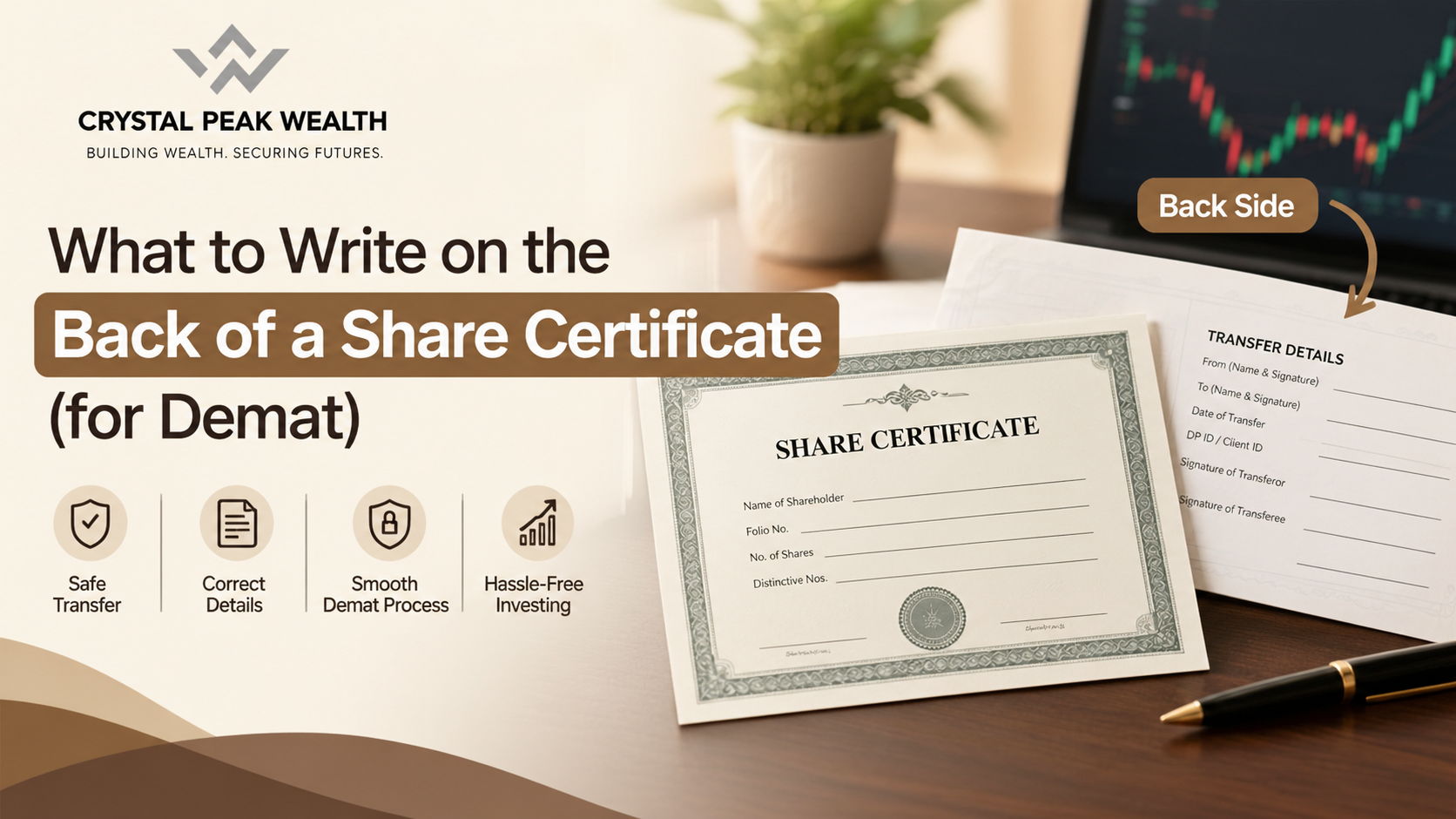
If you’re holding old, physical share certificates and getting ready to convert them into electronic form, one small but important question always comes up: what to write on back of share certificate before you hand it over to your Depository Participant (DP)? Get this step wrong, and your Dematerialisation Request Form (DRF) can bounce back, adding weeks to a process that should take under a month.
This guide answers exactly what to write on back of share certificate, where to write it, who needs to sign, and the mistakes that most commonly cause rejections at the Registrar & Transfer Agent (RTA) stage.
The Short Answer: What to Write on Back of Share Certificate for Demat
The short version of what to write on back of share certificate is this: you (or your DP, depending on their internal process) need to clearly write or stamp the words “SURRENDERED FOR DEMATERIALISATION” on the certificate, in capital letters, before it is sent along with the DRF. This is often called “defacing” the certificate. Its purpose is simple — it permanently marks that particular certificate as cancelled for physical use, so it can never be reused, resold, or fraudulently presented again once your shares exist electronically in your demat account.
Some DPs prefer this written across the face of the certificate (the printed side with your name, folio number, and share quantity), while others accept it on the back, especially when the front has little blank space left. Either way, the core answer to what to write on back of share certificate stays the same: it’s the defacement phrase, written legibly, in the space your DP indicates.
Why You Need to Know What to Write on Back of Share Certificate
Physical shares in India can no longer be transferred on the stock exchange — SEBI’s 2018 rule made dematerialised form mandatory for any transfer. So most people asking what to write on back of share certificate are doing so because they’re finally converting inherited, gifted, or long-forgotten paper certificates into a demat account.
Getting the defacement wording right matters for three reasons:
- It prevents your DP or the company’s RTA from rejecting the DRF on a technicality.
- It protects you — once the certificate is defaced and stamped, nobody else can use that same physical document.
- It creates a clean paper trail between the old physical holding and your new electronic one, which the RTA cross-checks against its own records before approving the request.
This is precisely why knowing what to write on back of share certificate in advance saves you a return trip to your DP’s office.
Step-by-Step: What to Write on Back of Share Certificate Before Submission
Here’s the practical sequence for handling what to write on back of share certificate, from the moment you decide to dematerialise to the moment you submit your documents.
Step 1: Confirm the exact wording with your DP first
Before you touch a pen to the certificate, call or visit your DP. Most banks and brokers follow the standard SEBI-recommended phrase, but a few have slightly different internal formats. Confirming what to write on back of share certificate with your specific DP avoids any risk of using outdated or incorrect wording.
Step 2: Fill your DRF completely
The Dematerialisation Request Form needs to match the certificate exactly — company name, ISIN, folio number, distinctive numbers, and number of shares in both figures and words. Errors here are actually a more common cause of rejection than the defacement wording itself, so double-check this before you even think about what to write on back of share certificate.
Step 3: Write the defacement text clearly
Once the DRF is ready, write “SURRENDERED FOR DEMATERIALISATION“ in bold, legible capital letters, using a pen (never pencil). This is the actual answer to what to write on back of share certificate that most DPs will ask you to follow. Avoid overlapping it with the printed folio number, distinctive numbers, or certificate number — those need to stay fully readable for verification.
Step 4: Sign as per your specimen signature
Every registered holder listed on the certificate must sign it, and the signature must match what’s on file with the company’s RTA and your demat account. If you’re wondering what to write on back of share certificate in terms of signature placement, keep it directly below or beside the defacement text, not over any printed detail.
Step 5: Attach the certificate to your DRF and submit
Hand over the defaced certificate along with the filled DRF to your DP. Always ask for an acknowledgement slip with a DRN (Demat Request Number) — this is your tracking reference until the shares are credited electronically.
Where Exactly Should You Write It on the Certificate
A lot of the confusion around what to write on back of share certificate actually comes down to a slightly different question: front or back? Traditionally, RTAs and DPs have asked holders to write the defacement phrase across the face of the certificate — the printed side with the company name and holder details — because that’s the side that gets compared against RTA records first.
The back of a physical share certificate usually carries the pre-printed “Form of Transfer” (used for older-style physical transfers, which are no longer permitted for trading purposes). If your DP specifically tells you to write on the reverse side instead — which some do when the front is crowded or already partially filled — then what to write on back of share certificate is still exactly the same phrase and signature requirement. Always follow your DP’s stated preference rather than assuming; it’s a two-minute phone call that avoids a rejected submission.
Who Should Write on the Back — Single vs Joint Holders
If the certificate is held solely in your name, only your signature is required alongside the defacement text. But what to write on back of share certificate changes slightly for jointly-held certificates: every single joint holder listed on the certificate must sign, in the same order their names appear on the certificate and in the demat account. Missing even one signature is one of the most common reasons DRFs get sent back for correction.
If one of the joint holders has passed away, this isn’t a simple demat request anymore — it becomes a transmission case first, and the demat step follows afterward. Don’t attempt to write “surrendered for dematerialisation” on a certificate involving a deceased holder without first completing transmission formalities.
Common Mistakes When Writing on Back of Share Certificate
Knowing what to write on back of share certificate is only half the job — avoiding these common errors is the other half:
- Wrong or incomplete phrase — writing “surrendered” alone, or an abbreviated version, instead of the full “SURRENDERED FOR DEMATERIALISATION.”
- Writing over printed details — obscuring the folio number, certificate number, or distinctive number makes verification harder and can delay approval.
- Mismatched signatures — a signature that doesn’t match your DP or RTA specimen record is the single biggest cause of DRF rejection.
- Using pencil or erasable ink — this can be challenged as tampering; always use a permanent pen.
- Forgetting a joint holder’s signature — every named holder must sign, not just the first one.
- Defacing before confirming with the DP — some DPs want to witness or stamp the defacement themselves; check first so you don’t have to arrange a duplicate certificate.
Getting even one of these wrong turns a simple what to write on back of share certificate question into a weeks-long delay while you sort out corrections with the RTA.
What to Write on Back of Share Certificate If It’s Damaged or Illegible
If your certificate is torn, faded, or has illegible printed details, don’t attempt any defacement yet. In this situation, what to write on back of share certificate isn’t the right first question — you first need a duplicate certificate issued by the company’s RTA, using an indemnity bond and the required supporting documents. Only once you have a clean, legible duplicate should you move on to writing the defacement phrase and submitting your DRF.
What Happens After You Write on the Certificate
Once you’ve handled what to write on back of share certificate correctly and submitted it with your DRF, your DP forwards the request electronically to the company’s RTA through NSDL or CDSL. The RTA checks the defaced certificate, your signature, and the DRF details against its own records. If everything matches, it confirms the request, the physical certificate is permanently cancelled, and an equal number of shares are credited to your demat account — usually within 15 to 30 days for a clean submission.
FAQs: What to Write on Back of Share Certificate for Demat
Do I write on the back or the front of the certificate?
Most DPs prefer the front (face) of the certificate for the defacement phrase, but some accept it on the back depending on available space. Always confirm with your DP before writing anything.
What exact words should I use?
The standard phrase confirmed across DPs and RTAs is “SURRENDERED FOR DEMATERIALISATION,” written clearly in capital letters using permanent ink.
Do all joint holders need to sign, or just one?
All registered holders must sign, in the same order as on the certificate, matching their specimen signatures on file.
What if I write the wrong thing by mistake?
Contact your DP immediately. Depending on the error, you may need a fresh duplicate certificate from the RTA rather than trying to correct the original.
Can my DP write it for me instead?
Some DPs prefer to witness or apply the defacement themselves rather than have the holder do it independently. It’s worth asking this before you write anything yourself.
Is there a fee for this step?
Writing the defacement text itself is free; your DP may charge a standard per-certificate dematerialisation and postage fee separately.
Final Word
Once you know what to write on back of share certificate, the rest of the dematerialisation process is mostly about paperwork accuracy — matching signatures, correct folio details, and a properly filled DRF. Get this one step right, and a request that could otherwise drag on for months usually clears in a matter of weeks.
If you’d rather not risk a rejected DRF over a mismatched signature or an incorrectly defaced certificate, Crystal Peak Wealth handles the entire process for you — verifying your documents, coordinating directly with your DP and the company’s RTA, and following the request through to final credit. You can read the full step-by-step process, including exactly what to write on back of share certificate, or reach out to their team directly to get your physical shares converted correctly the first time.
