
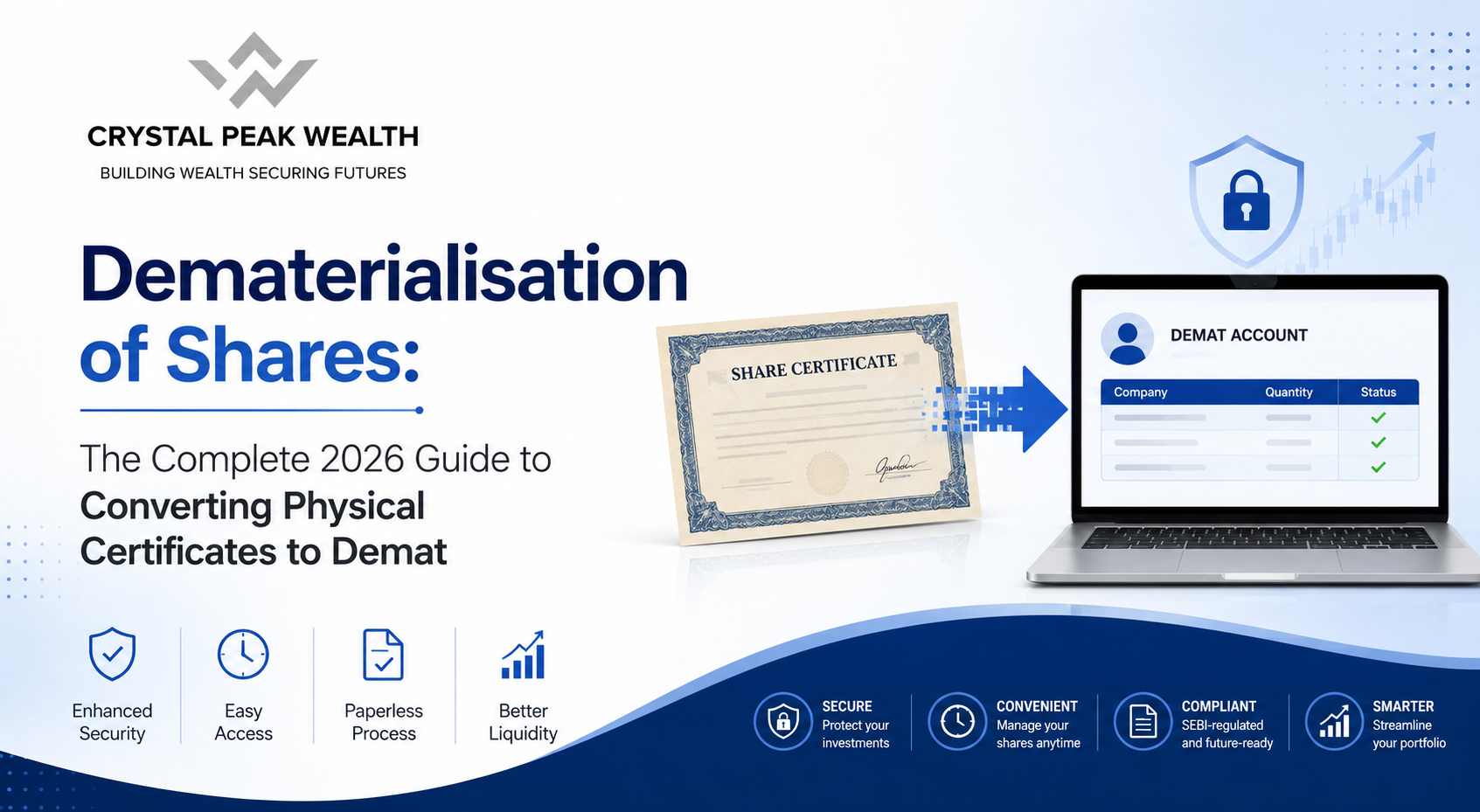
If you’ve inherited a bundle of old share certificates from a parent or grandparent, or if you’ve simply never gotten around to converting paper stocks you bought years ago, you’ve probably heard the term dematerialisation of shares thrown around. And you may have wondered: what exactly does it mean, is it complicated, and do I really need to do it now?
The short answer to the last question is yes — especially in 2026, with SEBI having introduced sweeping reforms that make the dematerialisation of shares faster and more investor-friendly than ever before. In this guide, we’ll walk you through everything you need to know: what dematerialisation means, why it matters, how to convert physical shares to demat step by step, what the latest SEBI changes mean for you, and how to handle the trickier edge cases that can make the process feel overwhelming.
What Is Dematerialisation of Shares?
Dematerialisation of shares is the process of converting physical paper share certificates into electronic form, stored securely in a demat (dematerialised) account. Instead of keeping a stack of certificates in a drawer or locker, you hold your securities digitally — accessible anytime, anywhere, through your depository participant’s (DP’s) platform.
In India, the dematerialisation of shares is facilitated through two central depositories authorised by the Securities and Exchange Board of India (SEBI):
- NSDL — National Securities Depository Limited
- CDSL — Central Depository Services Limited
Depository Participants — typically banks or brokerage firms — act as the intermediaries between investors and these depositories. When you initiate the dematerialisation of shares, your DP coordinates the entire process on your behalf.
Why Dematerialisation of Shares Is No Longer Optional
Since 2019, SEBI has made it compulsory to hold shares in demat form if you wish to sell, transfer, or pledge them. Physical share certificates sitting in paper form cannot be traded on stock exchanges — the National Stock Exchange (NSE) or the Bombay Stock Exchange (BSE) — until they are dematerialised.
Beyond legal compliance, the dematerialisation of shares protects your investment in several concrete ways:
1. Eliminates Risk of Physical Damage or Loss
Paper certificates can be destroyed by fire, water damage, pests, or simply misplaced over decades. Once you complete the dematerialisation of shares, the electronic record is permanently held by the depository — safe from physical hazards.
2. Prevents Forgery and Fraud
Physical certificates are susceptible to tampering and duplication. The dematerialisation of shares replaces paper with encrypted digital records, making forgery virtually impossible.
3. Enables Instant Trading and Transfer
With dematerialised shares, buying, selling, and transferring takes seconds online. Physical share transfers, by contrast, involve couriering certificates, waiting weeks, and navigating layers of paperwork — processes that the dematerialisation of shares renders completely obsolete.
4. Simplifies Portfolio Tracking
A demat account gives you a consolidated, real-time view of all your holdings — equities, bonds, ETFs, and mutual fund units — in one place. This transparency is one of the most underrated benefits of completing the dematerialisation of shares.
5. Streamlines Inheritance and Transmission
One of the most painful consequences of holding physical certificates is what happens when the original holder passes away. Legal heirs often face months of paperwork, court orders, and RTA back-and-forth. Completing the dematerialisation of shares during the holder’s lifetime dramatically simplifies the inheritance process.
SEBI’s 2026 Reforms: Dematerialisation Just Got Much Faster
If you’ve been putting off the dematerialisation of shares because you dreaded the long wait times, 2026 brings genuinely good news.
The LOC Era Is Over
Previously, the process for investor service requests — like duplicate certificate issuance, transmission, or transposition — required a Letter of Confirmation (LOC) to be issued by the listed company or RTA, which the investor then submitted to their DP. This multi-step relay could take up to 150 days.
From April 2, 2026, SEBI has formally abolished the LOC requirement. Under the revised framework, RTAs and listed companies now directly credit securities to the investor’s demat account after completing due diligence — cutting the processing timeline from approximately 150 days to just 30 days.
This single reform has the potential to resolve one of the biggest pain points in the dematerialisation of shares process: the agonising wait during which your investment is in limbo, confirmed neither by the company nor your demat account.
The Special One-Year Window for Pre-2019 Physical Securities
In parallel, SEBI opened a special one-year window from February 5, 2026, to February 4, 2027, specifically for investors who hold physical securities bought or sold before April 1, 2019, and were unable to complete dematerialisation due to documentation gaps, procedural deficiencies, or rejection of earlier transfer requests.
If you’re in this situation — holding old certificates with rejected or pending transfer deeds from before April 2019 — this window is your best opportunity to regularise and complete the dematerialisation of shares before the window closes.
Important note: Securities processed through this special facility will carry a mandatory one-year lock-in from the date of transfer registration, during which they cannot be transferred, pledged, or encumbered.
How to Convert Physical Shares to Demat: Step-by-Step
Now let’s get into the practical mechanics. Here is how to convert physical shares into demat, from start to finish.
Step 1: Open a Demat Account (If You Don’t Have One)
Before initiating the dematerialisation of shares, you need an active demat account with a registered Depository Participant. This involves completing KYC — submitting your PAN card, Aadhaar, bank account details, and a passport-size photograph. Most DPs now allow this entirely online.
Step 2: Obtain the Dematerialisation Request Form (DRF)
The DRF is the central document for the dematerialisation of shares. You collect this form from your DP. It requires you to fill in details of each share certificate you want to convert, including the ISIN number (International Securities Identification Number), number of shares, and certificate numbers.
Step 3: Deface Your Physical Share Certificates
Before submission, write “Surrendered for Dematerialisation” across the face of each certificate. This critical step prevents reuse and is mandatory for the dematerialisation of shares process to be accepted.
Step 4: Submit the DRF and Certificates to Your DP
Submit the defaced certificates along with the completed DRF to your DP. At this stage, under the new SEBI framework, your DP coordinates directly with the RTA and depository — without requiring an LOC.
Step 5: DP Verifies and Forwards to RTA
Your DP validates your submission and forwards the request to the Registrar and Transfer Agent (RTA) of the company whose shares you’re dematerialising.
Step 6: RTA Verification and Direct Demat Credit
The RTA verifies ownership, checks the documents, and confirms authenticity. Once approved, under the April 2026 reforms, securities are directly credited to your demat account — typically within 30 days of a valid request being received.
Step 7: Receive Confirmation
Once the dematerialisation of shares is complete, both your DP and the depository send a confirmation. Your holdings will now be visible in your demat account, and you can trade them freely.
Documents Required for Dematerialisation of Shares
For standard dematerialisation of shares, you’ll typically need:
- Original physical share certificates (defaced)
- Completed Dematerialisation Request Form (DRF)
- Copy of your demat account’s Client Master List (CML), not older than 2 months, attested by your DP
- PAN card copy
- KYC documents (if not already completed with your DP)
For more complex cases — transmission (on the death of a holder), transposition (change in order of joint holders), or duplicate certificates — additional documents like a death certificate, legal heir certificate, succession certificate, or notarised affidavit may be required.
Common Pain Points in the Dematerialisation of Shares Process
Despite the process being well-defined, several situations can cause delays, rejections, or frustration during the dematerialisation of shares:
Name Mismatches
If the name on your physical certificate differs from the name in your demat account or PAN records — due to spelling variations, surname changes after marriage, or typographical errors — the RTA may flag or reject your request.
Signature Discrepancies
The signature on the transfer deed must match the original holder’s signature on record with the company. Discrepancies here can cause the dematerialisation of shares to stall.
Lost or Damaged Certificates
If the original certificates are missing or damaged, you’ll need to apply for duplicate certificates before initiating the dematerialisation of shares. This involves submitting an FIR, an indemnity bond, and a surety bond — adding time and complexity.
Duplicate Certificate Cases
Duplicate share certificate requests were previously among the most time-consuming because they required an LOC. Under the new April 2026 framework, even duplicate certificate cases benefit from direct demat credit, cutting the previous 150-day wait down to 30 days.
Transmission Involving Multiple Legal Heirs
When a shareholder passes away and there are multiple legal heirs — especially when the heirship structure is complicated by a deceased relative on a legal certificate — the dematerialisation of shares via transmission can become a multi-month ordeal involving NOCs, succession certificates, and RTA correspondence.
Old, Pre-Dematerialisation Era Certificates
Some certificates date back to the 1970s, 80s, or 90s — from companies that have since undergone mergers, name changes, or delistings. Tracing the current RTA and ensuring the company is still listed adds another layer of complexity to the dematerialisation of shares.
Dematerialisation of Shares in Transmission Cases: What You Need to Know
Transmission is the process through which shares are transferred to the legal heir of a deceased shareholder. It’s one of the most emotionally and procedurally challenging aspects of the dematerialisation of shares journey.
Here’s what typically happens:
The legal heir submits a transmission request to the company’s RTA along with a death certificate, legal heir certificate (or succession certificate for larger holdings), and the original share certificates. The RTA verifies the claim. Once approved, under the new SEBI framework, shares are directly credited to the heir’s demat account.
However, complications arise quickly when:
- The legal heir certificate is outdated or lists a deceased relative
- Multiple heirs are involved and NOCs are required from all
- The shareholding is large (typically above ₹5 lakh), requiring a succession certificate from a court
In such cases, professional assistance is invaluable. The dematerialisation of shares through transmission is an area where small document errors can lead to months of delays or worse — outright rejection and the need to start over.
What Happens If You Don’t Dematerialise Your Physical Shares?
Inaction has real consequences. Physical share certificates that are not converted through the dematerialisation of shares process:
- Cannot be sold or transferred on any Indian stock exchange
- Cannot be pledged as collateral for loans
- Are at risk of going into the Unclaimed Suspense Account if dividends remain unclaimed for years
- May eventually transfer to the Investor Education and Protection Fund (IEPF) after 7 years of unclaimed dividends — requiring a separate, time-consuming recovery process
Every year you delay the dematerialisation of shares, the risk of your investment slipping into procedural limbo increases.
Dematerialisation of Shares vs. Physical Shares: A Quick Comparison
Factor | Physical Shares | Dematerialised Shares |
Trading | Not possible | Instant online trading |
Safety | Vulnerable to loss/damage | Secure digital record |
Transfer | Time-consuming, paper-based | Instant, online |
Transparency | Limited | Consolidated real-time view |
Inheritance | Legally complex | Simplified |
SEBI Compliance | Non-compliant for trading | Fully compliant |
Processing time (2026) | N/A | ~30 days (post-LOC removal) |
How Crystal Peak Wealth Makes Dematerialisation of Shares Stress-Free
The dematerialisation of shares is straightforward in simple cases. But the reality is that many investors dealing with old certificates, inherited holdings, or complex transmission cases face situations that go well beyond filling out a DRF.
Crystal Peak Wealth specialises in exactly this kind of end-to-end support for the dematerialisation of shares. Whether you’re an individual investor, a joint holder, or a legal heir navigating a transmission case, Crystal Peak Wealth’s team handles the full lifecycle — from document preparation and DRF filing to follow-ups with RTAs and depositories.
Here’s what sets Crystal Peak Wealth apart:
Expert Documentation Support: The team assists with DRF completion, KYC coordination, and the preparation of affidavits, indemnity bonds, and NOCs required in complex dematerialisation of shares cases — reducing the risk of rejection.
Name Mismatch and Signature Issue Resolution: Crystal Peak Wealth’s experience with RTAs means they know how to navigate common blockers in the dematerialisation of shares process — including name discrepancies, outdated signatures, and certificate endorsement issues.
Transmission and Legal Heir Cases: From gathering NOCs from multiple heirs to coordinating with RTAs on succession certificate requirements, Crystal Peak Wealth handles the most sensitive and legally complex forms of the dematerialisation of shares with professionalism and care.
Lost Certificate Recovery: If your original certificates are missing, Crystal Peak Wealth can guide you through the duplicate certificate application — a mandatory prerequisite for the dematerialisation of shares — including FIR filing, indemnity bond execution, and RTA coordination.
Pre-2019 Special Window Assistance: If you hold physical securities from before April 2019 that were rejected or not processed, Crystal Peak Wealth can help you act within SEBI’s special one-year window (February 2026 – February 2027) to complete your dematerialisation of shares before the deadline.
IEPF Recovery: If your shares or dividends have already transferred to the IEPF due to prolonged inaction, Crystal Peak Wealth also offers specialised IEPF claim services to help you recover what’s rightfully yours.
Hundreds of investors across India have trusted Crystal Peak Wealth to convert their physical share certificates into demat form — quickly, securely, and without the stress of navigating paperwork alone.
Frequently Asked Questions About Dematerialisation of Shares
How long does dematerialisation of shares take in 2026?
Under SEBI’s April 2026 reforms, standard dematerialisation of shares cases — including duplicate certificate requests, transmission, and transposition — are now processed within approximately 30 days of a valid request being received. This is a significant improvement from the previous timeline of up to 150 days under the LOC system.
Can I dematerialise shares if I’ve lost my physical certificates?
Yes, but you must first apply for duplicate certificates before the dematerialisation of shares can proceed. This involves submitting an FIR, an indemnity bond, and a surety bond to the company’s RTA. Crystal Peak Wealth can assist with this process.
Do I need a demat account before initiating dematerialisation of shares?
Yes. A demat account is mandatory before you can begin the dematerialisation of shares. Under the new SEBI framework, you must also provide a Client Master List (CML) of your demat account — not older than 2 months and attested by your DP — along with your service request.
What is the SEBI special window for dematerialisation of shares?
SEBI opened a one-year special window from February 5, 2026, to February 4, 2027, allowing investors holding physical securities bought or sold before April 1, 2019, to complete the dematerialisation of shares even if earlier transfer attempts were rejected or returned due to documentation gaps.
Is there a lock-in period for shares dematerialised through the special window?
Yes. Securities processed through the special window carry a one-year lock-in from the date of transfer registration. During this period, they cannot be sold, transferred, pledged, or otherwise encumbered.
What happens to unclaimed shares if I don’t complete dematerialisation?
If dividends on your shares go unclaimed for 7 consecutive years, both the shares and the unclaimed dividends transfer to the Investor Education and Protection Fund (IEPF). Recovering them requires filing Form IEPF-5 and navigating a government-supervised recovery process — a situation that proper dematerialisation of shares prevents entirely.
Can NRIs complete dematerialisation of shares?
Yes. NRIs can complete the dematerialisation of shares by opening either a repatriable or non-repatriable demat account, depending on whether they wish to transfer investment gains back to their country of residence.
Final Thoughts: Don’t Let Your Physical Shares Stay Locked
The dematerialisation of shares is not just a regulatory checkbox — it’s the single most important step you can take to protect the value of investments that may have been sitting dormant for years or even decades. With SEBI’s April 2026 reforms cutting processing times from 150 days to 30 and a special one-year window open for pre-2019 legacy certificates, there has never been a better time to act.
Whether your situation is straightforward or involves name mismatches, lost certificates, multiple legal heirs, or IEPF-transferred assets — the dematerialisation of shares is manageable with the right guidance.
Ready to convert your physical shares to demat? Get in touch with Crystal Peak Wealth today and let their expert team handle your dematerialisation of shares from start to finish — so you can stop worrying and start investing.
Crystal Peak Wealth specialises in dematerialisation of shares, IEPF recovery, transmission cases, and unclaimed investment recovery across India. Visit crystalpeakwealth.com to learn more about their services.