
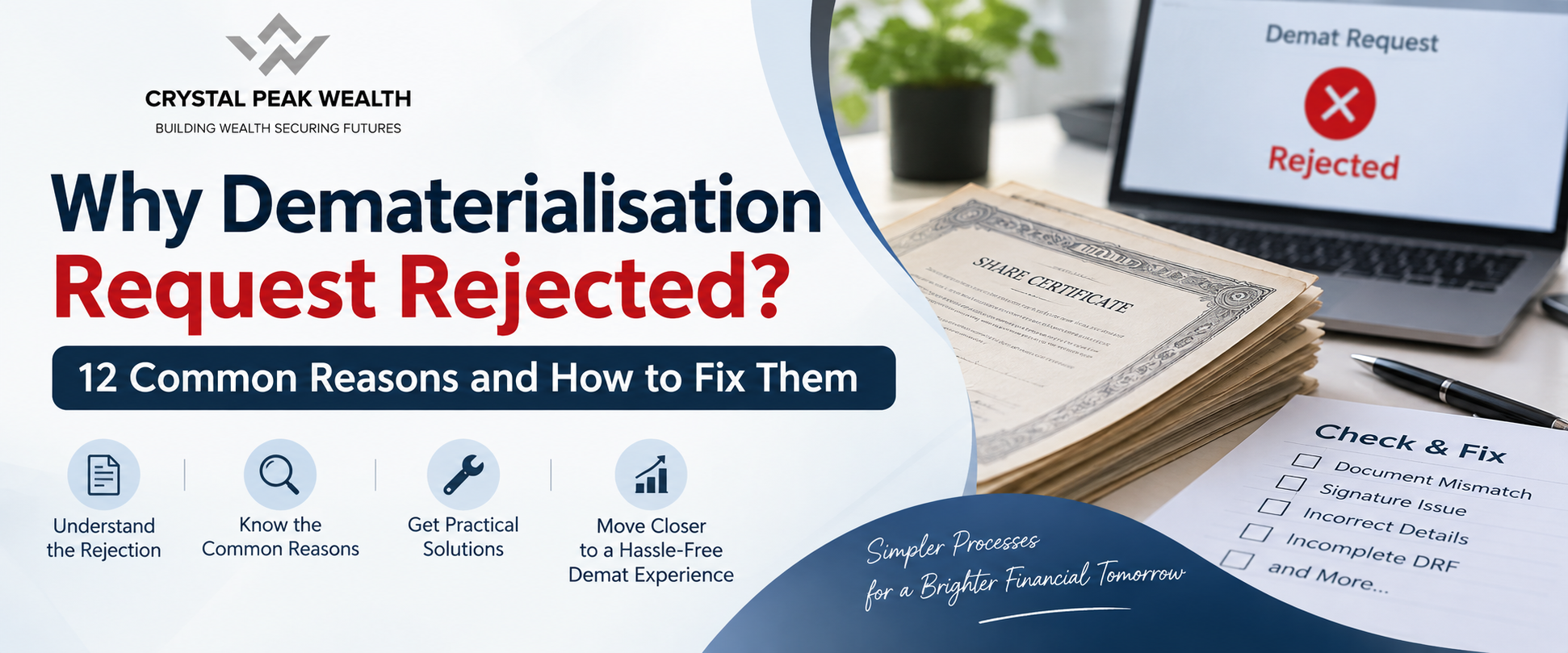
You handed over your paper certificates, waited weeks, and then got a rejection or silence. If you are asking why dematerialisation request rejected happened to you, the answer is usually small and fixable. Most rejections come from a mismatch between your certificate and the records held by your depository participant (DP), the registrar and transfer agent (RTA) or your bank. They rarely mean there is a problem with the shares themselves. Understanding why dematerialisation request rejected in your case is the first step to fixing it. The dematerialisation of physical shares can almost always be completed once the cause is found.
This guide lists the 12 most common reasons behind why dematerialisation request rejected or delayed cases occur, what to do about each, and how to prevent them next time.
Why Dematerialisation Request Rejected: Rejection vs Delay
Before you look for causes, work out which situation you are in. Why dematerialisation request rejected and why it is merely delayed need different responses.
- Rejection: You receive a written reason, usually through your DP. Fix the stated problem and resubmit.
- Delay: No decision has been issued. Ask your DP to check the status with the RTA using your Dematerialisation Request Number (DRN), and chase politely but regularly.
Always ask for the rejection reason in writing. The letter is the best evidence of why dematerialisation request rejected for you. Without it, you cannot know why dematerialisation request rejected, and you risk repeating the same mistake.
How the Process Works, and Where It Breaks
You submit a Dematerialisation Request Form (DRF) and your original certificates to your DP. The DP forwards the request to the depository and the certificates to the company’s RTA. The RTA checks the certificates, signatures and folio details against the company’s records, and then confirms or rejects the request.
SEBI has asked RTAs to apply enhanced due diligence to demat requests for physical shares, which is one reason RTAs look closely at signatures and details. Every stage is a point where a small mismatch can stall the request, and each stage can be the answer to why dematerialisation request rejected for a particular investor.
12 Reasons Why Dematerialisation Request Rejected
1. Name mismatch
The name on the certificate differs from your PAN or demat account, through a spelling variation, expanded initials or a change of name after marriage. This is the most common answer to why dematerialisation request rejected. If the company’s name has changed rather than yours, see our guide on a company name changed on a share certificate.
Fix: Align your demat account with the certificate wherever possible. If your own name changed, supply the supporting documents the RTA asks for, such as a marriage certificate or a gazette notice. Our case study on how one wrong letter locked an investor’s shares for 12 years shows how small the cause can be.
2. Signature mismatch
Your signature on the DRF does not match the specimen the RTA holds. Signatures drift over decades, which makes this a frequent reason why dematerialisation request rejected cases appear years after the shares were bought.
Fix: Get a banker’s attestation of your current signature, or update your specimen with the RTA before you resubmit.
3. Incomplete or incorrect DRF
A missing folio number, an unsigned joint-holder field or a blank box on the form is enough. Many people find out why dematerialisation request rejected only after the form is returned.
Fix: Fill every field from the certificate itself. Our DRF submission checklist walks through each one.
4. Certificate details do not match RTA records
Folio, certificate or distinctive numbers differ from the RTA’s register. This often follows a merger, split or other corporate action.
Fix: Ask the RTA for a statement of your holding, compare it line by line with your certificates, and ask them to explain any difference.
5. Shares of a deceased holder
If a holder has died, the shares cannot be dematerialised directly. Skipping transmission is a classic answer to why dematerialisation request rejected for inherited holdings.
Fix: Complete transmission to the legal heirs first, with the death certificate and succession documents. Then dematerialise.
6. Incomplete KYC of a joint holder
Every joint holder needs complete KYC. One missing document can stop the whole request.
Fix: Get PAN and KYC for all holders in order before you file.
7. PAN not linked or KYC not updated
If your PAN is not linked to the folio or your DP’s KYC is outdated, the request can be queried even after the RTA approves it.
Fix: Update KYC with your DP and, if needed, submit a PAN-folio linking request.
8. Torn, damaged or illegible certificates
A DP will not forward a certificate whose numbers cannot be read.
Fix: If folio and distinctive numbers are still legible, many DPs will accept it. If not, apply for a duplicate certificate first.
9. Company delisted, struck off or under investigation
Shares of a company with a regulatory problem may not be dematerialised in the usual way.
Fix: Check the company’s status with the RTA and the stock exchange before you start. This is a case where you may need professional advice.
10. Address mismatch
Your address on the certificate differs from your current records.
Fix: Submit address proof with a covering letter explaining the change.
11. DP-level errors
Sometimes the problem is at the DP’s end: a wrongly entered detail, a certificate sent late or a form not forwarded.
Fix: Keep the acknowledgement slip and DRN. Ask the DP in writing to confirm the date it forwarded the request.
12. Shares moved to the IEPF
If dividends went unclaimed for seven years, the shares may have moved to the Investor Education and Protection Fund (IEPF). That is a hidden reason why dematerialisation request rejected for very old holdings.
Fix: File a claim with the IEPF Authority first. The ordinary demat route no longer applies.
Why Dematerialisation Request Rejected: Documents That Usually Solve It
Whatever your reason, keep these ready:
- PAN copy for every holder, self-attested
- Address proof and bank proof
- Client Master Report from your DP
- Name-variation proof: affidavit, gazette notice or marriage certificate
- Death certificate and succession documents, for inherited shares
- Indemnity letter, for lost or damaged certificates
Why Dematerialisation Request Rejected: Quick Reference Table
Rejection reason | Typical cause | First fix |
|---|---|---|
Name mismatch | Spelling, initials, marriage, company rename | Align accounts or supply name-variation proof |
Signature mismatch | Signature changed over the years | Banker’s attestation or RTA specimen update |
Incomplete DRF | Blank or wrong fields | Refill from the certificate |
Details differ from RTA records | Merger, split, corporate action | Get the RTA’s holding statement |
Deceased holder | Transmission not done | Complete transmission first |
KYC or PAN issue | Joint holder KYC missing, PAN unlinked | Update KYC with the DP |
Damaged certificate | Torn, stained, illegible | Apply for a duplicate if needed |
IEPF transfer | Dividends unclaimed for 7 years | File an IEPF claim |
Use this table to match the answer to why dematerialisation request rejected for your case in under a minute.
Why Dematerialisation Request Rejected for Joint Holdings
Joint holdings multiply the places where something can go wrong. All holders must sign, all holders need KYC, and the demat account must list the holders in the same order as the certificate. Many cases of why dematerialisation request rejected for joint holders come down to one holder’s missing signature or a different name order.
Fix: Check the order of names on the certificate, confirm every holder’s signature and KYC, and open the demat account with the identical sequence. If the order must change, a transposition request comes first.
Why Dematerialisation Request Rejected for Inherited Shares
Inherited certificates are the most common source of long delays. The registered holder has died, so the RTA will not credit the shares to an heir’s account until the right to them is established. That is the whole answer to why dematerialisation request rejected for most inherited holdings.
Under a SEBI circular dated 25 January 2022, the RTA processes transmission and issues a letter of confirmation, valid for 120 days. You must use it within that window to have the shares credited to your demat account, or you may have to start again.
What to Do Step by Step After a Rejection
Once you know why dematerialisation request rejected, follow this sequence.
- Read the rejection reason. Ask your DP for it in writing if you do not have it.
- Match it to the list above. Most cases of why dematerialisation request rejected map to one of the 12 reasons.
- Correct the documents. Fix the cause, not just the form.
- Resubmit through your DP. Attach a covering note referring to the original DRN.
- Track the new request. Use the DRN every week.
- Escalate if needed. If you get no reply, raise a grievance with the RTA, then lodge a complaint on SEBI’s SCORES portal.
How Long Should You Wait Before Chasing?
Dematerialisation typically takes a few weeks when documents are in order. Cases with mismatches take longer. If you have heard nothing for much longer than that, assume nothing and ask your DP for a written status. Waiting silently never explains why dematerialisation request rejected or stalled.
Do not ignore a rejection. Shares left on paper stay illiquid and exposed to loss, and very old holdings may eventually move to the IEPF. Since April 2019, physical listed shares cannot be transferred, so dematerialisation is the only way to sell them. If you are unsure whether you need dematerialisation or a transfer, read our guide on dematerialisation vs transfer of shares.
How to Prevent Rejection in Future
- Match your name across PAN, demat account and certificate before filing.
- Update KYC with your DP early.
- Complete transmission before dematerialising inherited shares.
- Double-check certificate and distinctive numbers against the RTA’s holding statement.
- Read this list of reasons why dematerialisation request rejected cases happen before you file, not after.
- Get your signature attested if it has changed.
- Store certificates flat and dry, and never staple or laminate them.
From our desk: [EDITOR: add 2–3 sentences from a real, anonymised Crystal Peak case: the rejection reason, the fix and how long resubmission took. Delete this note before publishing.]
Frequently Asked Questions
What is the most common reason why dematerialisation request rejected? Name and signature mismatches between the certificate and the RTA’s or DP’s records. Both are fixable with attestation or supporting documents.
Can I dematerialise a deceased relative’s shares? Not directly. Transmission to the legal heirs or nominee must be completed first. Then the shares can be credited to the claimant’s demat account.
How do I find out why dematerialisation request rejected in my case? Ask your DP for the rejection reason in writing. If the DP cannot give it, write to the RTA with your DRN and folio number.
Can I resubmit after a rejection? Yes. Correct the cause and resubmit through your DP, with a covering note that refers to the original DRN.
Does a rejection affect my ownership? No. A rejected request means the paperwork was not accepted. Your ownership of the shares is unchanged.
Conclusion: Find the Cause, Then Fix It
Knowing why dematerialisation request rejected happens turns a frustrating setback into a checklist. Read the reason, match it to one of the 12 causes, correct the documents and resubmit. Keep your acknowledgement and DRN throughout.
Need help? If you are still unsure why dematerialisation request rejected for your holding, Crystal Peak Wealth’s team can review the rejection reason and your documents, resolve signature and KYC mismatches and track the resubmission to the end. Talk to our team before you resubmit.
Sources: SEBI press release on transfer of securities only in demat form · SEBI circular of 5 November 2019 on due diligence for demat of physical shares · SEBI SCORES portal · NSDL · CDSL
Change Log and Implementation Notes (not for publishing)
Audit ID | Status | What changed in this draft |
|---|---|---|
C1 (red) | Fixed | The hub was linked only in the last paragraph before the FAQ. It is now linked once, in the opening paragraph. |
C2 (red) | Fixed | Hub anchor is “dematerialisation of physical shares”, not the page’s own head keyword. None of the 30 keyword uses is a link anchor. |
C3 (red) | Fixed | Four useful in-body spoke links, each placed where it helps the reader: the name-change post (reason 1), the name-mismatch case study (reason 1), the DRF checklist (reason 3) and dematerialisation vs transfer (near the end). |
C4 (red) | Hub-page task | Add this post to the “Related guides” block on /dematerialization-of-physical-shares/: Why Dematerialisation Request Rejected? 12 Common Reasons. |
B6 (red) | Fixed | The live page mentioned SEBI and SCORES without links. The draft links SEBI’s SCORES portal, the SEBI press release on physical transfers, SEBI’s 5 Nov 2019 due-diligence circular and the 25 Jan 2022 circular, plus a Sources line. |
B4 (red/amber) | Partly fixed | Byline reads “Pavan Kayal”, which the live page already shows. Still to do: rename the WordPress user’s nicename so the author URL is /author/pavan-kayal/. |
D7 (red) | Image task | The live image is still named “ChatGPT-Image-Sep-9-2026-01_57_17-PM.png”. Re-export as WebP at 1200 × 675 px, under 100 KB. Filename: why-dematerialisation-request-rejected.webp. Alt text: “Common reasons a dematerialisation request is rejected, shown as a checklist”. Update og:image, which still points to the old file. Also update the gallery attachment’s title and alt. |
D5 (note) | Optional | The live title tag is 57 characters, the longest of the five. “Why Dematerialisation Request Rejected? 12 Reasons” is 50 characters and keeps the keyword first. The H1 here is longer and descriptive. |
B9 length (No) | Fixed | About 2,050 words including link URLs, against roughly 4,350 on the live page. |
B2 originality | Needs you | A “From our desk” placeholder needs a real, anonymised Crystal Peak case. I did not invent one. |
Keyword count: the primary keyword appears exactly 30 times in the post body, including headings and excluding the byline and this log. That is about one use per 70 words, well above normal density, and Google’s spam policies treat repetitive keyword use as stuffing. The keyword is also an awkward fragment, so a few sentences read stiffly. If rankings stall, cut it to roughly 10 to 12 and use more natural phrasing such as “why a dematerialisation request is rejected”.
What I changed from the live article
- Fetch limit: My page fetch returned a summary of the live article, not its exact wording. This draft follows its structure and 12 reasons, rewritten and trimmed. Compare it against the original in WordPress before you paste anything over it.
- Reason 12: The live article’s last reason was odd-lot or fractional share discrepancies. I could not support it as a common rejection cause, so I replaced it with shares moved to the IEPF. Restore the original if your team has evidence for it.
- Timeline: The live article said processing takes “about 15 to 30 days”. I found no source for the figure, so the draft says “a few weeks”.
- Previous/Next links: The live page’s post navigation links to the “without original certificate” post and the name-change post. Those are separate theme links, not touched here.
- SCORES link: I confirmed scores.sebi.gov.in exists, but I did not open it. Check that it loads. Check the NSE-hosted copy of the 5 Nov 2019 circular too, and swap in the sebi.gov.in page if you have it.
Left for a human: E1 final quality review and FAQ schema validation (Google’s Rich Results Test).

[…] Most of these trace back to one issue: not knowing which side of the line your situation falls on. For a deeper look at rejections, read why a dematerialisation request gets rejected. […]
[…] Even shareholders who use a dematerialisation request form checklist sometimes slip. For a fuller list of rejection reasons, read why a dematerialisation request is rejected. […]
[…] The costliest mistake is assuming that can physical shares be sold without demat has a loophole. Most other delays come from a handful of avoidable errors. For a deeper look, read why a dematerialisation request gets rejected. […]
[…] If your request has already been returned or delayed, read Why Do Some Dematerialisation Requests Get Rejected or Delayed?. […]
[…] If your request has already been returned or delayed, read Why Do Some Dematerialisation Requests Get Rejected or Delayed?. […]
[…] If your request has already been returned or delayed, read Why Do Some Dematerialisation Requests Get Rejected or Delayed?. […]
[…] has changed since the shares were issued, sort out the update with the RTA first. Our explainer on why some dematerialisation requests are rejected or delayed lists the mismatches that most often cause problems, so you can spot them before you open […]
[…] has changed since the shares were issued, sort out the update with the RTA first. Our explainer on why some dematerialisation requests are rejected or delayed lists the mismatches that most often cause problems, so you can spot them before you open […]